What’s New for 2027 Students
- Higher maintenance funds from 30 November 2026. The monthly maintenance requirement rises from £1,529 to £1,570 for London and from £1,171 to £1,203 outside London, for applications made on or after 30 November 2026. The nine-month maximums are £14,130 (London) and £10,827 (outside London). The requirement is now reviewed every year, so recheck GOV.UK before you apply.
- UK student visa fee and health surcharge. The Student visa fee rose from £524 to £558 on 8 April 2026. Students generally pay an Immigration Health Surcharge (IHS) of £776 per year, depending on visa length.
- Shorter Graduate visa. For applications submitted on or after 1 January 2027, the Graduate visa for bachelor’s and master’s graduates falls to 18 months from 24. PhD graduates keep 36 months.
- International student levy (2028). English universities will pay £925 per international student per year from August 2028. Universities pay it, not students, but some may raise fees or trim scholarships.
- Stricter scrutiny for Pakistani applicants. Pakistan has historically had a high UK visa refusal rate, so preparation matters.
Why Study in the UK from Pakistan?
Benefits for Pakistani Students
- Globally recognised UK degrees from top-ranked universities
- Shorter courses: 3-year bachelor’s (4 in Scotland) and 1-year master’s degrees save time and money
- Strong research and industry links
- Large Pakistani community, halal food and student societies in most cities
- Post-study work through the Graduate visa
Is the UK a Good Destination?
Yes, if you plan properly. Costs are high and visa checks are tight. Applicants who choose a course that fits their background, show genuine funds and explain their plan clearly do best.
Who Can Study in the UK from Pakistan?
- Study in UK after Matric: You cannot go straight to a UK degree. Complete Intermediate/FSc or A Levels first.
- Study in UK after Intermediate/FSc: Apply for a foundation year or international year one.
- Study in UK after A Levels: Apply directly to a bachelor’s degree through UCAS.
- Study in UK after bachelor’s: Apply for a master’s, a pre-master’s or a postgraduate diploma. A 16-year degree is generally accepted. A 14-year degree may need a bridging programme.
- Study in UK after master’s: Apply for a PhD or a second master’s if the course is clearly different.
- Study in UK with a study gap: Possible, but you must explain it with documents such as employment letters, professional courses or medical records. Unexplained gaps are a common reason for refusal.
UK Education System Explained
- Undergraduate degrees: 3 years (4 in Scotland). Apply through UCAS.
- Postgraduate degrees: Usually 1 year (MSc, MA, MBA, LLM).
- PhD and research degrees: 3 to 4 years, with a research proposal and supervisor.
- Foundation courses: 1-year bridge to a bachelor’s degree.
- Pre-master’s courses: 3 to 9 months of bridging for master’s applicants.
UK Study Requirements for Pakistani Students
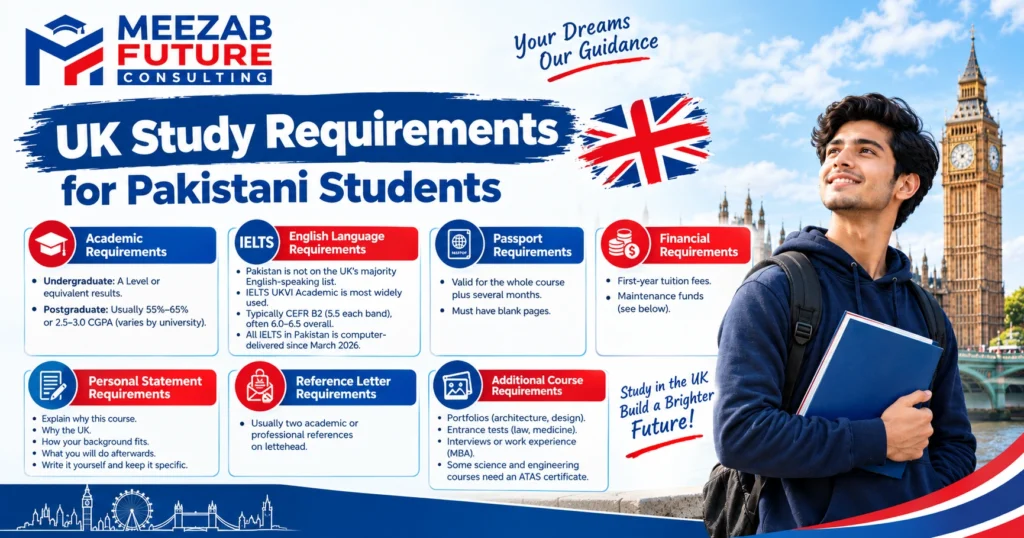
Academic requirements: Undergraduate applicants need strong A Level or equivalent results. Master’s applicants usually need around 55% to 65% or a 2.5 to 3.0 CGPA, depending on the university.
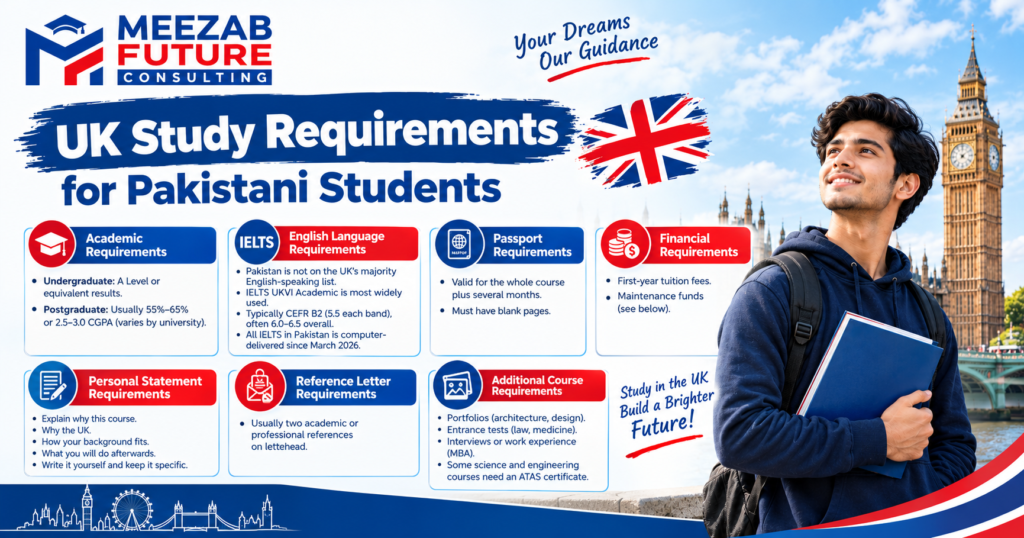
English language requirements: Pakistan is not on the UK’s majority English-speaking country list, so Pakistani applicants need a Secure English Language Test (SELT). IELTS UKVI Academic is the most widely used. Degree-level courses normally require CEFR B2 (about 5.5 in each band), but many universities ask for an overall 6.0 to 6.5. All IELTS testing in Pakistan has been computer-delivered since March 2026.
Passport requirements: Valid for the whole course plus several months, with blank pages.
Financial requirements: First-year tuition plus maintenance funds (see below).
Personal statement requirements: Explain why this course, why the UK, how your background fits and what you will do afterwards. Write it yourself and keep it specific.
Reference letter requirements: Usually two academic or professional references on letterhead.
Additional course requirements: Portfolios (architecture, design), entrance tests (law, medicine), interviews or work experience (MBA). Some science and engineering courses need an ATAS certificate.
Step-by-Step: How to Study in the UK from Pakistan
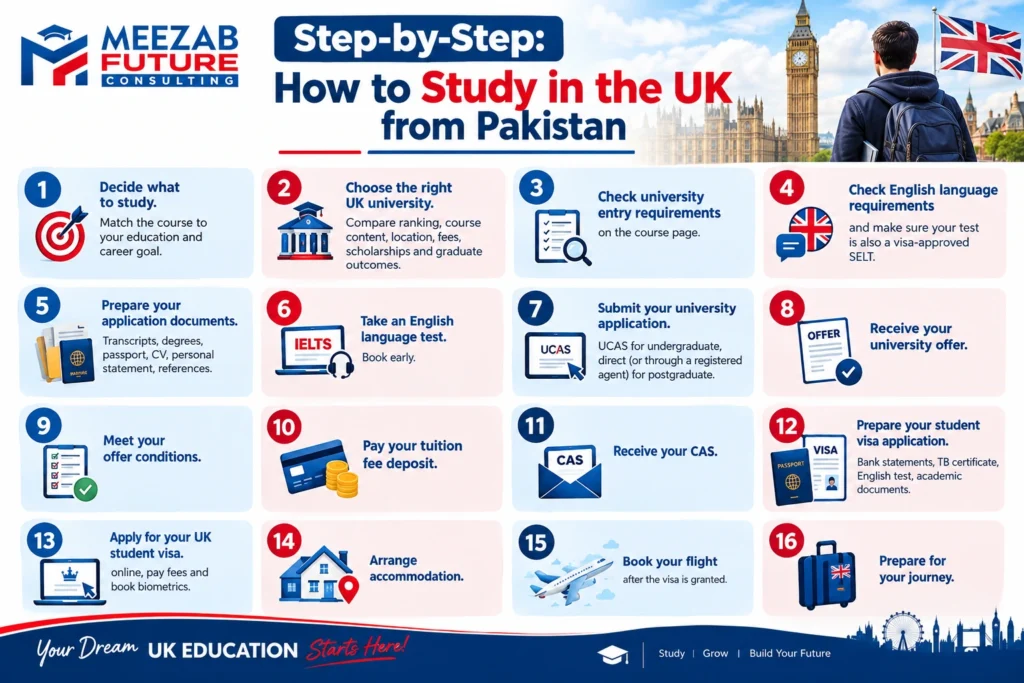
- Decide what to study. Match the course to your education and career goal.
- Choose the right UK university. Compare ranking, course content, location, fees, scholarships and graduate outcomes.
- Check university entry requirements on the course page.
- Check English language requirements and make sure your test is also a visa-approved SELT.
- Prepare your application documents. Transcripts, degrees, passport, CV, personal statement, references.
- Take an English language test. Book early.
- Submit your university application. UCAS for undergraduate, direct (or through a registered agent) for postgraduate.
- Receive your university offer.
- Meet your offer conditions.
- Pay your tuition fee deposit.
- Receive your CAS.
- Prepare your student visa application. Bank statements, TB certificate, English test, academic documents.
- Apply for your UK student visa online, pay fees and book biometrics.
- Arrange accommodation.
- Book your flight after the visa is granted.
- Prepare for your journey.
Documents Required to Study in the UK from Pakistan
- Valid passport
- CAS number
- Transcripts and certificates
- IELTS UKVI (or another approved SELT)
- Bank statements and sponsor documents
- TB test certificate from an approved clinic
- Passport photos
- Study gap evidence
- Personal statement, CV and references
- ATAS certificate (if required)
Best UK Universities for Pakistani Students
Popular choices include the University of Manchester, University of Leeds, University of Birmingham, University of Sheffield, University of Nottingham, University of Glasgow, University of Edinburgh and University of Bristol, plus Coventry, Hertfordshire, Teesside and Middlesex. Check the licensed sponsor list and graduate outcomes for any course you shortlist.
Popular Courses to Study in the UK
- Business and Management: MBA, MSc Management. Work experience helps.
- Computer Science and IT: Software, cloud, networks. Check ATAS.
- Engineering: Civil, mechanical, electrical. Check accreditation.
- Accounting and Finance: Look for ACCA/ICAEW exemptions.
- Law: LLB and LLM. An LLM alone does not qualify you to practise in the UK.
- Medicine and Healthcare: Very competitive and expensive.
- Data Science and Artificial Intelligence: Growing demand, strong maths needed.
- Cybersecurity: Look for NCSC-certified courses.
- Architecture: Portfolio and RIBA/ARB recognition matter.
- Hospitality and Tourism: Choose courses with real placements.
Cost of Studying in the UK from Pakistan
UK University Tuition Fees (approximate, check each university)
- Undergraduate: about £15,000 to £30,000 per year
- Postgraduate taught: about £14,000 to £30,000 per year
- MBA: often £20,000 to £40,000+
- Medicine/dentistry: often £40,000+
Cost of Living in the UK
The visa figure is a minimum, not a budget. Real spending is usually close to it or higher, depending on your city.
- Accommodation costs: roughly £450 to £1,000+ per month
- Food and grocery costs: about £150 to £300 per month
- Transportation costs: student passes and railcards help
- Other student expenses: phone, books, clothing, social life
London vs Other UK Cities
London costs more for rent and transport, and the visa maintenance requirement is higher. Sheffield, Leeds, Nottingham and Glasgow offer strong universities at lower cost.
UK Student Visa Requirements for Pakistani Students
UK Student Visa Application Process from Pakistan
Get your CAS, apply online on GOV.UK, pay the visa fee and health surcharge, book biometrics, upload documents and wait for a decision.
Financial Requirements for UK Student Visa
You must show first-year tuition (minus any deposit paid) plus maintenance funds. Funds must be held in a regulated bank account for at least 28 days. A deposit paid for university-arranged accommodation can be deducted from the maintenance funds you need to show.
| Maintenance per month | Up to 9 months | |
|---|---|---|
| London | £1,570 | £14,130 |
| Outside London | £1,203 | £10,827 |
Example (outside London): tuition £15,000, deposit £3,000 paid → £12,000 + £10,827 = £22,827 in your account for 28 days.
UK Student Visa Fees and Additional Costs
Visa fee £558, health surcharge £776 per year of visa (a one-year master’s often counts as two years because the visa runs longer, so use the official IHS calculator), English test, TB test, biometrics, translation and courier.
TB Test Requirements for Pakistani Students
Pakistani nationals need a TB test for visa applications of 6 months or longer. It involves a chest X-ray and costs about PKR 15,000 to 20,000. Use an approved clinic, book it before applying and check the certificate’s validity.
CAS: What Is It and Why Is It Important?
The CAS (Confirmation of Acceptance for Studies) is a unique reference number issued by your university once you accept the offer and meet its conditions. You cannot submit a valid Student visa application without it. Make sure the course, fee and dates on it match your documents.
UK Student Visa Interview and Credibility Requirements
Some applicants face a credibility interview with the university or UKVI. Be ready to explain why this course and university, how it fits your background, how you are funding it and what you plan afterwards. Answers must match your application.
UK Student Visa Processing Time
Decisions from outside the UK typically take around 3 weeks after biometrics, but apply well ahead of your start date.
Scholarships for Pakistani Students in the UK
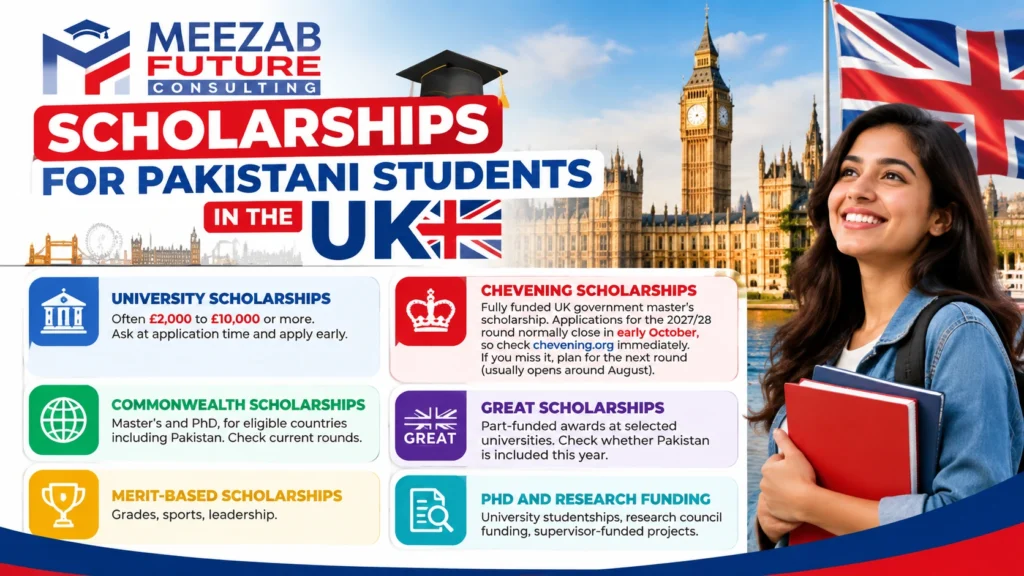
- University scholarships: Often £2,000 to £10,000 or more. Ask at application time and apply early.
- Chevening Scholarships: Fully funded UK government master’s scholarship. Applications for the 2027/28 round normally close in early October, so check chevening.org immediately. If you miss it, plan for the next round (usually opens around August).
- Commonwealth Scholarships: Master’s and PhD, for eligible countries including Pakistan. Check current rounds.
- GREAT Scholarships: Part-funded awards at selected universities. Check whether Pakistan is included this year.
- Merit-based scholarships: Grades, sports, leadership.
- PhD and research funding: University studentships, research council funding, supervisor-funded projects.
UK Intakes and Application Deadlines for 2027
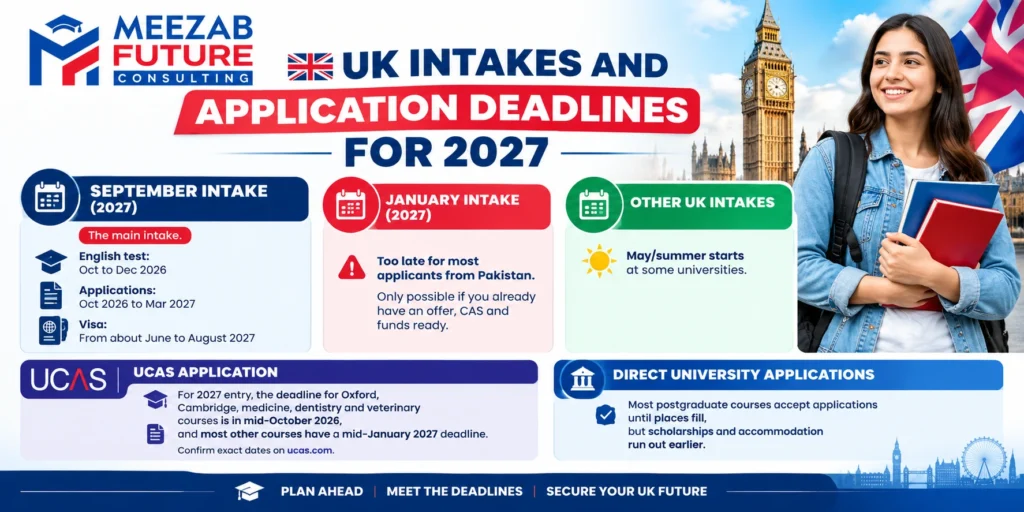
- September intake (2027): The main intake. Start now: English test in Oct to Dec 2026, applications from Oct 2026 to Mar 2027, visa from about June to August 2027.
- January intake (2027): Too late for most applicants from Pakistan. Only possible if you already have an offer, CAS and funds ready.
- Other UK intakes: May/summer starts at some universities.
UCAS application: For 2027 entry, the deadline for Oxford, Cambridge, medicine, dentistry and veterinary courses is in mid-October 2026, and most other courses have a mid-January 2027 deadline. Confirm exact dates on ucas.com.
Direct university applications: Most postgraduate courses accept applications until places fill, but scholarships and accommodation run out earlier.
Best UK Cities for Pakistani Students
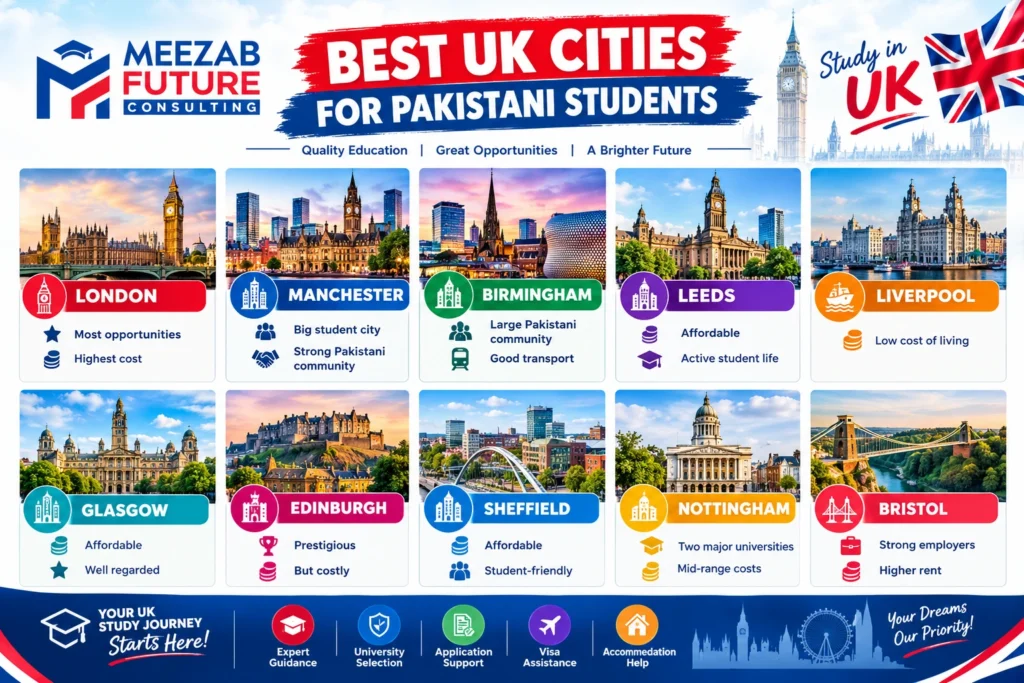
- London: Most opportunities, highest cost
- Manchester: Big student city, strong Pakistani community
- Birmingham: Large Pakistani community, good transport
- Leeds: Affordable, active student life
- Liverpool: Low cost of living
- Glasgow: Affordable and well regarded
- Edinburgh: Prestigious but costly
- Sheffield: Affordable and student-friendly
- Nottingham: Two major universities, mid-range costs
- Bristol: Strong employers, higher rent
Accommodation Options for Pakistani Students in the UK
- University halls: Safest start. Apply as soon as you get an offer.
- Private student accommodation: Modern but pricier.
- Shared accommodation: Cheaper. Read the contract and check the deposit protection scheme.
- Homestay accommodation: Living with a local family.
Never pay a deposit to someone you have not verified.
Part-Time Work for Pakistani Students in the UK
Degree-level students can normally work up to 20 hours a week in term time and full-time during official holidays, subject to your visa conditions. Courses below degree level have lower limits, and self-employment is not allowed. Never count on work income as your visa funds.
Post-Study Work Options in the UK
Graduate Visa for International Students
The Graduate visa is 18 months for bachelor’s and master’s graduates who apply on or after 1 January 2027, and the duration depends on your application date, not your degree award date. PhD graduates keep 36 months. Plan on 18 months, and build employer contacts, internships and sponsor-friendly experience from year one. Switching to a Skilled Worker visa has salary and role rules, and higher English standards apply on some skilled routes.
Can Students Bring Dependants to the UK?
Most Student visa holders cannot bring dependants. Only two groups can currently bring them. In practice these are postgraduate research students (such as PhD) and those on certain government-funded scholarships. Confirm on GOV.UK.
Life as a Pakistani Student in the UK
- Healthcare: The health surcharge gives NHS access. Register with a GP on arrival.
- Banking: Open a student bank account with your university letter and proof of address.
- Transportation: Student railcards and local passes save money.
- Halal food and Muslim life: Widely available in university cities, with mosques and prayer rooms.
- Pakistani communities and student societies: Most universities have South Asian or Pakistani societies.
- Cultural differences: Independent learning, direct communication, strict referencing and academic integrity rules.
- Common challenges: Homesickness, rent, weather, balancing work and study.
Budget and Practical Tips
- How to manage your budget: Track spending monthly, cook at home and use student discounts.
- How to find affordable accommodation: Apply early for halls, share with coursemates and compare commuting costs.
- Common mistakes to avoid:
- Course does not match your background
- Using outdated funds or fee figures
- Funds held for less than 28 days
- Inconsistent documents or unexplained gaps
- Unlicensed agents promising a “guaranteed visa”
- Booking flights before the visa decision
- How to choose the right UK university and course: Check modules, graduate outcomes, placements and scholarships. Compare at least five options.
- How to choose a university based on your budget: Set your total budget first, then shortlist.
- London vs other UK cities: Choose London only if the course or career path justifies the extra cost.
- Study in the UK with a low budget: Pick cities outside London, look for scholarships, shorter courses and lower-fee universities. Do not borrow in ways that create visa-evidence problems.
Study in the UK Without IELTS
Can Pakistani Students Study in the UK Without IELTS?
Some universities accept a Medium of Instruction (MOI) certificate or their own test for admission. For the visa, though, Pakistani applicants generally need a SELT, so ask the university exactly what it accepts before relying on an exemption.
Quick Answers
- Can Pakistani students work while studying in the UK? Yes, within visa limits.
- Can students bring dependants? Usually no.
- Can Pakistani students stay in the UK after graduation? Yes, through the Graduate visa (18 months from 1 January 2027 applications) or a Skilled Worker visa if sponsored.
What to Do After Receiving Your UK Student Visa
Pre-Departure Checklist for Pakistani Students
- Check visa dates and details
- Confirm accommodation and arrival date
- Buy insurance
- Arrange currency or a travel card
- Register online with the university
- Keep original documents in hand luggage
What to Pack When Moving to the UK
Passport, visa documents, CAS, university letter, certificates, warm and formal clothes, adaptors, medicines with prescriptions, basic kitchen items and familiar food (check airline and UK rules).
First Week in the UK
Collect your BRP or access your eVisa, complete enrolment, register with a GP, open a bank account, get a SIM, learn transport routes and attend orientation.
How Meezab Future Consulting Helps Pakistani Students Study in the UK
- University and course selection: Advice based on your profile, budget and goals
- Admission application support: Applications, deadlines and follow-up
- Document guidance: Transcripts, translations, financial documents and consistency checks
- Scholarship guidance: Funding options and applications
- CAS guidance: Matching CAS details to your documents
- UK student visa guidance: Application support, funds evidence and interview preparation
- Pre-departure support: Accommodation, packing and arrival planning
(Add your office address, phone, WhatsApp and booking link. I suggest avoiding “guaranteed visa” or fixed success-rate claims in your copy.)
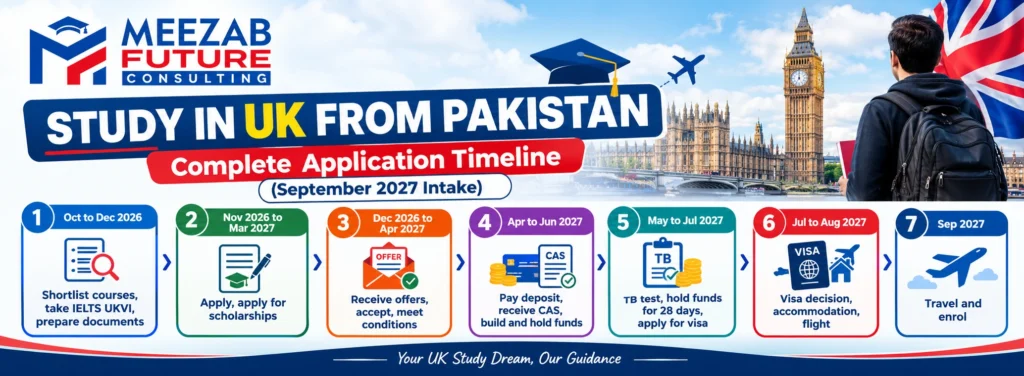
Study in UK from Pakistan: Complete Application Timeline (September 2027 Intake)
| When | What to do |
|---|---|
| Oct to Dec 2026 | Shortlist courses, take IELTS UKVI, prepare documents |
| Nov 2026 to Mar 2027 | Apply, apply for scholarships |
| Dec 2026 to Apr 2027 | Receive offers, accept, meet conditions |
| Apr to Jun 2027 | Pay deposit, receive CAS, build and hold funds |
| May to Jul 2027 | TB test, hold funds for 28 days, apply for visa |
| Jul to Aug 2027 | Visa decision, accommodation, flight |
| Sep 2027 | Travel and enrol |
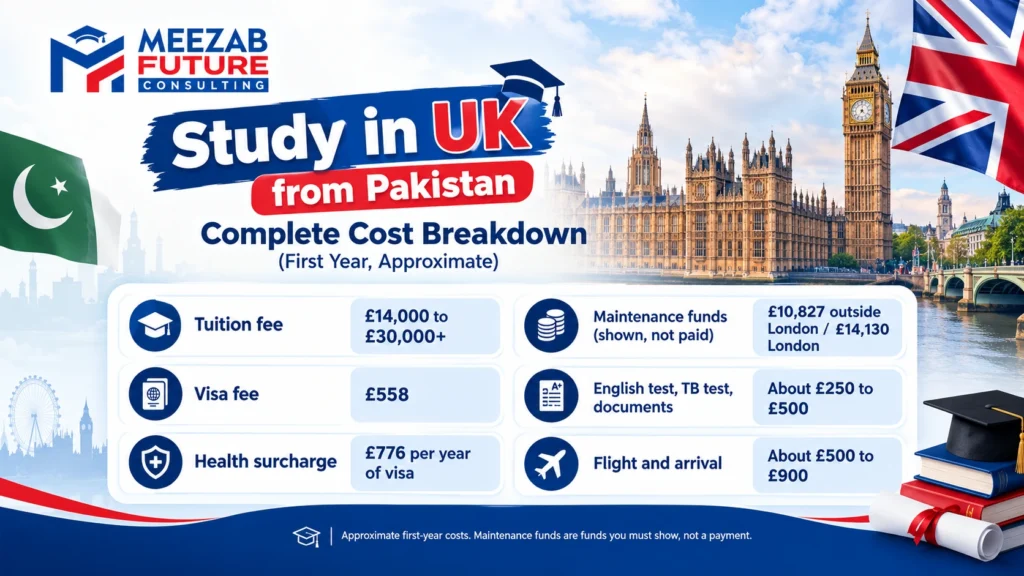
Study in UK from Pakistan: Complete Cost Breakdown (first year, approximate)
| Item | Estimate |
|---|---|
| Tuition fee | £14,000 to £30,000+ |
| Visa fee | £558 |
| Health surcharge | £776 per year of visa |
| Maintenance funds (shown, not paid) | £10,827 outside London / £14,130 London |
| English test, TB test, documents | About £250 to £500 |
| Flight and arrival | About £500 to £900 |
Study in UK from Pakistan: Document Checklist
- Passport
- CAS
- Transcripts & Degrees
- IELTS UKVI / SELT
- TB Certificate
- Bank Statements & Sponsor Documents
- Personal Statement
- CV
- References
- ATAS (if required)
- Study Gap Evidence
- Photos
- Accommodation Details
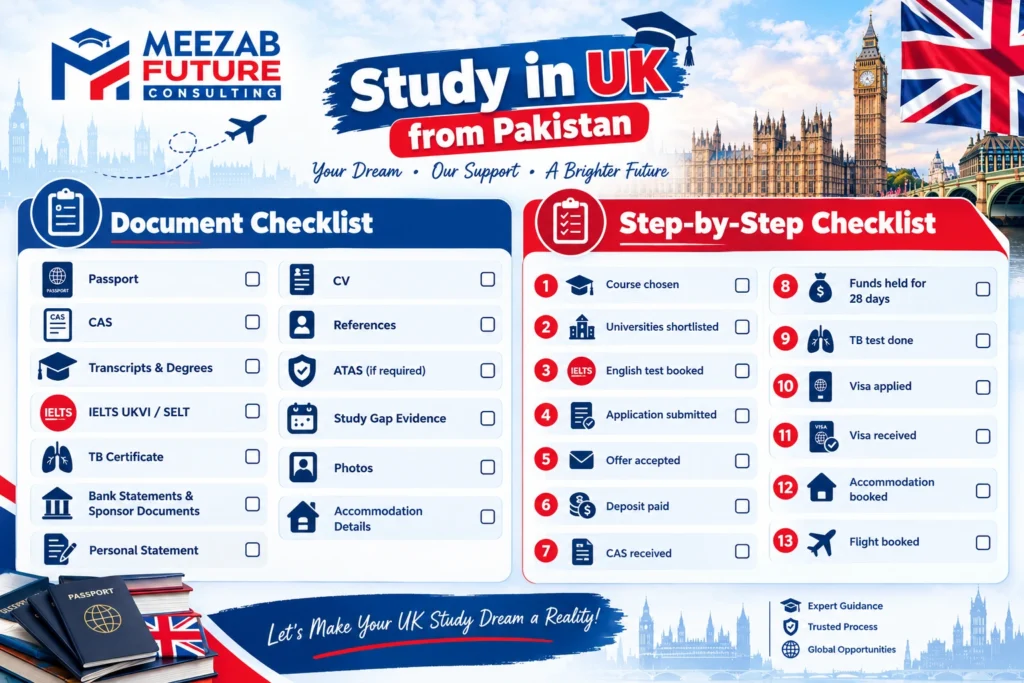
Study in UK from Pakistan: Step-by-Step Checklist
- Course chosen
- Universities shortlisted
- English test booked
- Application submitted
- Offer accepted
- Deposit paid
- CAS received
- Funds held for 28 days
- TB test done
- Visa applied
- Visa received
- Accommodation booked
- Flight booked
Frequently Asked Questions About Studying in the UK from Pakistan (2027)
How can I study in the UK from Pakistan?
Choose a course, apply, meet your offer conditions, get your CAS and apply for the Student visa.
How much does it cost to study in the UK from Pakistan?
Tuition plus living costs. Many students need roughly £25,000 to £45,000+ for the first year, depending on course and city.
What are the requirements to study in the UK?
Academic qualifications, English (SELT), passport, funds, CAS and TB test.
Can I study in the UK after FSC?
Yes, through a foundation year or international year one, or after A Levels.
Can I study in the UK after a bachelor’s degree?
Yes, for a master’s or pre-master’s.
Is IELTS required to study in the UK?
Usually yes, as IELTS UKVI or another approved SELT. Check with the university.
How much bank balance is required for a UK Student visa?
First-year tuition (minus deposit) plus up to 9 months of maintenance: £1,570 per month in London or £1,203 outside London, held for 28 days, for applications from 30 November 2026.
How long does a UK Student visa take?
About 3 weeks typically. Apply early.
Can Pakistani students work in the UK while studying?
Yes, generally up to 20 hours a week in term time for degree-level students.
Can I get a scholarship to study in the UK?
Yes, through universities, Chevening, Commonwealth, GREAT and others.
What are the UK intakes for international students?
Mainly September and January, with some May starts.
Can I study in the UK with a study gap?
Yes, if you can document and explain it.
Can I bring my family to the UK as a student?
Most students cannot.
Can I stay in the UK after completing my studies?
Yes, via the Graduate visa (18 months for applications from 1 January 2027) or another route you qualify for.
How can Meezab Future Consulting help me study in the UK?
With course selection, admission, scholarships, CAS, visa preparation and pre-departure planning.