What’s New for 2027 Students
- EMGS is the gatekeeper. International students must hold a Student Pass, and applications go through Education Malaysia Global Services (EMGS). Your university submits the application for you, and approval comes as an electronic Visa Approval Letter (eVAL), which you need before travelling.
- Processing time. EMGS states a client charter of about 14 working days for a complete application, but real-world timelines for Pakistani applicants are often 4 to 8 weeks, and the full journey from application to Student Pass can take around 10 to 16 weeks. Apply early, especially for the busy September intake.
- Higher all-in costs than the headline Student Pass fee. The Student Pass sticker is only about RM 60 per year, but recent Pakistan-focused estimates put first-year EMGS and immigration charges at roughly RM 2,750 to 3,450, plus a separate Single Entry Visa fee. Confirm the current amount with your university and the official EMGS fee calculator.
- Work rules. International students may work part time for up to 20 hours per week only during semester breaks or holidays longer than seven days, with prior approval. You cannot work during normal teaching weeks.
- Postgraduate scholarship. Under the 2026 guidelines, the Malaysia International Scholarship (MIS) was reported to cover tuition for the sponsorship period and provide a monthly living allowance of RM 1,500 to eligible full-time postgraduate scholars. Check the current round.
- Medical degrees. Pakistani students should confirm whether a Malaysian medical programme is recognised by the Pakistan Medical Commission (PMC) and what licensing steps apply before paying any fees.
Why Study in Malaysia from Pakistan?
Benefits for Pakistani Students
- Affordable tuition and living costs compared with the UK, USA, Australia and Canada
- A Muslim-majority country with halal food everywhere, mosques and prayer rooms on campuses
- English is widely used in higher education
- Branch campuses of UK and Australian universities (for example Monash, Nottingham, Heriot-Watt, Curtin, Swinburne), offering foreign degrees at lower cost
- Multiple intakes and a relatively straightforward visa process through EMGS
- A large and growing Pakistani student community
- Easy travel to the rest of South-East Asia
Is Malaysia a Good Destination?
Yes, especially for students who want an affordable, safe and culturally comfortable study destination. The main challenges are limited work rights, fewer post-study work and PR options than the UK or Canada, varying quality between institutions, and the need to verify recognition of your degree in Pakistan (for medicine, engineering and law). Choose carefully.
Who Can Study in Malaysia from Pakistan?
- After Matric: You cannot enter a degree directly. Complete FSc/Intermediate or O/A Levels first.
- After Intermediate/FSc: You can apply for foundation programmes, diplomas or bachelor’s programmes (some universities admit FSc students into a foundation or first year, depending on subject and grades).
- After A Levels: Strong route for direct bachelor’s entry.
- After Bachelor’s: Apply for a master’s degree. A 16-year degree (for example BS 4-year) with a good CGPA is generally preferred, and some universities may ask for extra study if your degree is shorter.
- After Master’s: Apply for a PhD, often with a supervisor and sometimes with a scholarship.
- With a study gap: Possible, but explain it clearly with documents. Some institutions will ask for a CV and an explanation.
Malaysian Education System Explained
- Foundation and pre-university: 1 year of preparation for degree entry.
- Diploma: 2 to 3 years, often leading to a degree.
- Undergraduate degrees: Bachelor’s takes 3 to 4 years.
- Postgraduate degrees: Master’s takes 1 to 2 years (coursework or research), and PhD takes 3 to 4 years.
- Public universities: Government-funded universities (for example UM, UKM, UPM, USM, UTM), generally lower cost but more competitive and sometimes with Malay-medium programmes.
- Private universities and colleges: Many with English-medium programmes and international partnerships.
- International branch campuses: Offer degrees from foreign universities with local fees.
- Accreditation: Check MQA (Malaysian Qualifications Agency) accreditation and MOHE approval for any institution and programme.
- Intakes: January/February, May and September, with September and January the most common.
Study Requirements for Pakistani Students in Malaysia
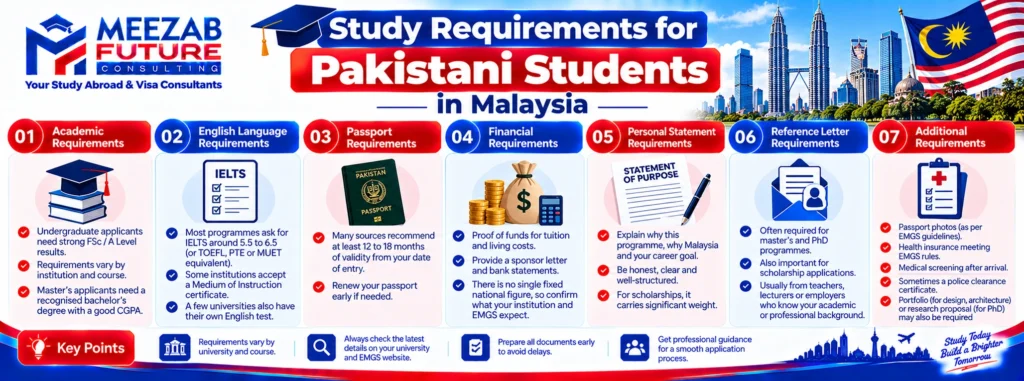
Academic requirements: Undergraduate applicants need strong FSc/A Level results (requirements vary by institution and course), and master’s applicants need a recognised bachelor’s degree with a good CGPA.
English language requirements: Most programmes ask for IELTS around 5.5 to 6.5 (or TOEFL, PTE or MUET equivalent). Some institutions accept a Medium of Instruction certificate or their own English test.
Passport requirements: Many sources recommend at least 12 to 18 months of validity from your date of entry, so renew early if needed.
Financial requirements: Proof of funds for tuition and living costs, with a sponsor letter and bank statements. There is no single fixed national figure, so confirm what your institution and EMGS expect.
Personal statement requirements: Explain why this programme, why Malaysia and your career goal. For scholarships, it carries significant weight.
Reference letter requirements: Often required for master’s and PhD, and for scholarships.
Additional requirements: Passport photos, health insurance meeting EMGS rules, medical screening after arrival, and sometimes police clearance, portfolio (design, architecture) or research proposal (PhD).
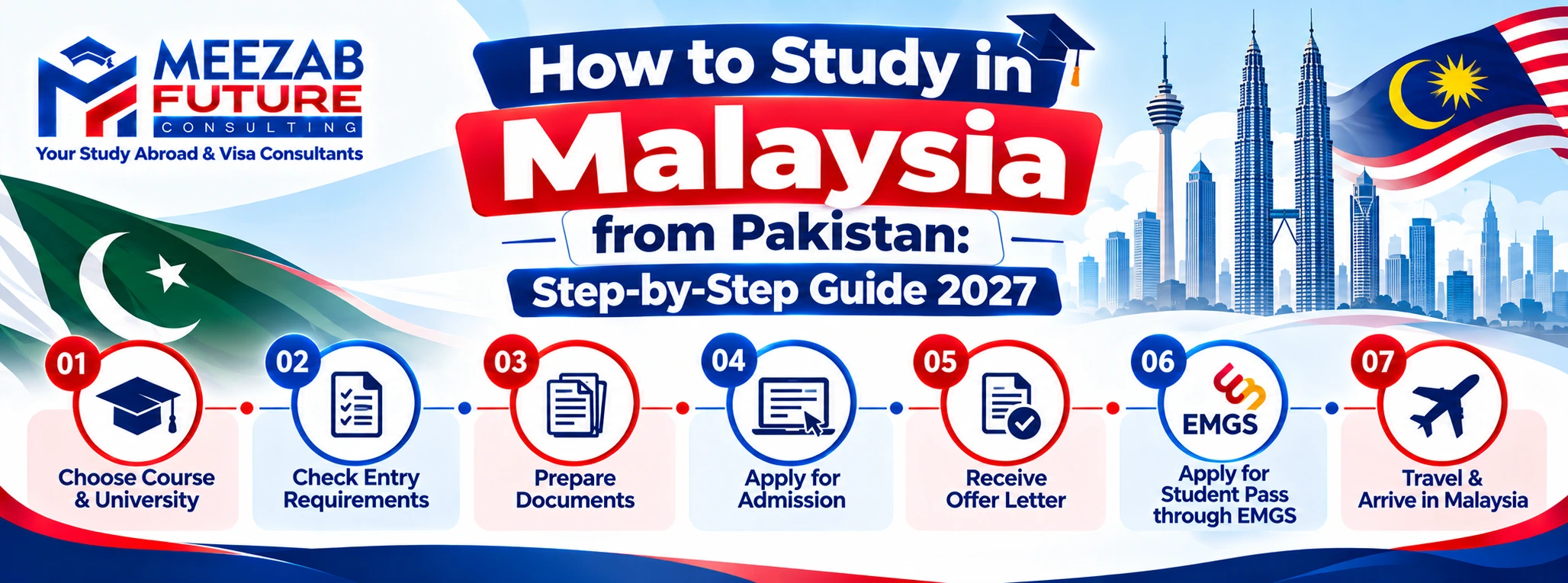
Step-by-Step: How to Study in Malaysia from Pakistan
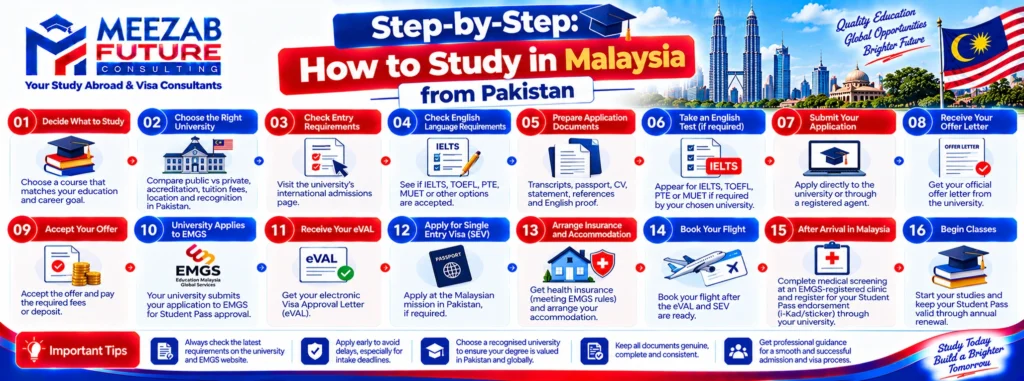
- Decide what to study. Match the course to your education and career goal.
- Choose the right Malaysian university. Compare public vs private, accreditation, tuition, location and recognition in Pakistan.
- Check entry requirements on the university’s international admissions page.
- Check English language requirements.
- Prepare your application documents. Transcripts, passport, CV, statement, references, English proof.
- Take an English test if required.
- Submit your application to the university (directly or through a registered agent).
- Receive your offer letter.
- Accept your offer and pay the required fees or deposit.
- Your university applies to EMGS for your Student Pass approval.
- Receive your eVAL (electronic Visa Approval Letter).
- Apply for your Single Entry Visa (SEV) at the Malaysian mission in Pakistan, if required.
- Arrange insurance and accommodation.
- Book your flight after the eVAL and SEV are ready.
- After arrival: complete the medical screening at an EMGS-registered clinic within the required time, and register for your Student Pass endorsement (i-Kad/sticker) through your university.
- Begin classes and keep your Student Pass valid through annual renewal.
Documents Required to Study in Malaysia from Pakistan
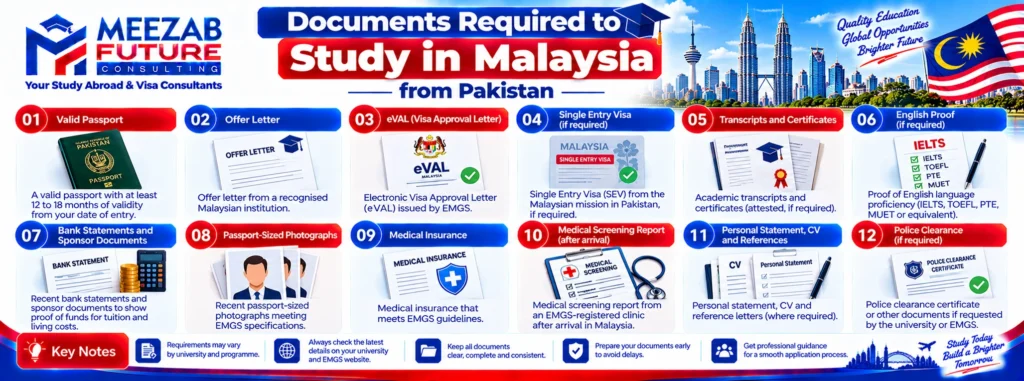
- Valid passport
- Offer letter from a recognised Malaysian institution
- eVAL (Visa Approval Letter)
- Single Entry Visa (if required)
- Transcripts and certificates
- English proof (if required)
- Bank statements and sponsor documents
- Passport-sized photographs meeting EMGS specifications
- Medical insurance meeting EMGS guidelines
- Medical screening report (after arrival)
- Personal statement, CV and references (where required)
- Police clearance or other documents if requested
Best Malaysian Universities for Pakistani Students
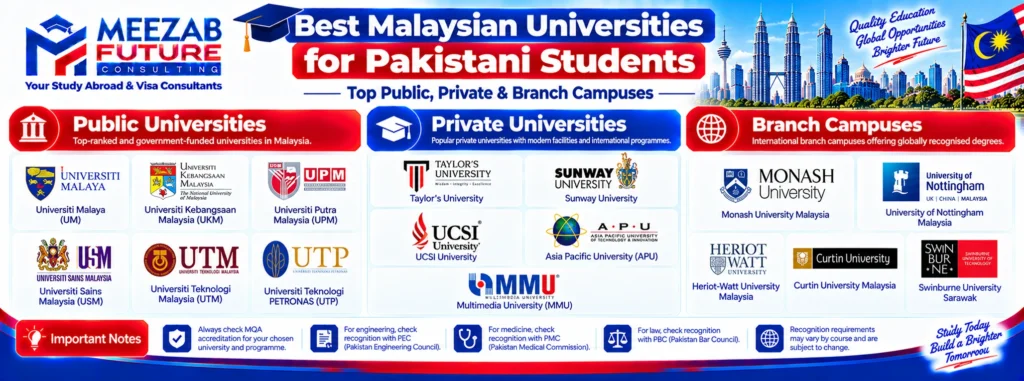
- Public universities: Universiti Malaya (UM), Universiti Kebangsaan Malaysia (UKM), Universiti Putra Malaysia (UPM), Universiti Sains Malaysia (USM), Universiti Teknologi Malaysia (UTM), Universiti Teknologi PETRONAS (UTP)
- Private universities: Taylor’s University, Sunway University, UCSI University, Asia Pacific University (APU), Multimedia University (MMU)
- Branch campuses: Monash University Malaysia, University of Nottingham Malaysia, Heriot-Watt University Malaysia, Curtin University Malaysia, Swinburne University Sarawak
Always check MQA accreditation, programme-level recognition and recognition in Pakistan (PEC for engineering, PMC for medicine, PBC for law).
Popular Courses to Study in Malaysia
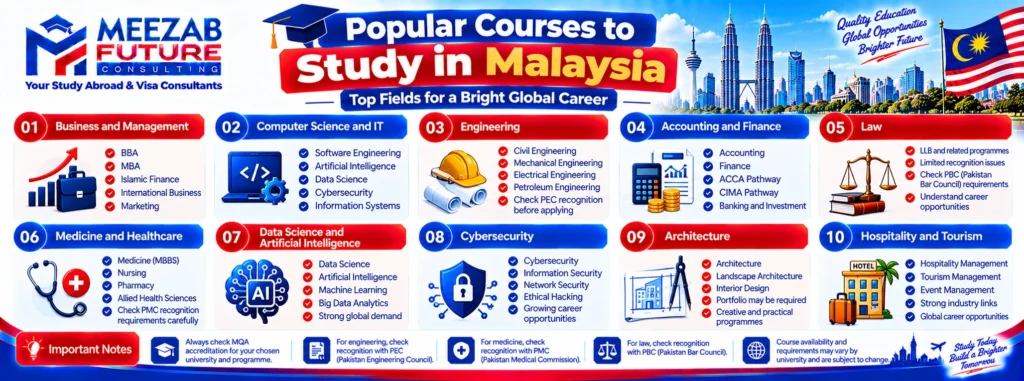
- Business and Management: BBA, MBA, Islamic finance
- Computer Science and IT: Software, AI, data, cybersecurity
- Engineering: Civil, mechanical, electrical, petroleum (check PEC recognition)
- Accounting and Finance: ACCA/CIMA pathways
- Law: Limited recognition issues, check PBC requirements
- Medicine and Healthcare: Popular but needs careful PMC recognition checks
- Data Science and Artificial Intelligence
- Cybersecurity
- Architecture: Portfolio required
- Hospitality and Tourism: Strong industry links
Cost of Studying in Malaysia from Pakistan
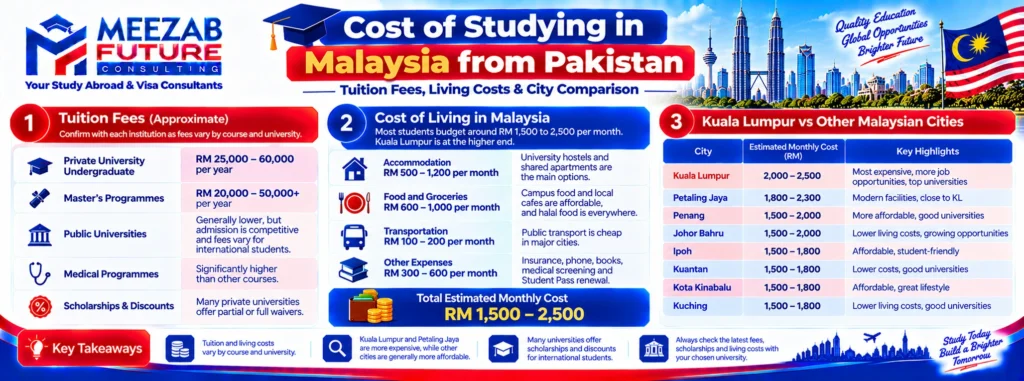
Tuition Fees (approximate, confirm with each institution)
- Private university undergraduate: often roughly RM 25,000 to 60,000 per year, depending on programme and institution
- Master’s programmes: roughly RM 20,000 to 50,000+ per year
- Public universities: often lower, but admission is competitive and fees for international students vary
- Medical programmes: significantly higher than other courses
- Scholarships and discounts: Many private universities offer partial or full waivers
Cost of Living
Many students budget roughly RM 1,500 to 2,500 per month, with Kuala Lumpur at the higher end.
- Accommodation costs: University hostels and shared apartments are the main options.
- Food and grocery costs: Campus food and local cafes are cheap, and halal food is everywhere.
- Transportation costs: A monthly public transport pass is cheap in major cities.
- Other student expenses: Insurance, phone, books, medical screening and Student Pass renewal.
Kuala Lumpur vs Other Malaysian Cities
Kuala Lumpur and Petaling Jaya are the most expensive but have the most opportunities. Penang, Johor Bahru, Ipoh, Kuantan, Kota Kinabalu and Kuching are generally cheaper while still offering good universities.
Malaysia Student Visa Requirements for Pakistani Students
Malaysia Student Visa Application Process from Pakistan
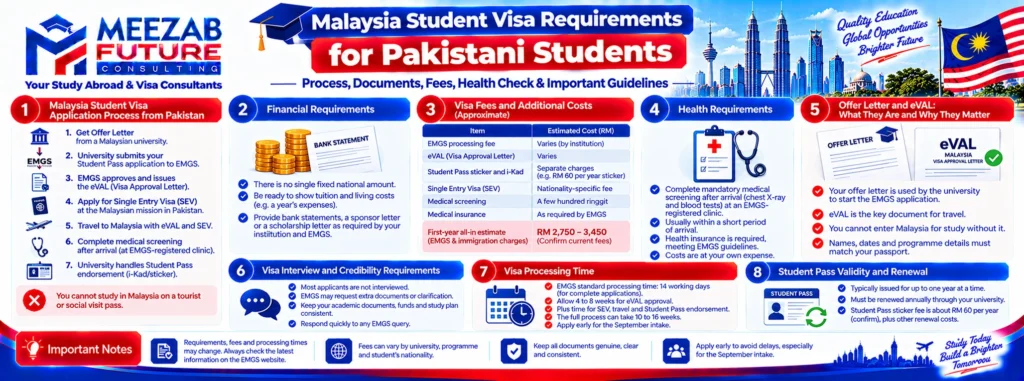
Pakistani students do not apply for a visa on their own at first. Your university submits your Student Pass application to EMGS. After approval, EMGS issues the eVAL. Pakistani students then usually apply for a Single Entry Visa (SEV) at the Malaysian mission before travelling. After arrival, you complete the medical screening and your institution handles the Student Pass endorsement. You cannot study in Malaysia on a tourist or social visit pass.
Financial Requirements
There is no single fixed national amount. You should be ready to show tuition and living costs (for example, a year’s expenses) through bank statements, a sponsor letter or a scholarship letter, as required by your institution and EMGS.
Visa Fees and Additional Costs
- EMGS processing fee: varies by institution and services included
- eVAL, Student Pass sticker and i-Kad: separate charges
- Single Entry Visa: nationality-specific fee
- Medical screening: a few hundred ringgit
- Medical insurance: as required by EMGS
- First-year all-in estimate for Pakistani students: roughly RM 2,750 to 3,450 in EMGS and immigration charges (confirm current fees)
Health Requirements
After arrival, you must complete mandatory medical screening (including chest X-ray and blood tests) at an EMGS-registered clinic, usually within a short period, at your own cost. You also need health insurance meeting EMGS requirements.
Offer Letter and eVAL: What They Are and Why They Matter
Your offer letter is the document your university uses to start the EMGS application. The eVAL is the key document for travel, and you cannot enter Malaysia for study without it. Names, dates and programme details must match your passport.
Visa Interview and Credibility Requirements
Most applicants are not interviewed, but EMGS may request extra documents or clarification. Keep your academic documents, funds and study plan consistent, and respond quickly to any EMGS query.
Visa Processing Time
EMGS states a 14 working day standard for complete applications, but allow 4 to 8 weeks for eVAL approval, plus time for the SEV, travel and Student Pass endorsement. The full process can take 10 to 16 weeks, so apply early for the September intake.
Student Pass Validity and Renewal
The Student Pass is typically issued for up to one year at a time and must be renewed annually through your university. The Student Pass sticker fee has been about RM 60 per year (confirm), plus other renewal costs.
Scholarships for Pakistani Students in Malaysia
- Malaysia International Scholarship (MIS): For eligible international postgraduate students, reportedly covering tuition for the sponsorship period and a monthly allowance of RM 1,500 under 2026 guidelines. Check the current round and eligibility.
- University scholarships and fee waivers: Merit-based awards at public and private universities, often 20% to 100% for strong applicants.
- Government and technical cooperation programmes: Some programmes target developing countries. Check MTCP and other schemes for eligibility.
- PhD and research funding: Research assistantships and supervisor-funded positions.
- Other funding: Foundation, corporate and country-specific awards.
Beware: Never pay anyone for a “guaranteed Malaysian scholarship”, and avoid unaccredited institutions.
Intakes and Application Deadlines for 2027
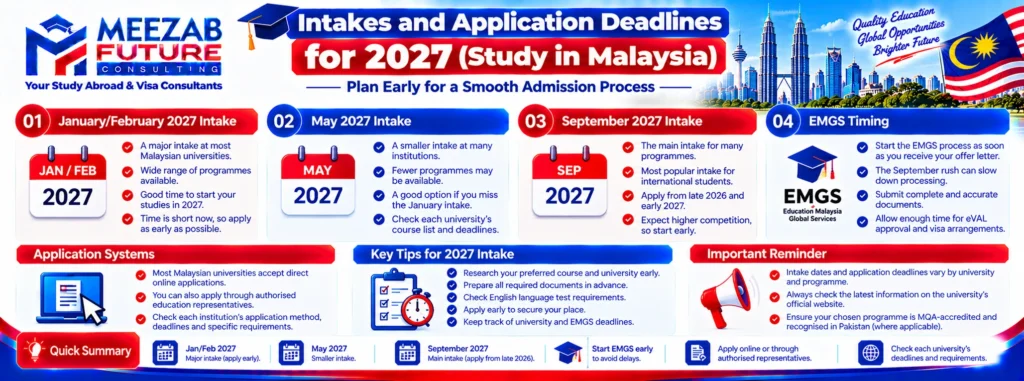
- January/February 2027: A major intake, but time is short now.
- May 2027: A smaller intake at many institutions.
- September 2027: The main intake for many programmes. Apply from late 2026 and early 2027.
- EMGS timing: Start the EMGS process as soon as you receive your offer, because the September rush can slow processing.
Application systems: Most institutions accept direct online applications or applications through authorised representatives. Check each institution’s deadlines and requirements.
Best Malaysian Cities for Pakistani Students
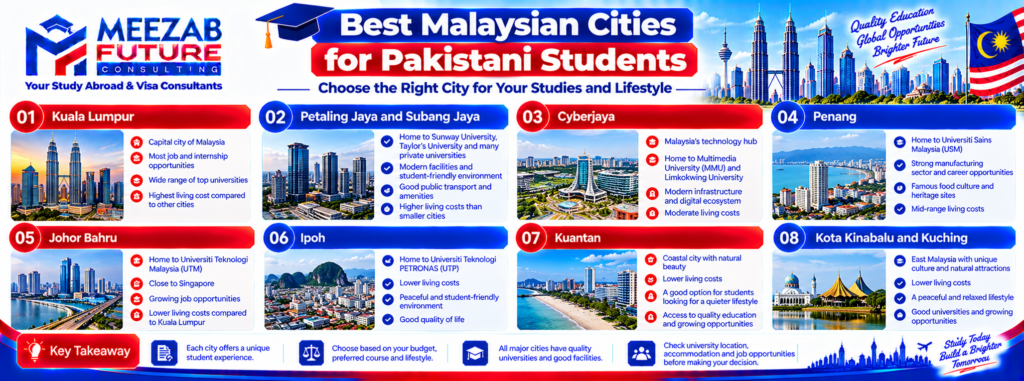
- Kuala Lumpur: Capital, most opportunities, highest cost
- Petaling Jaya and Subang Jaya: Home to Sunway, Taylor’s and many private universities
- Cyberjaya: Technology hub with MMU and Limkokwing
- Penang: USM, manufacturing and food culture, mid-cost
- Johor Bahru: UTM, close to Singapore
- Ipoh: UTP and lower costs
- Kuantan: Coastal city with lower costs
- Kota Kinabalu and Kuching: East Malaysia with lower costs and distinct culture
Accommodation Options for Pakistani Students in Malaysia
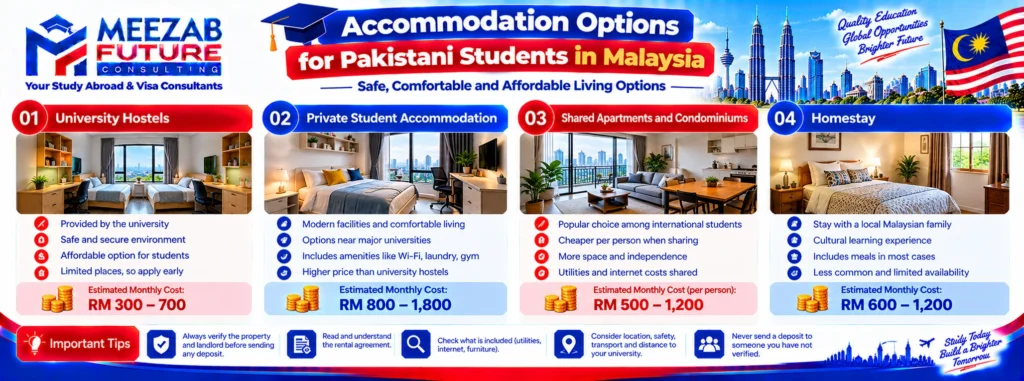
- University hostels: Safe and affordable, with limited places.
- Private student accommodation: More comfortable, higher price.
- Shared apartments and condominiums: Popular and cheaper per person.
- Homestay: Less common.
Never send a deposit to someone you have not verified, and read the rental agreement.
Part-Time Work for Pakistani Students in Malaysia
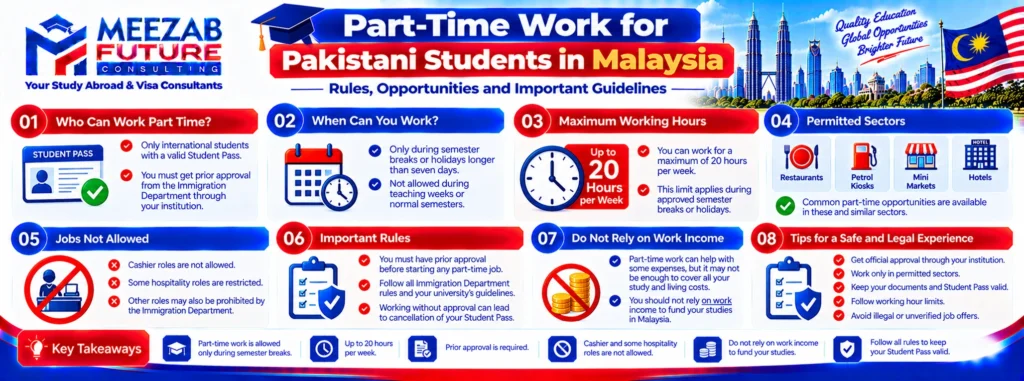
International students with a valid Student Pass may work part time only during semester breaks or holidays longer than seven days, for up to 20 hours per week, in permitted sectors such as restaurants, petrol kiosks, mini markets and hotels, and only with prior approval from the Immigration Department through your institution. Certain roles, such as cashier and some hospitality roles, are not allowed. Working without approval can lead to cancellation of your pass. Do not rely on work income to fund your studies.
Post-Study Work Options in Malaysia
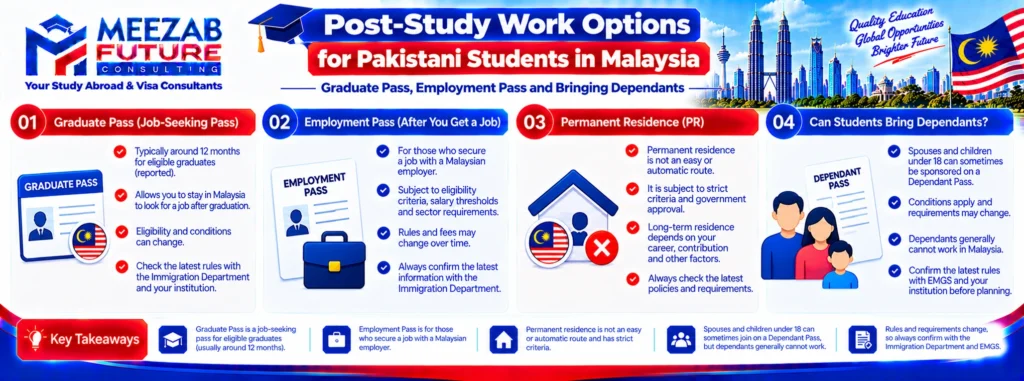
Graduate Pass and Employment Pass
Malaysia offers a Graduate Pass (job-seeking pass, reported at around 12 months for eligible graduates) and Employment Pass options for those who secure a job. Eligibility and conditions change, so confirm current rules with the Immigration Department and your institution. Permanent residence is not an easy or automatic route.
Can Students Bring Dependants to Malaysia?
Spouses and children under 18 can sometimes be sponsored on a Dependant Pass, but conditions apply, and dependants generally cannot work. Confirm with EMGS and your institution before planning.
Life as a Pakistani Student in Malaysia
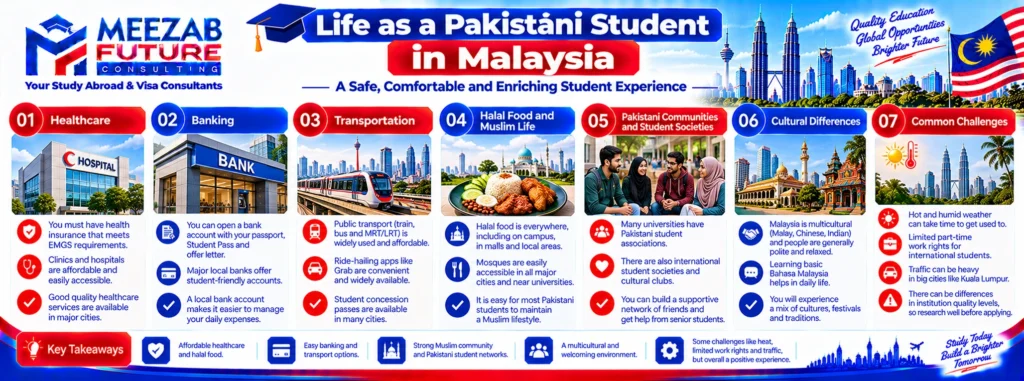
- Healthcare: You must hold health insurance meeting EMGS rules, and clinics and hospitals are affordable.
- Banking: Opening a bank account is possible with your passport, Student Pass and offer letter.
- Transportation: Public transport and ride-hailing apps are widely used and affordable.
- Halal food and Muslim life: Halal food and mosques are everywhere, which makes daily life easy for most Pakistani students.
- Pakistani communities and student societies: Many universities have Pakistani student associations and international student societies.
- Cultural differences: Malaysia is multicultural (Malay, Chinese, Indian), polite and relaxed. Basic Bahasa Malaysia helps.
- Common challenges: Heat and humidity, limited work rights, traffic in big cities and adjusting to different institution quality levels.
Budget and Practical Tips
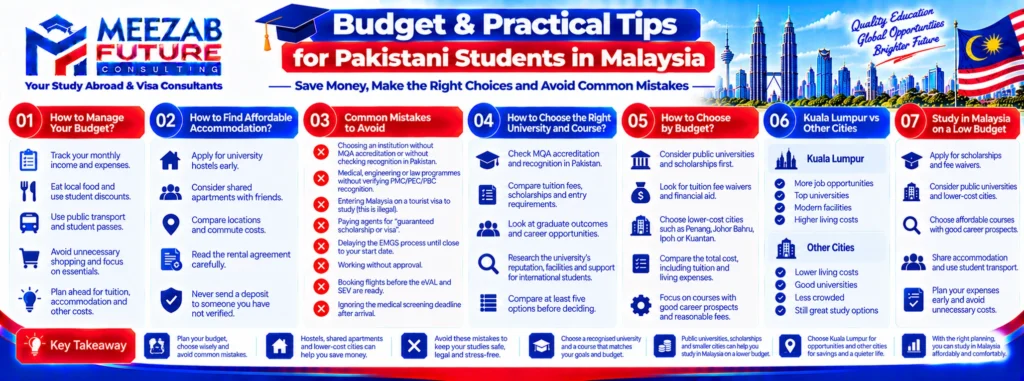
- How to manage your budget: Track spending, eat local food, use student transport and avoid unnecessary shopping.
- How to find affordable accommodation: Apply for hostels early, share apartments and compare commute costs.
- Common mistakes to avoid:
- Choosing an institution without MQA accreditation or without checking recognition in Pakistan
- Medical, engineering or law programmes without verifying PMC/PEC/PBC recognition
- Entering Malaysia on a tourist visa to study (this is illegal)
- Paying agents for “guaranteed scholarship or visa”
- Delaying the EMGS process until close to your start date
- Working without approval
- Booking flights before the eVAL and SEV are ready
- Ignoring the medical screening deadline after arrival
- How to choose the right university and course: Check accreditation, recognition, tuition, scholarships and graduate outcomes. Compare at least five options.
- How to choose by budget: Public universities, scholarships and lower-cost cities first.
- Kuala Lumpur vs other cities: Choose KL for opportunities, other cities for savings.
- Study in Malaysia on a low budget: Target scholarships, public universities and smaller cities.
Study in Malaysia Without IELTS
Can Pakistani Students Study in Malaysia Without IELTS?
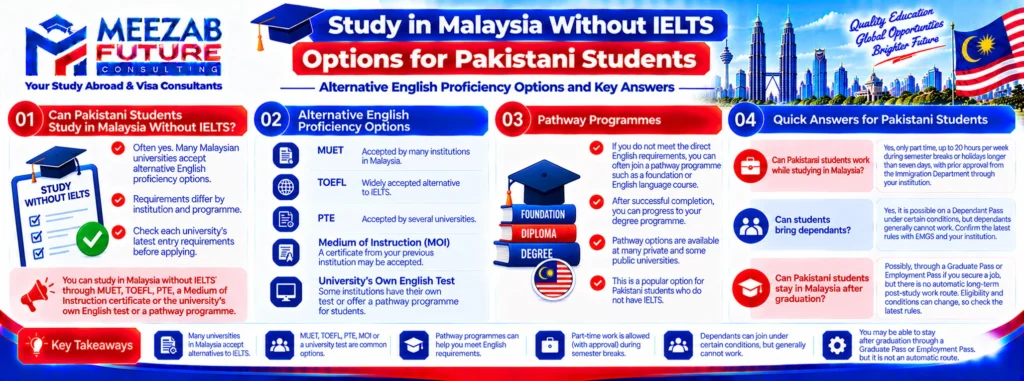
Often yes. Many institutions accept MUET, TOEFL, PTE, a Medium of Instruction certificate or their own English test or a pathway programme. Requirements differ by institution, so check each programme.
Quick Answers
- Can Pakistani students work while studying in Malaysia? Only part time, up to 20 hours per week during semester breaks or holidays longer than seven days, with approval.
- Can students bring dependants? Possible on a Dependant Pass under conditions, but dependants cannot usually work.
- Can Pakistani students stay in Malaysia after graduation? Possibly through a Graduate Pass or Employment Pass, but there is no automatic long-term post-study work route.
What to Do After Receiving Your Malaysia eVAL
Pre-Departure Checklist for Pakistani Students
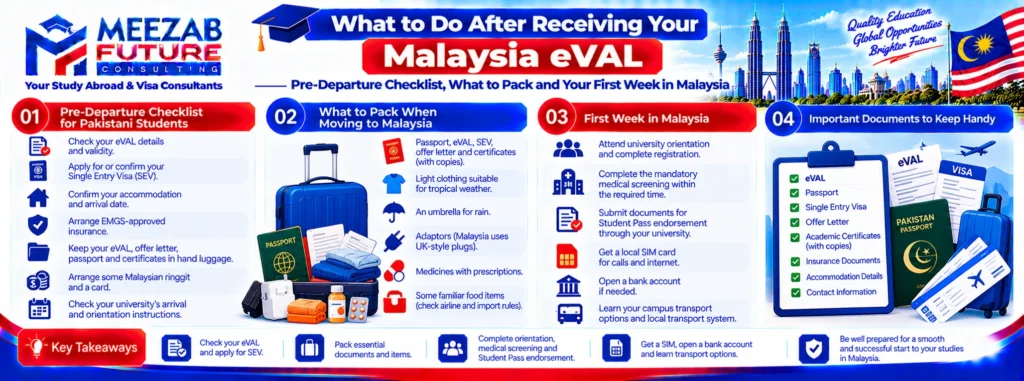
- Check your eVAL details and validity
- Apply for or confirm your Single Entry Visa
- Confirm accommodation and arrival date
- Arrange EMGS-approved insurance
- Keep your eVAL, offer letter, passport and certificates in hand luggage
- Arrange some Malaysian ringgit and a card
- Check your university’s arrival and orientation instructions
What to Pack When Moving to Malaysia
Passport, eVAL, SEV, offer letter, certificates (with copies), light clothing, an umbrella, adaptors (Malaysia uses UK-style plugs), medicines with prescriptions, and some familiar food (check airline and import rules).
First Week in Malaysia
Attend orientation, complete the medical screening within the required time, submit documents for Student Pass endorsement, get a SIM, open a bank account if needed, and learn your campus transport options.
How Meezab Future Consulting Helps Pakistani Students Study in Malaysia
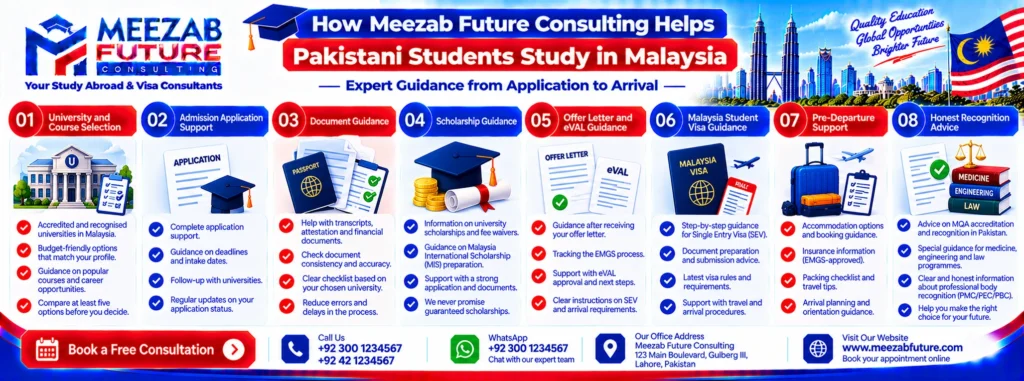
- University and course selection: Accredited, budget-friendly options that match your profile
- Admission application support: Applications, deadlines and follow-up
- Document guidance: Transcripts, attestation, financial documents and consistency checks
- Scholarship guidance: University waivers and MIS preparation (we never promise guaranteed scholarships)
- Offer letter and eVAL guidance: Tracking the EMGS process
- Malaysia student visa guidance: SEV preparation and arrival steps
- Pre-departure support: Accommodation, insurance, packing and arrival planning
- Honest recognition advice: Especially for medicine, engineering and law
(Add your office address, phone, WhatsApp and booking link. Avoid “guaranteed visa/scholarship/PMC approval” claims.)
Study in Malaysia from Pakistan: Complete Application Timeline (2027)
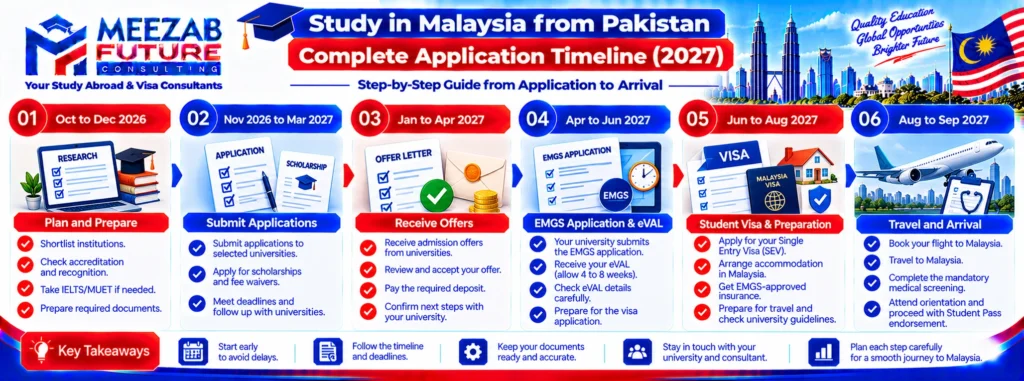
| When | What to do |
|---|---|
| Oct to Dec 2026 | Shortlist institutions, check accreditation and recognition, take IELTS/MUET if needed, prepare documents |
| Nov 2026 to Mar 2027 | Submit applications, apply for scholarships and fee waivers |
| Jan to Apr 2027 | Receive offers, accept, pay deposit |
| Apr to Jun 2027 | University submits EMGS application, receive eVAL (allow 4 to 8 weeks) |
| Jun to Aug 2027 | Apply for Single Entry Visa, arrange accommodation and insurance |
| Aug to Sep 2027 | Book flight, travel, complete medical screening and Student Pass endorsement |
Study in Malaysia from Pakistan: Complete Cost Breakdown (first year, approximate)
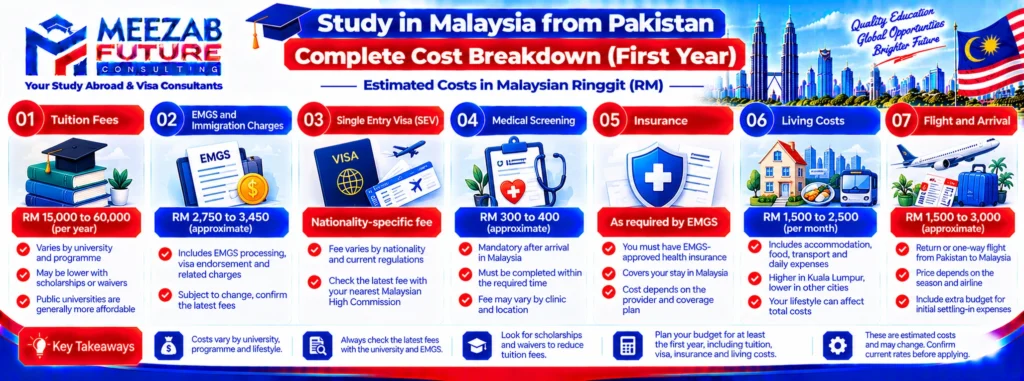
| Item | Estimate |
|---|---|
| Tuition | About RM 15,000 to 60,000 (minus any waiver) |
| EMGS and immigration charges | About RM 2,750 to 3,450 (confirm) |
| Single Entry Visa | Nationality-specific fee |
| Medical screening | About RM 300 to 400 |
| Insurance | As required by EMGS |
| Living costs | About RM 1,500 to 2,500 per month |
| Flight and arrival | About RM 1,500 to 3,000 |
Study in Malaysia from Pakistan: Document Checklist
- ☐ Passport
- ☐ Offer letter
- ☐ eVAL
- ☐ Single Entry Visa
- ☐ Transcripts and certificates
- ☐ English proof
- ☐ Bank statements/sponsor documents
- ☐ Photos (EMGS specifications)
- ☐ Insurance
- ☐ Medical screening report
- ☐ Personal statement and CV
- ☐ Study gap evidence
Study in Malaysia from Pakistan: Step-by-Step Checklist
- ☐ Course chosen
- ☐ Institutions shortlisted
- ☐ Accreditation and recognition checked
- ☐ English test booked (if needed)
- ☐ Application submitted
- ☐ Offer received
- ☐ Deposit paid
- ☐ EMGS application submitted
- ☐ eVAL received
- ☐ SEV applied
- ☐ Accommodation booked
- ☐ Flight booked
- ☐ Medical screening done
- ☐ Student Pass endorsed
Frequently Asked Questions About Studying in Malaysia from Pakistan (2027)
How can I study in Malaysia from Pakistan?
Choose an accredited institution, apply, receive your offer letter, let your university submit your EMGS application, receive your eVAL, obtain your Single Entry Visa, travel and complete your Student Pass steps.
How much does it cost to study in Malaysia from Pakistan?
Tuition varies widely, often roughly RM 15,000 to 60,000 per year, plus living costs of about RM 1,500 to 2,500 per month and first-year visa charges of around RM 2,750 to 3,450.
What are the requirements to study in Malaysia?
Academic qualifications, English proof, passport, offer letter, funds, eVAL, insurance and a Student Pass.
Can I study in Malaysia after FSC?
Yes, usually through a foundation, diploma or bachelor’s programme, depending on the institution.
Can I study in Malaysia after a bachelor’s degree?
Yes, for a master’s degree, with a 16-year degree generally preferred.
Is IELTS required to study in Malaysia?
Not always. Many institutions accept MUET, TOEFL, PTE, an MOI certificate or their own test.
How much bank balance is required for a Malaysia student visa?
There is no single fixed national figure. Show tuition and living costs through bank statements, a sponsor letter or a scholarship letter, as required by your institution and EMGS.
How long does a Malaysia student visa take?
EMGS has a 14 working day standard, but allow 4 to 8 weeks for the eVAL, and 10 to 16 weeks for the full process.
Can Pakistani students work in Malaysia while studying?
Only part time, up to 20 hours per week during semester breaks or holidays longer than seven days, with prior approval.
Can I get a scholarship to study in Malaysia?
Yes, through university scholarships and fee waivers, and programmes such as the Malaysia International Scholarship (MIS) for postgraduate students.
What are the intakes for international students?
Mainly January/February, May and September.
Can I study in Malaysia with a study gap?
Yes, if you can explain and document it.
Can I bring my family to Malaysia as a student?
Possible on a Dependant Pass under conditions, but dependants generally cannot work.
Can I stay in Malaysia after completing my studies?
Possibly through a Graduate Pass or Employment Pass, but there is no automatic long-term route.
Is a Malaysian medical degree valid in Pakistan?
Only if the programme and institution are recognised by PMC and you meet the current licensing requirements, so verify before paying any fees.
How can Meezab Future Consulting help me study in Malaysia?
With university selection, applications, scholarship preparation, EMGS and visa guidance and pre-departure planning, with honest advice about recognition and risks.