What’s New for 2027 Students
- Blocked account amount. The blocked account requirement for a student visa is €11,904 per year (€992 per month) for 2026, unchanged from 2025, and it is linked to the national student funding rate. Check whether it changes for 2027 before you deposit money.
- Visa fee. The German student visa fee is €75 (€37.50 for minors), and scholarship holders from German public institutions such as DAAD are exempt.
- Apostille for documents. Pakistan joined the Hague Apostille Convention in 2023, so your documents may now need an apostille instead of the old multi-step attestation route. Confirm the exact legalisation steps with the German Embassy before you start.
- Long appointment waits. The real bottleneck for Pakistani applicants is often the visa appointment, not the visa itself. Waiting lists can be very long, so register as early as possible.
- 18-month job search after graduation. After completing a German degree, you can apply for a residence permit of up to 18 months to look for a job.
- Public universities remain tuition-free for most programmes, except in Baden-Württemberg, where non-EU students pay tuition.
Why Study in Germany from Pakistan?
Benefits for Pakistani Students
- Tuition-free public universities for most degrees (you pay a small semester contribution)
- World-renowned engineering, technical and research universities
- Hundreds of English-taught master’s programmes
- Part-time work rights and an 18-month job search permit after graduation
- A strong job market in engineering, IT, healthcare and manufacturing
- Central location in Europe, with Schengen travel
Is Germany a Good Destination?
Yes, especially for students who want low tuition and strong career prospects. The main challenges are the blocked account, the visa appointment wait, German language needs for daily life and for many programmes, and finding affordable housing. Applicants who plan 12 months ahead do best.
Who Can Study in Germany from Pakistan?
- After Matric: You cannot enter a German degree directly. Complete FSc/Intermediate or A Levels first.
- After Intermediate/FSc: Pakistani FSc alone is generally not enough for direct bachelor’s admission, because German universities expect 13 years of schooling. Most FSc holders need a Studienkolleg (preparatory year). Some may qualify for direct or conditional entry with FSc plus one or two years at an HEC-recognised university.
- After A Levels: A strong route. Check each university’s rules on subjects and grades.
- After Bachelor’s: Apply for a master’s degree. Your degree must be HEC-recognised, and the programme usually requires a matching subject background.
- After Master’s: Apply for a PhD with a supervisor, often as a paid research position.
- With a study gap: Possible, but German universities and the embassy expect a clear, documented explanation (work, courses or other activity). A CV with no gaps is important.
German Education System Explained
- Undergraduate degrees: Usually 3 to 4 years (6 to 8 semesters).
- Postgraduate degrees: Master’s takes 1.5 to 2 years (3 to 4 semesters).
- PhD and research degrees: 3 to 5 years, often as an employee of a university or research institute.
- Foundation course (Studienkolleg): A 1-year preparatory course ending with the Feststellungsprüfung entrance exam.
- Public vs private universities: Public universities are tuition-free but competitive. Private universities charge tuition but may offer easier admission and more English-taught options.
- Types of universities: Universities (TU/Uni) are research-focused, and Universities of Applied Sciences (Fachhochschule/HAW) are practice-focused, with strong industry links.
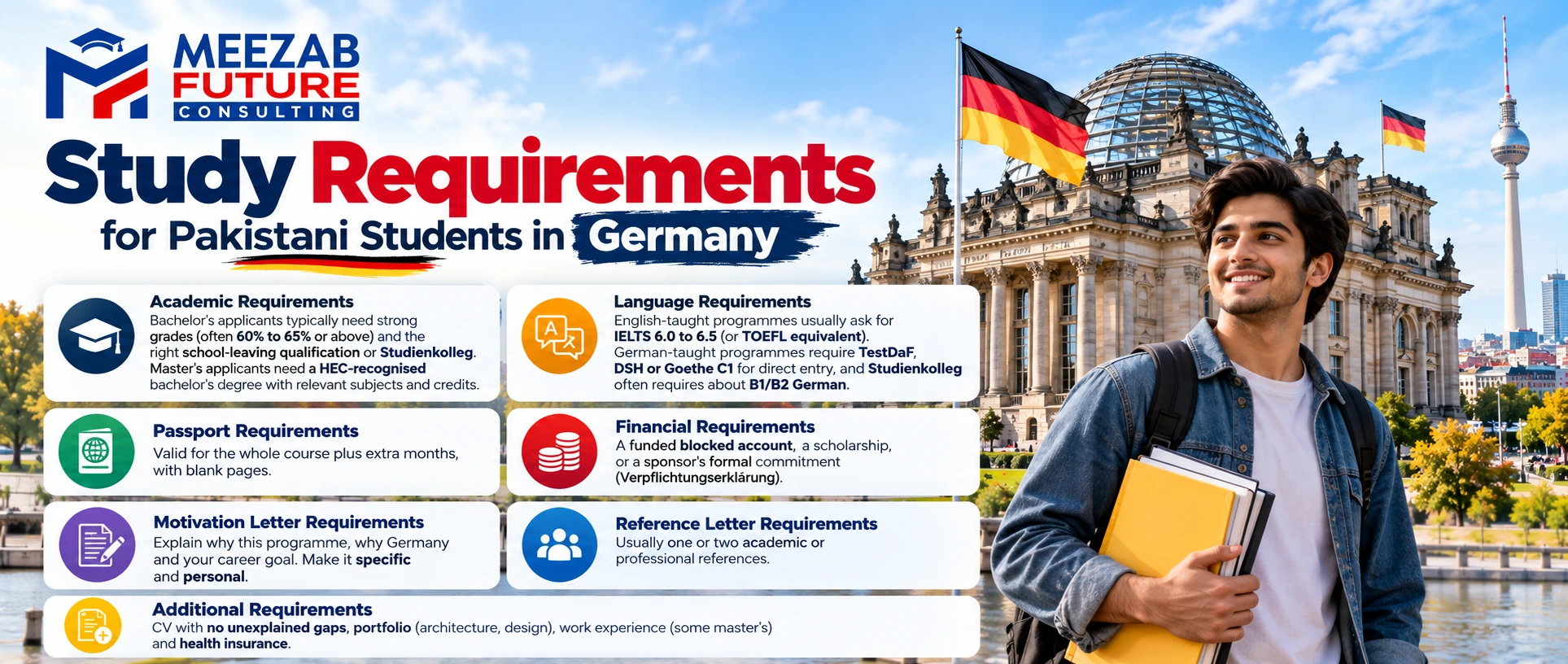
Study Requirements for Pakistani Students in Germany
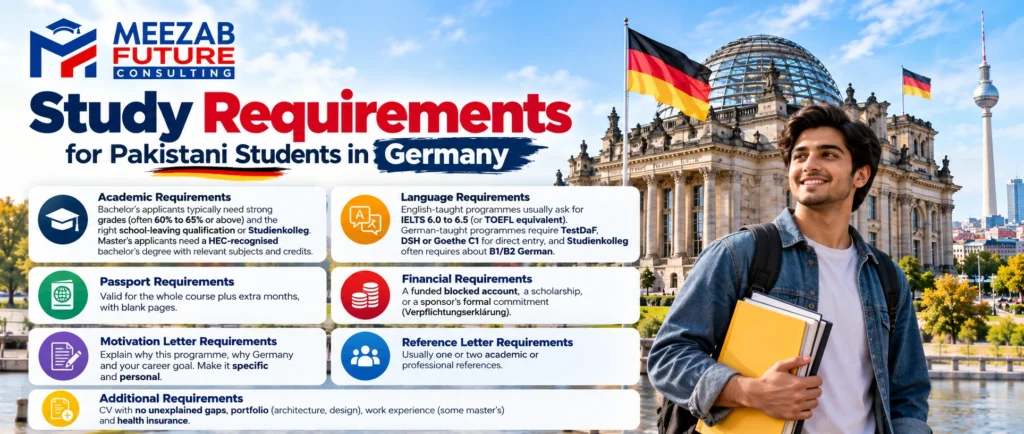
Academic requirements: Bachelor’s applicants typically need strong grades (often 60% to 65% or above) and the right school-leaving qualification or Studienkolleg. Master’s applicants need a HEC-recognised bachelor’s degree with relevant subjects and credits.
Language requirements: English-taught programmes usually ask for IELTS 6.0 to 6.5 (or TOEFL equivalent). German-taught programmes require TestDaF, DSH or Goethe C1 for direct entry, and Studienkolleg often requires about B1/B2 German.
Passport requirements: Valid for the whole course plus extra months, with blank pages.
Financial requirements: A funded blocked account, a scholarship, or a sponsor’s formal commitment (Verpflichtungserklärung).
Motivation letter requirements: Explain why this programme, why Germany and your career goal. Make it specific and personal.
Reference letter requirements: Usually one or two academic or professional references.
Additional requirements: CV with no unexplained gaps, portfolio (architecture, design), work experience (some master’s) and health insurance.
Step-by-Step: How to Study in Germany from Pakistan
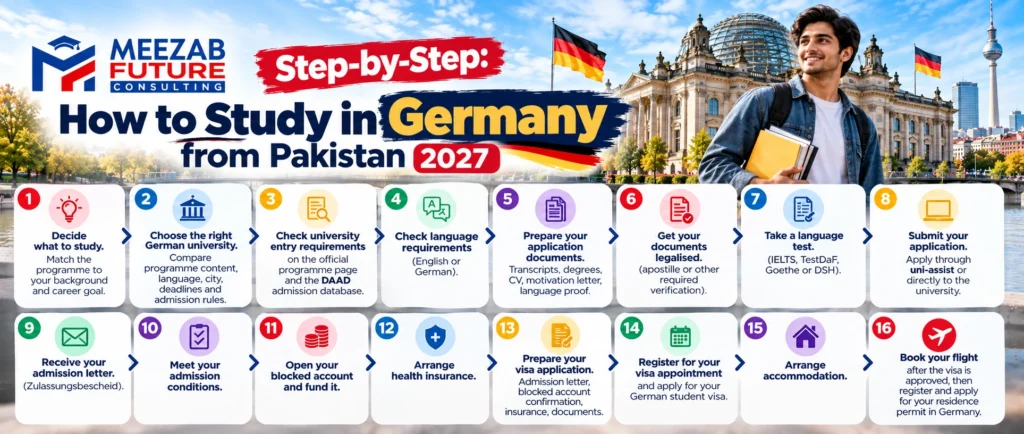
- Decide what to study. Match the programme to your background and career goal.
- Choose the right German university. Compare programme content, language, city, deadlines and admission rules.
- Check university entry requirements on the official programme page and the DAAD admission database.
- Check language requirements (English or German).
- Prepare your application documents. Transcripts, degrees, CV, motivation letter, language proof.
- Get your documents legalised (apostille or other required verification).
- Take a language test (IELTS, TestDaF, Goethe or DSH).
- Submit your application. Apply through uni-assist or directly to the university.
- Receive your admission letter (Zulassungsbescheid).
- Meet your admission conditions.
- Open your blocked account and fund it.
- Arrange health insurance.
- Prepare your visa application. Admission letter, blocked account confirmation, insurance, documents.
- Register for your visa appointment and apply for your German student visa.
- Arrange accommodation.
- Book your flight after the visa is approved, then register and apply for your residence permit in Germany.
Documents Required to Study in Germany from Pakistan
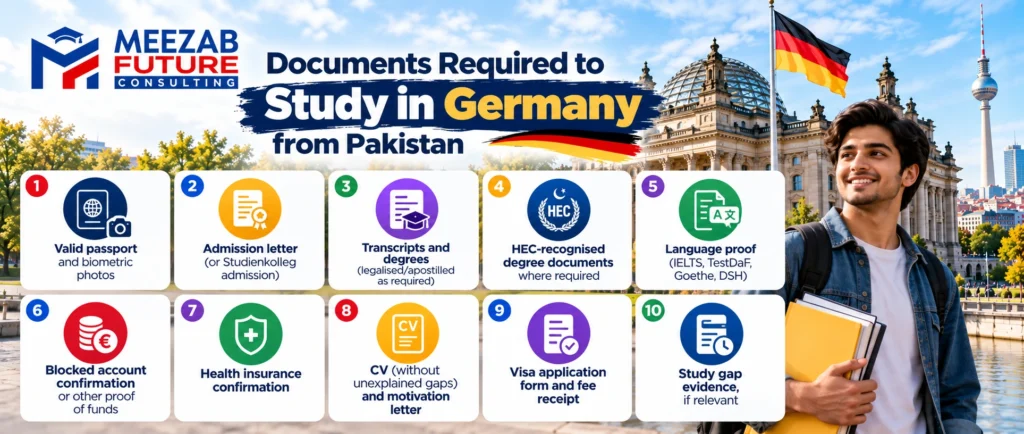
- Valid passport and biometric photos
- Admission letter (or Studienkolleg admission)
- Transcripts and degrees (legalised/apostilled as required)
- HEC-recognised degree documents where required
- Language proof (IELTS, TestDaF, Goethe, DSH)
- Blocked account confirmation or other proof of funds
- Health insurance confirmation
- CV (without unexplained gaps) and motivation letter
- Visa application form and fee receipt
- Study gap evidence, if relevant
Best German Universities for Pakistani Students
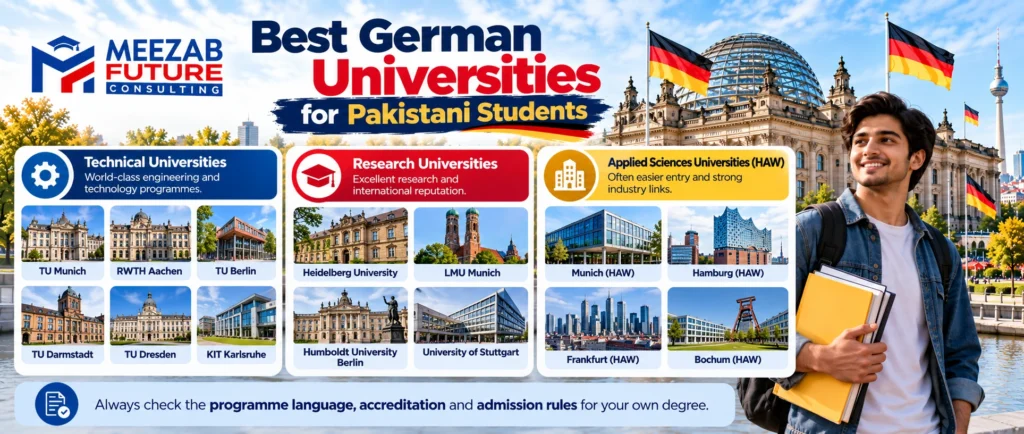
- Technical universities: TU Munich, RWTH Aachen, TU Berlin, TU Darmstadt, TU Dresden, KIT Karlsruhe
- Research universities: Heidelberg University, LMU Munich, Humboldt University Berlin, University of Stuttgart
- Applied sciences universities (HAW): Often easier entry and strong industry links, for example in Munich, Hamburg, Frankfurt and Bochum
Always check the programme language, accreditation and admission rules for your own degree.
Popular Courses to Study in Germany
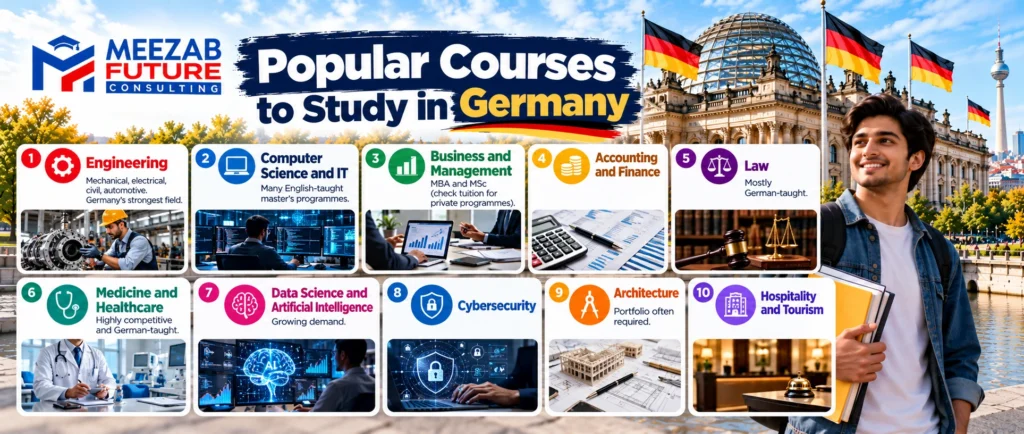
- Engineering: Mechanical, electrical, civil, automotive. Germany’s strongest field.
- Computer Science and IT: Many English-taught master’s programmes
- Business and Management: MBA and MSc (check tuition for private programmes)
- Accounting and Finance
- Law: Mostly German-taught
- Medicine and Healthcare: Highly competitive and German-taught
- Data Science and Artificial Intelligence: Growing demand
- Cybersecurity
- Architecture: Portfolio often required
- Hospitality and Tourism
Cost of Studying in Germany from Pakistan
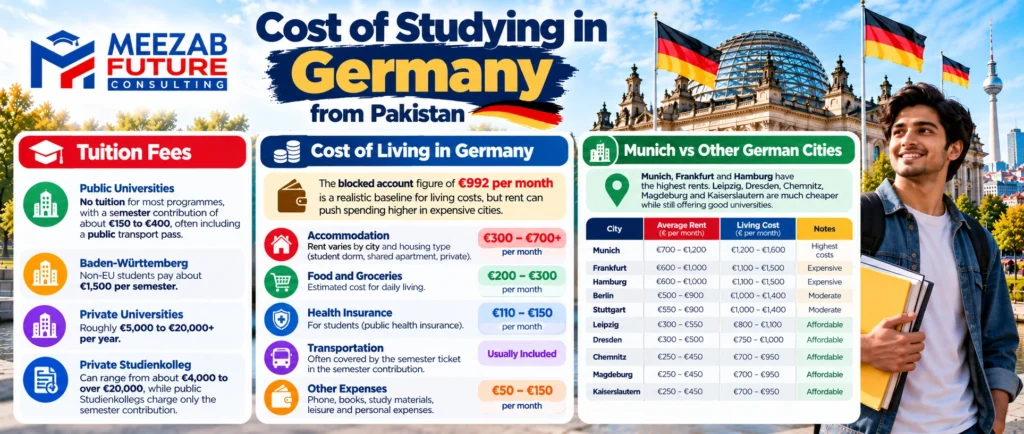
Tuition Fees
- Public universities: No tuition for most programmes, with a semester contribution of about €150 to €400 that often includes a public transport pass
- Baden-Württemberg: Non-EU students pay about €1,500 per semester
- Private universities: Roughly €5,000 to €20,000+ per year
- Private Studienkolleg: Can range from about €4,000 to over €20,000, while public Studienkollegs charge only the semester contribution
Cost of Living
The blocked account figure of €992 per month is a realistic baseline for living costs, but rent can push spending higher in expensive cities.
- Accommodation costs: about €300 to €700+ per month, depending on the city and housing type
- Food and grocery costs: about €200 to €300 per month
- Health insurance: roughly €110 to €150 per month for students
- Transportation costs: often covered by the semester ticket
- Other student expenses: phone, books, study materials, leisure
Munich vs Other German Cities
Munich, Frankfurt and Hamburg have the highest rents. Leipzig, Dresden, Chemnitz, Magdeburg and Kaiserslautern are much cheaper while still offering good universities.
Germany Student Visa Requirements for Pakistani Students
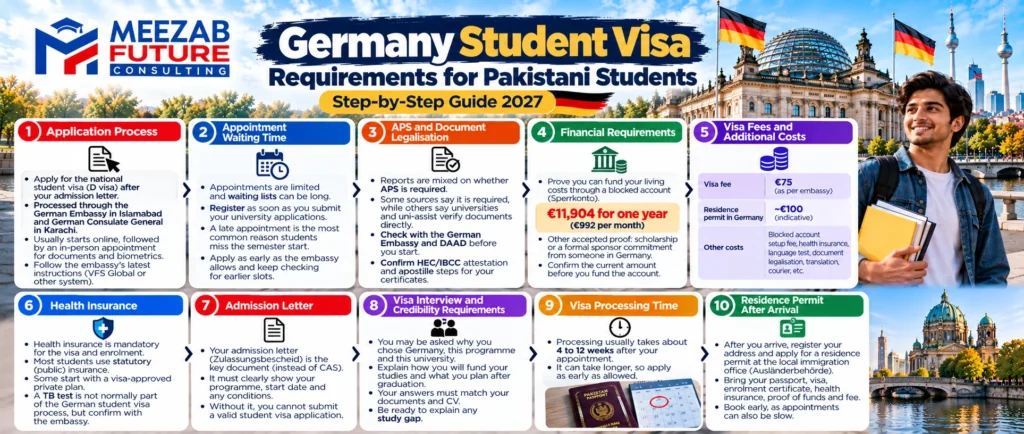
Germany Student Visa Application Process from Pakistan
Apply for the national student visa (D visa) after you have your admission letter. Applications are processed through the German Embassy in Islamabad and the German Consulate General in Karachi, and the process usually starts online with an in-person appointment for documents and biometrics. Follow the embassy’s current instructions on whether VFS Global or another system handles the appointment.
Appointment Waiting Time (very important)
Appointments are limited, and waiting lists can be long. Register for an appointment as soon as you submit your university applications, because a late appointment is the most common reason students miss the semester start. Apply as early as the embassy allows, and keep checking for earlier slots.
Academic Verification (APS) and Document Legalisation
Reports are mixed on whether Pakistani applicants must obtain an APS (Academic Evaluation Centre) certificate. Some sources say it is required, while others say German universities and uni-assist verify Pakistani documents directly. Check with the German Embassy and DAAD before you start, and also confirm HEC/IBCC attestation and apostille steps for your certificates.
Financial Requirements for Germany Student Visa
You must prove you can fund your living costs, usually through a blocked account (Sperrkonto) with €11,904 for one year (€992 per month can be withdrawn after arrival). Other accepted proof may include a scholarship or a formal sponsor commitment from someone in Germany. Confirm the current amount before you fund the account.
Visa Fees and Additional Costs
- Visa fee: €75 (paid in the way the embassy specifies)
- Residence permit in Germany: about €100 (indicative)
- Other costs: blocked account setup fee, health insurance, language test, document legalisation, translation, courier
Health Insurance
Health insurance is mandatory for the visa and for enrolment. Most students use statutory (public) insurance, and some start with a visa-approved private plan. A TB test is not normally part of the German student visa process, but confirm with the embassy.
Admission Letter: What It Is and Why It Matters
Instead of a UK-style CAS, your admission letter (Zulassungsbescheid) is the key document. It must clearly show your programme, start date and any conditions. Without it you cannot submit a valid student visa application.
Visa Interview and Credibility Requirements
You may be asked why you chose Germany, this programme and this university, how you will fund your studies and what you plan after graduation. Answers must match your documents and CV. Be ready to explain any study gap.
Visa Processing Time
Processing usually takes about 4 to 12 weeks after your appointment, but it can take longer, so apply as early as allowed.
Residence Permit After Arrival
After you arrive, you must register your address and apply for a residence permit at the local immigration office (Ausländerbehörde). Bring your passport, visa, enrolment certificate, health insurance, proof of funds and fee. Book early, as appointments can also be slow.
Scholarships for Pakistani Students in Germany
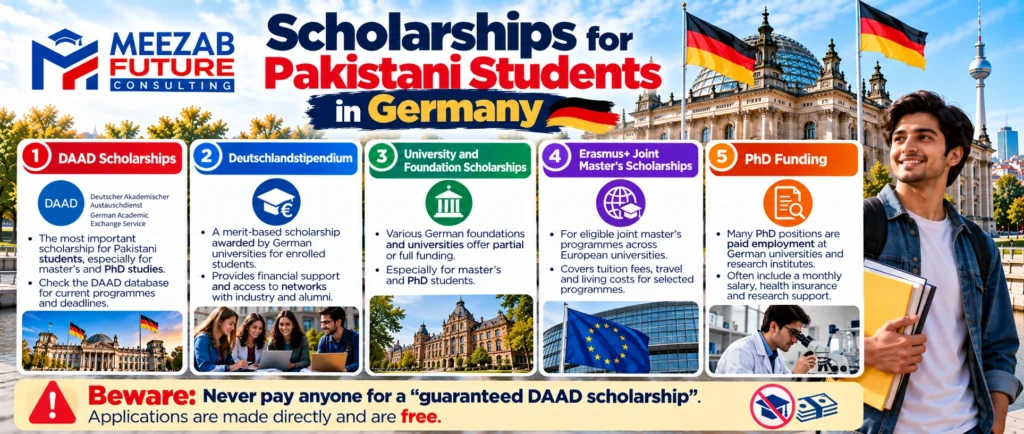
- DAAD scholarships: The most important scholarship for Pakistani students, especially for master’s and PhD studies. Check the DAAD database for current programmes and deadlines.
- Deutschlandstipendium: A merit-based scholarship awarded by universities for enrolled students.
- University and foundation scholarships: Various German foundations and universities offer partial or full funding, especially for master’s and PhD students.
- Erasmus+ joint master’s scholarships: For eligible joint programmes across European universities.
- PhD funding: Many PhD positions are paid employment at universities and research institutes.
Beware: Never pay anyone for a “guaranteed DAAD scholarship”. Applications are made directly and are free.
Intakes and Application Deadlines for 2027
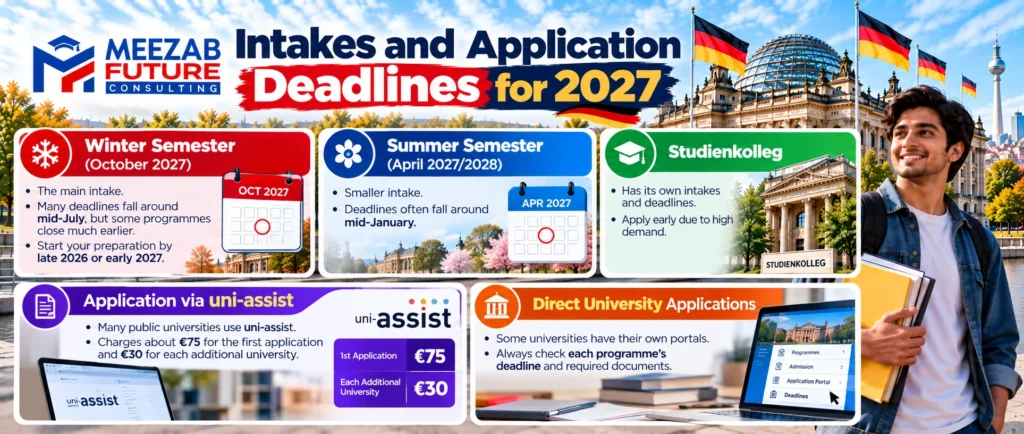
- Winter semester (October 2027): The main intake. Many deadlines fall around mid-July, but some programmes close much earlier, so start by late 2026 or early 2027.
- Summer semester (April 2027/2028): Smaller intake. Deadlines often fall around mid-January.
- Studienkolleg: Has its own intakes and deadlines, so apply early.
Application via uni-assist: Many public universities use uni-assist, which charges about €75 for the first application and €30 for each additional university. Direct university applications: Some universities have their own portals. Always check each programme’s deadline and required documents.
Best German Cities for Pakistani Students
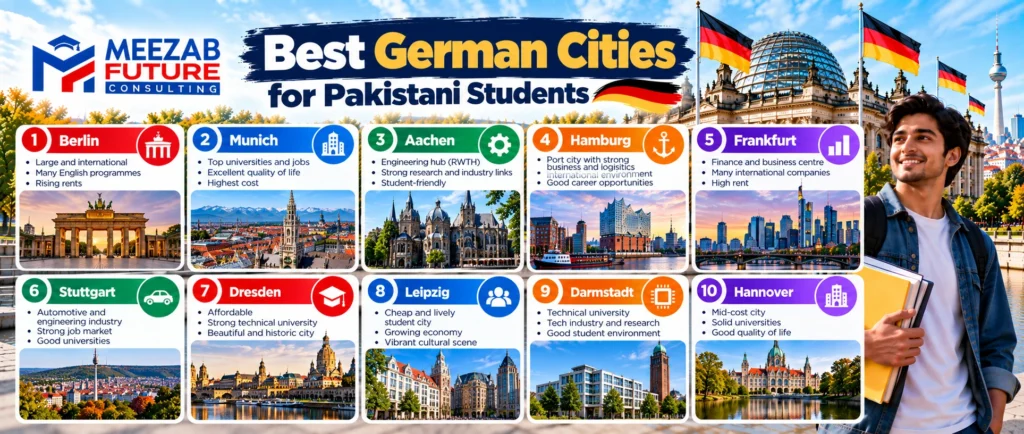
- Berlin: Large and international, with many English programmes, rising rents
- Munich: Top universities and jobs, highest cost
- Aachen: Engineering hub (RWTH), student-friendly
- Hamburg: Port city with strong business and logistics
- Frankfurt: Finance and business centre, high rent
- Stuttgart: Automotive and engineering industry
- Dresden: Affordable, strong technical university
- Leipzig: Cheap and lively student city
- Darmstadt: Technical university and tech industry
- Hannover: Mid-cost city with solid universities
Accommodation Options for Pakistani Students in Germany
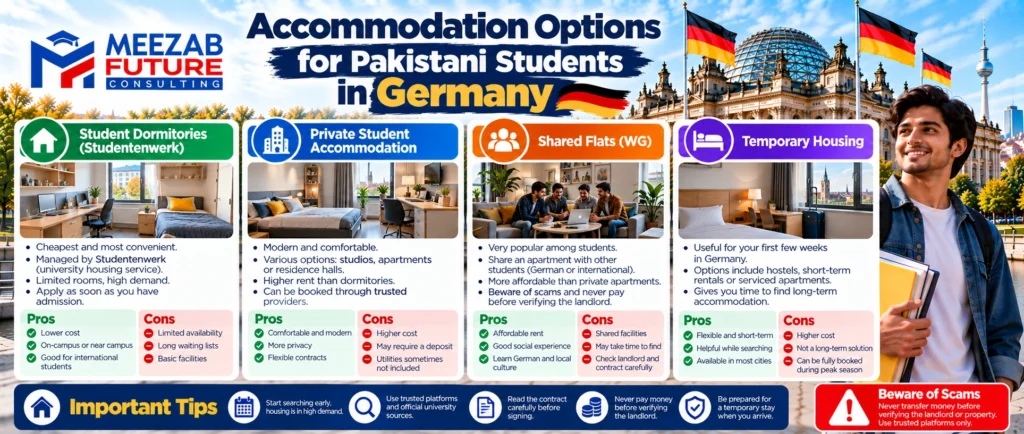
- Student dormitories (Studentenwerk): Cheapest and most convenient, but limited. Apply as soon as you have admission.
- Private student accommodation: More comfortable, higher price.
- Shared flats (WG): Very popular and affordable. Beware of scams and never pay before verifying the landlord.
- Temporary housing: Useful for your first weeks while you search.
Housing is one of the biggest challenges, so start searching early.
Part-Time Work for Pakistani Students in Germany
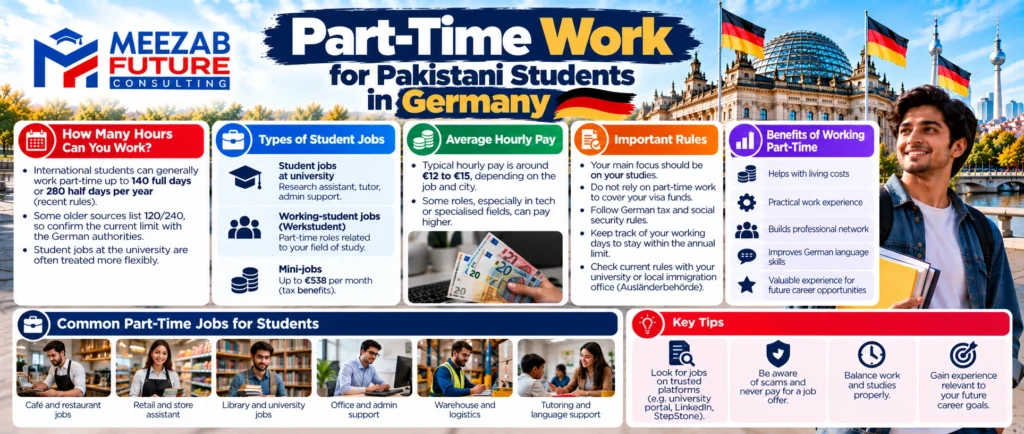
International students can generally work part-time up to a set number of days per year (recent rules are 140 full days or 280 half days, while some older sources list 120/240, so confirm the current limit). Student jobs at the university are usually treated more flexibly. Work should support your studies and should not be relied on for your visa funds. Mini-jobs and working-student jobs are common.
Post-Study Work Options in Germany
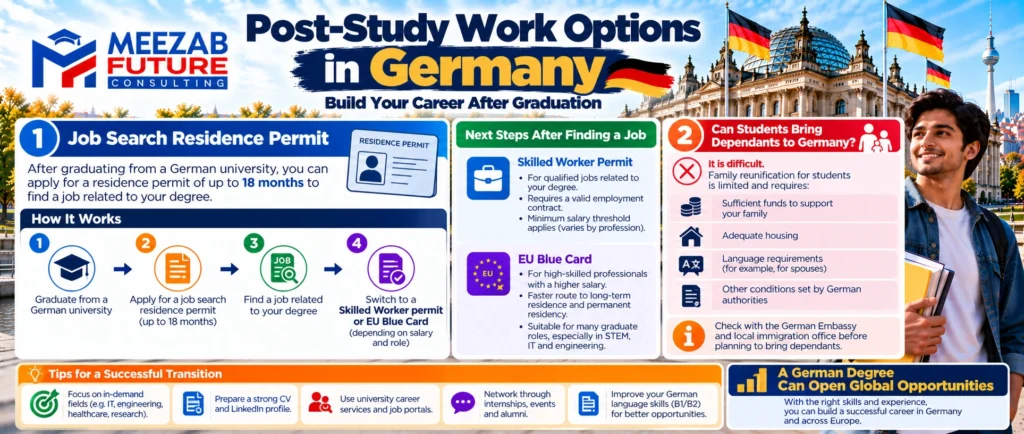
Job Search Residence Permit
After graduating from a German university, you can apply for a residence permit of up to 18 months to find a job related to your degree. Once you find qualifying work, you can switch to a Skilled Worker permit or an EU Blue Card, depending on salary and role.
Can Students Bring Dependants to Germany?
It is difficult. Family reunification for students is limited and requires sufficient funds, housing and other conditions (for example, language requirements for spouses). Check with the embassy and immigration office before planning.
Life as a Pakistani Student in Germany
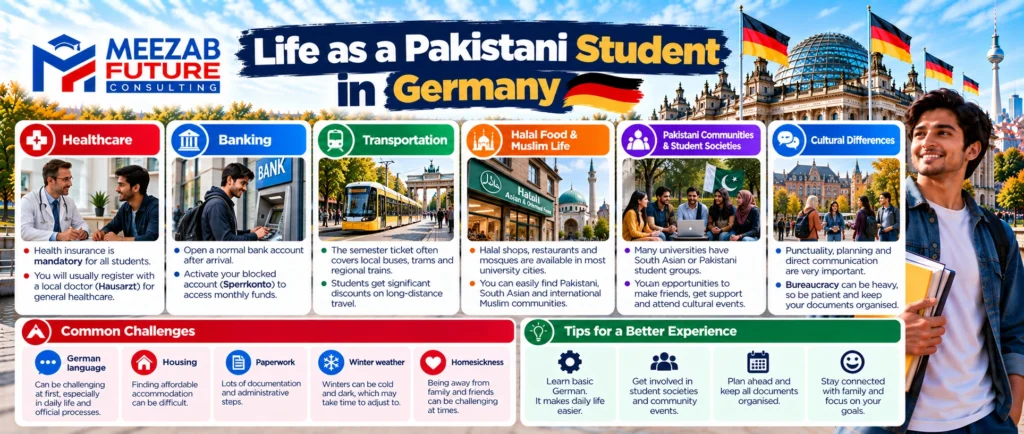
- Healthcare: Health insurance is mandatory, and you will use a local doctor (Hausarzt).
- Banking: Open a normal bank account after arrival and activate your blocked account.
- Transportation: The semester ticket often covers local transport.
- Halal food and Muslim life: Halal shops, restaurants and mosques are available in most university cities.
- Pakistani communities and student societies: Many universities have South Asian or Pakistani student groups.
- Cultural differences: Punctuality, planning and direct communication are important, and bureaucracy is heavy.
- Common challenges: German language, housing, paperwork, winter weather and homesickness.
Budget and Practical Tips
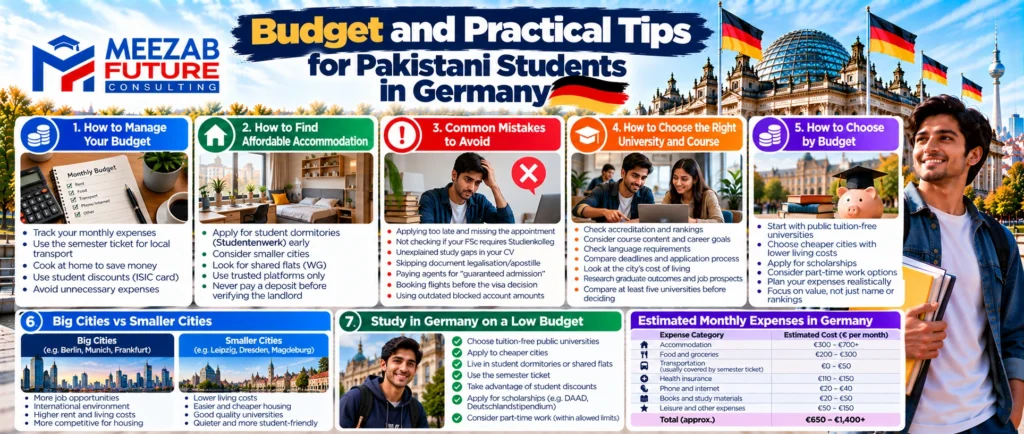
- How to manage your budget: Track spending, use the semester ticket, cook at home and use student discounts.
- How to find affordable accommodation: Apply for dorms early, consider smaller cities and avoid paying deposits before verification.
- Common mistakes to avoid:
- Applying too late and missing the appointment window
- Not checking whether your FSc requires Studienkolleg
- Unexplained study gaps in your CV
- Skipping document legalisation/apostille steps
- Paying agents for “guaranteed admission” or scholarships
- Booking flights before the visa decision
- Using outdated blocked account amounts
- How to choose the right university and course: Check accreditation, language, deadlines, city costs and graduate outcomes. Compare at least five options.
- How to choose by budget: Public tuition-free universities in cheaper cities first.
- Choosing between big cities and smaller cities: Big cities offer more jobs and higher rent, smaller cities offer lower costs and easier housing.
- Study in Germany on a low budget: Choose tuition-free public universities, cheaper cities, dorms and scholarships.
Study in Germany Without IELTS
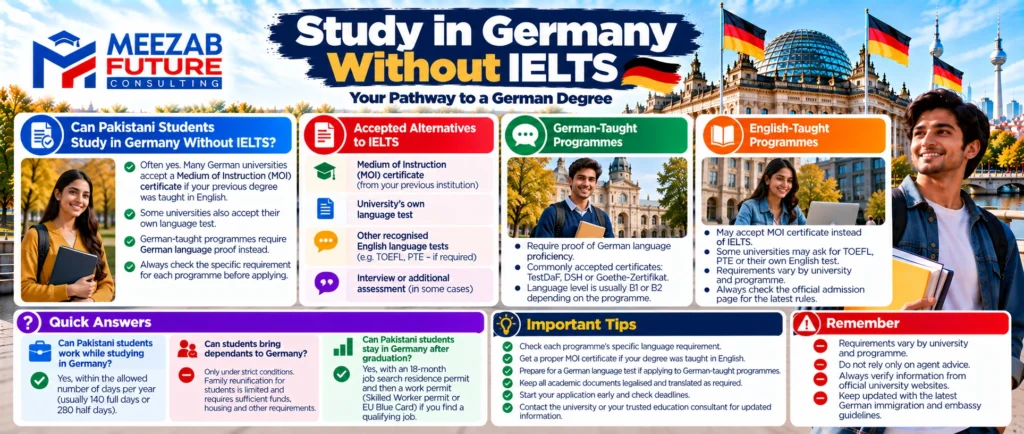
Can Pakistani Students Study in Germany Without IELTS?
Often yes. Some universities accept a Medium of Instruction (MOI) certificate if your previous degree was taught in English, or their own language test. German-taught programmes require German language proof instead. Always check each programme’s rule.
Quick Answers
- Can Pakistani students work while studying in Germany? Yes, within the allowed days per year.
- Can students bring dependants? Only under strict conditions.
- Can Pakistani students stay in Germany after graduation? Yes, with an 18-month job search permit and then a work permit if you find a qualifying job.
What to Do After Receiving Your Germany Student Visa
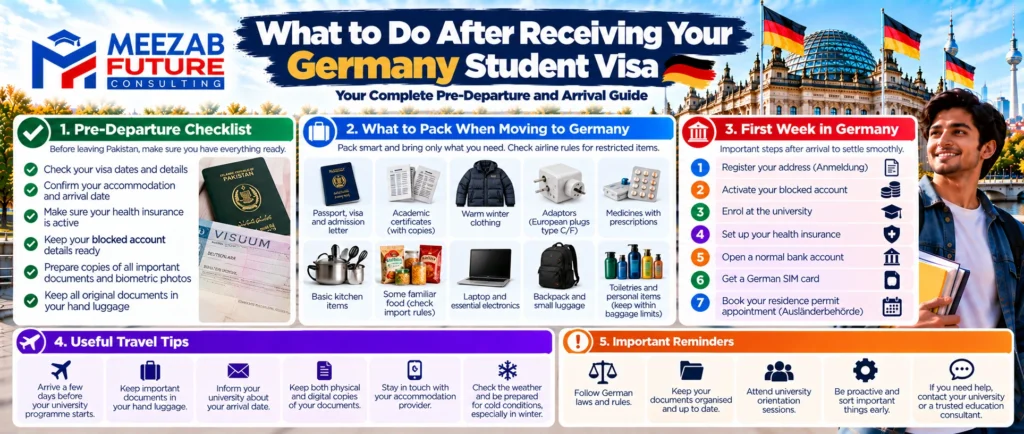
Pre-Departure Checklist for Pakistani Students
- Check visa dates and details
- Confirm accommodation and arrival date
- Confirm health insurance is active
- Keep blocked account details ready
- Prepare copies of documents and biometric photos
- Keep originals in hand luggage
What to Pack When Moving to Germany
Passport, visa, admission letter, certificates (with copies), warm winter clothing, adaptors (European plugs), medicines with prescriptions, basic kitchen items and some familiar food (check airline and import rules).
First Week in Germany
Register your address (Anmeldung), activate your blocked account, enrol at the university, set up health insurance, open a bank account, get a SIM, and book your residence permit appointment.
How Meezab Future Consulting Helps Pakistani Students Study in Germany
- University and course selection: Tuition-free options that fit your profile and budget
- Admission application support: uni-assist, direct applications and deadline tracking
- Document guidance: Legalisation, apostille steps, translations and CV/gap explanation
- Scholarship guidance: DAAD and other scholarship preparation (we never promise guaranteed scholarships)
- Admission letter guidance: Checking conditions and details
- German student visa guidance: Blocked account, appointment planning and interview preparation
- Pre-departure support: Accommodation search, packing and arrival planning
(Add your office address, phone, WhatsApp and booking link. Avoid “guaranteed visa/admission” claims in your copy.)
Study in Germany from Pakistan: Complete Application Timeline (Winter 2027)
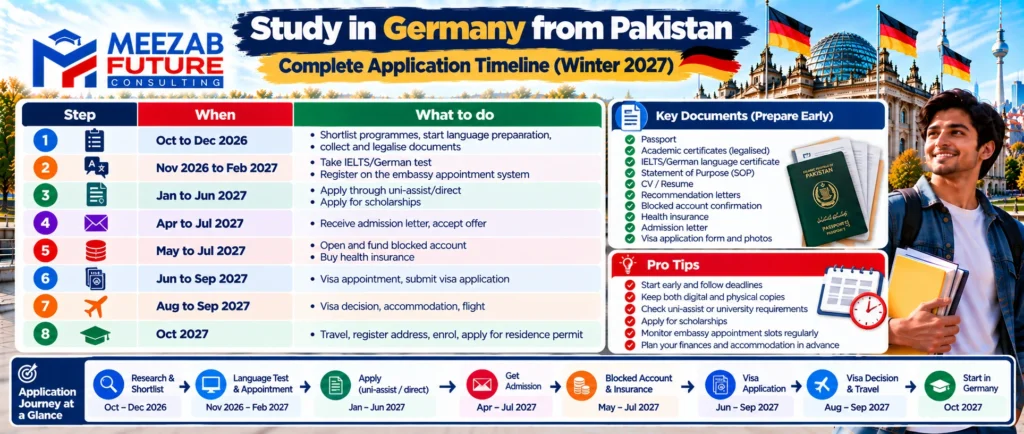
| When | What to do |
| Oct to Dec 2026 | Shortlist programmes, start language preparation, collect and legalise documents |
| Nov 2026 to Feb 2027 | Take IELTS/German test, register on the embassy appointment system |
| Jan to Jun 2027 | Apply through uni-assist/direct, apply for scholarships |
| Apr to Jul 2027 | Receive admission letter, accept offer |
| May to Jul 2027 | Open and fund blocked account, buy health insurance |
| Jun to Sep 2027 | Visa appointment, submit visa application |
| Aug to Sep 2027 | Visa decision, accommodation, flight |
| Oct 2027 | Travel, register address, enrol, apply for residence permit |
Study in Germany from Pakistan: Complete Cost Breakdown (first year, approximate)
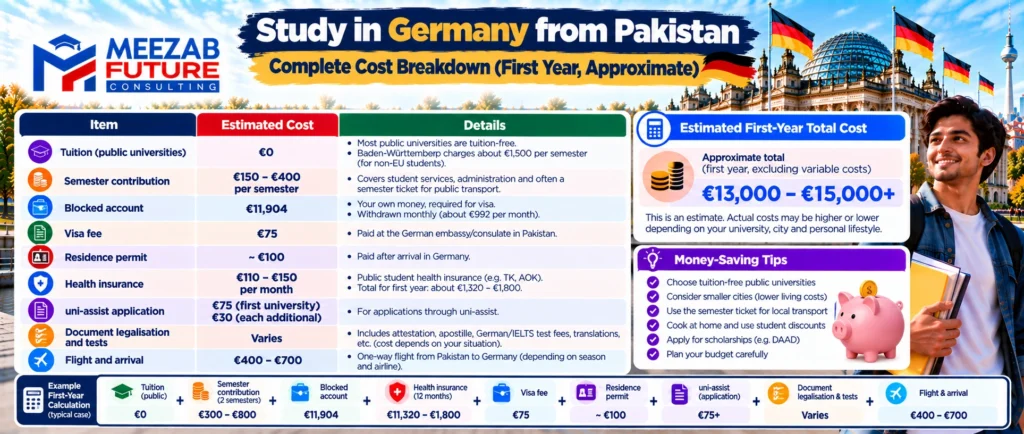
| Item | Estimate |
| Tuition (public) | €0 (except Baden-Württemberg, about €1,500 per semester) |
| Semester contribution | About €150 to €400 per semester |
| Blocked account | €11,904 (your own money, withdrawn monthly) |
| Visa fee | €75 |
| Residence permit | About €100 |
| Health insurance | About €110 to €150 per month |
| uni-assist application | About €75 first university, €30 each additional |
| Document legalisation and tests | Varies |
| Flight and arrival | About €400 to €700 |
Study in Germany from Pakistan: Document Checklist
- Passport
- Admission letter
- Transcripts and degrees (legalised)
- HEC-recognised documents
- Language proof
- Blocked account confirmation
- Health insurance
- CV and motivation letter
- References
- Photos (biometric)
- Study gap evidence
- Visa form and fee receipt
Study in Germany from Pakistan: Step-by-Step Checklist
- Course chosen
- Universities shortlisted
- Language test booked
- Documents legalised
- Application submitted
- Admission received
- Blocked account funded
- Health insurance bought
- Visa appointment booked
- Visa applied
- Visa received
- Accommodation booked
- Flight booked
- Address registered
- Residence permit applied
Frequently Asked Questions About Studying in Germany from Pakistan (2027)
How can I study in Germany from Pakistan?
Choose a programme, apply (uni-assist or directly), get your admission letter, fund a blocked account, arrange health insurance and apply for a student visa.
How much does it cost to study in Germany from Pakistan?
Public universities are tuition-free for most programmes, but you need about €11,904 in a blocked account for living costs, plus visa, insurance and semester fees.
What are the requirements to study in Germany?
A recognised qualification, language proof, passport, blocked account or other funding, health insurance and a visa.
Can I study in Germany after FSC?
Usually through a Studienkolleg, unless you also have extra university study that qualifies for conditional or direct entry.
Can I study in Germany after a bachelor’s degree?
Yes, for a master’s degree, with a HEC-recognised degree and relevant subjects.
Is IELTS required to study in Germany?
For English-taught programmes, usually yes or an accepted alternative. For German-taught programmes, you need German proof instead.
How much bank balance is required for a Germany student visa?
About €11,904 for one year (€992 per month) in a blocked account for 2026. Confirm the 2027 figure.
How long does a Germany student visa take?
Often 4 to 12 weeks after your appointment, but appointment waiting time can be much longer.
Can Pakistani students work in Germany while studying?
Yes, up to a set number of full or half days per year.
Can I get a scholarship to study in Germany?
Yes, through DAAD, universities and foundations, especially for master’s and PhD.
What are the intakes for international students?
Winter (October) and summer (April).
Can I study in Germany with a study gap?
Yes, if you can explain and document it.
Can I bring my family to Germany as a student?
Only under strict conditions.
Can I stay in Germany after completing my studies?
Yes, with an 18-month job search permit and then a work permit or Blue Card if you find a qualifying job.
How can Meezab Future Consulting help me study in Germany?
With programme selection, admissions, document legalisation, scholarship preparation, visa planning and pre-departure support.