What’s New for 2027 Students
- National study permit cap continues. Canada expects to issue about 408,000 study permits in 2026, made up of roughly 155,000 for new students and 253,000 extensions, and the cap affects mainly undergraduate, diploma and certificate applicants. Expect the cap system to continue into 2027, so confirm the latest numbers.
- PAL/TAL required for most undergraduates. Most applicants need a Provincial Attestation Letter (PAL) (or TAL for territories) from the province before IRCC processes the study permit. In Quebec, a CAQ (Quebec Acceptance Certificate) is needed first.
- Master’s and PhD exemption. From 1 January 2026, master’s and doctoral students at public Designated Learning Institutions (DLIs) no longer need a PAL/TAL and are outside the cap. They still must meet every other requirement, including proof of funds and a valid letter of acceptance.
- Higher proof of funds from 1 September 2026. For study permit applications submitted on or after 1 September 2026, a single applicant studying outside Quebec must show at least CAD 23,448 for living expenses, up from CAD 22,895, plus first-year tuition and travel costs. IRCC now adjusts this amount every year.
- Closer scrutiny of financial documents. Updated officer instructions in July 2026 mean financial evidence is checked more closely. Keep your documents clean, consistent and traceable.
- No more Student Direct Stream. The SDS programme ended in 2024, so there is no faster “GIC route”. A GIC can still be used as proof of funds, but it is not required.
- Work rules. Eligible students can work up to 24 hours per week off campus during academic sessions, and full-time during scheduled breaks.
- PGWP rules. The Post-Graduation Work Permit now requires language proof (CLB 7 for degree graduates, CLB 5 for college graduates), and college/non-degree graduates need an eligible field of study. IRCC froze the field-of-study list for 2026.
Why Study in Canada from Pakistan?
Benefits for Pakistani Students
- High-quality, globally recognised degrees at universities and colleges
- A safe, multicultural country with large Pakistani and Muslim communities
- Post-Graduation Work Permit of up to three years for eligible graduates
- Research funding for master’s and PhD students
- Strong programmes in technology, engineering, healthcare, business and trades
- Halal food, mosques and community support in most major cities
Is Canada a Good Destination?
Yes, especially for graduate students and those entering in-demand fields, but the rules have become much tighter. The main challenges are the cap and PAL system, higher funds requirements, housing shortages, rising costs, a harder permanent residence path and historically high refusal rates for some applicant profiles. Plan carefully and avoid agents who promise guaranteed approval.
Who Can Study in Canada from Pakistan?
- After Matric: You cannot enter a degree directly. Complete FSc/Intermediate or A Levels first.
- After Intermediate/FSc: You may apply for diploma, certificate or some bachelor’s programmes, but undergraduate and college routes are the most affected by the cap and PAL system. Some universities require A Levels, a foundation year or additional qualifications.
- After A Levels: A stronger route for bachelor’s admission at universities.
- After Bachelor’s: Apply for a master’s degree (usually 1 to 2 years) or a graduate diploma/certificate. A 16-year degree is generally required for master’s entry.
- After Master’s: Apply for a PhD, often with a funded supervisor and PAL exemption at public universities.
- With a study gap: Possible, but explain it clearly with documents. Gaps without a convincing reason are a common refusal factor.
Canadian Education System Explained
- Undergraduate degrees: Bachelor’s usually takes 4 years (3 years in some cases).
- Postgraduate degrees: Master’s takes 1 to 2 years, and graduate certificates take less.
- PhD: Usually 4 to 6 years, often funded.
- Colleges and polytechnics: Offer diplomas, advanced diplomas and certificates, often with co-op and practical training. PGWP eligibility depends on the field of study for these programmes.
- Public vs private institutions: Only programmes at eligible public DLIs (and some specific private institutions) qualify for the PGWP, so check this carefully.
- Intakes: Fall (September) is the main intake, with Winter (January) and Summer/Spring (May) at many institutions.
- Quebec: Needs a CAQ and has its own rules and French-language environment.
Study Requirements for Pakistani Students in Canada
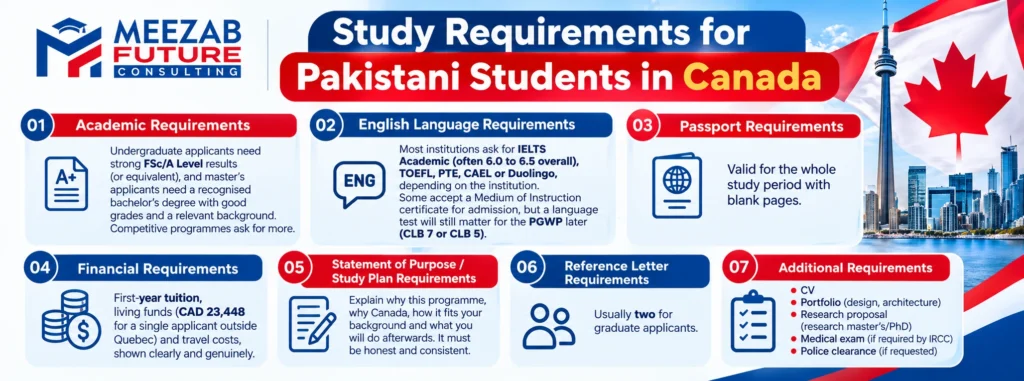
Academic requirements: Undergraduate applicants need strong FSc/A Level results (or equivalent), and master’s applicants need a recognised bachelor’s degree with good grades and a relevant background. Competitive programmes ask for more.
English language requirements: Most institutions ask for IELTS Academic (often 6.0 to 6.5 overall), TOEFL, PTE, CAEL or Duolingo, depending on the institution. Some accept a Medium of Instruction certificate for admission, but a language test will still matter for the PGWP later (CLB 7 or CLB 5).
Passport requirements: Valid for the whole study period with blank pages.
Financial requirements: First-year tuition, living funds (CAD 23,448 for a single applicant outside Quebec) and travel costs, shown clearly and genuinely.
Statement of purpose/study plan requirements: Explain why this programme, why Canada, how it fits your background and what you will do afterwards. It must be honest and consistent.
Reference letter requirements: Usually two for graduate applicants.
Additional requirements: CV, portfolio (design, architecture), research proposal (research master’s/PhD), medical exam (if required by IRCC) and police clearance (if requested).
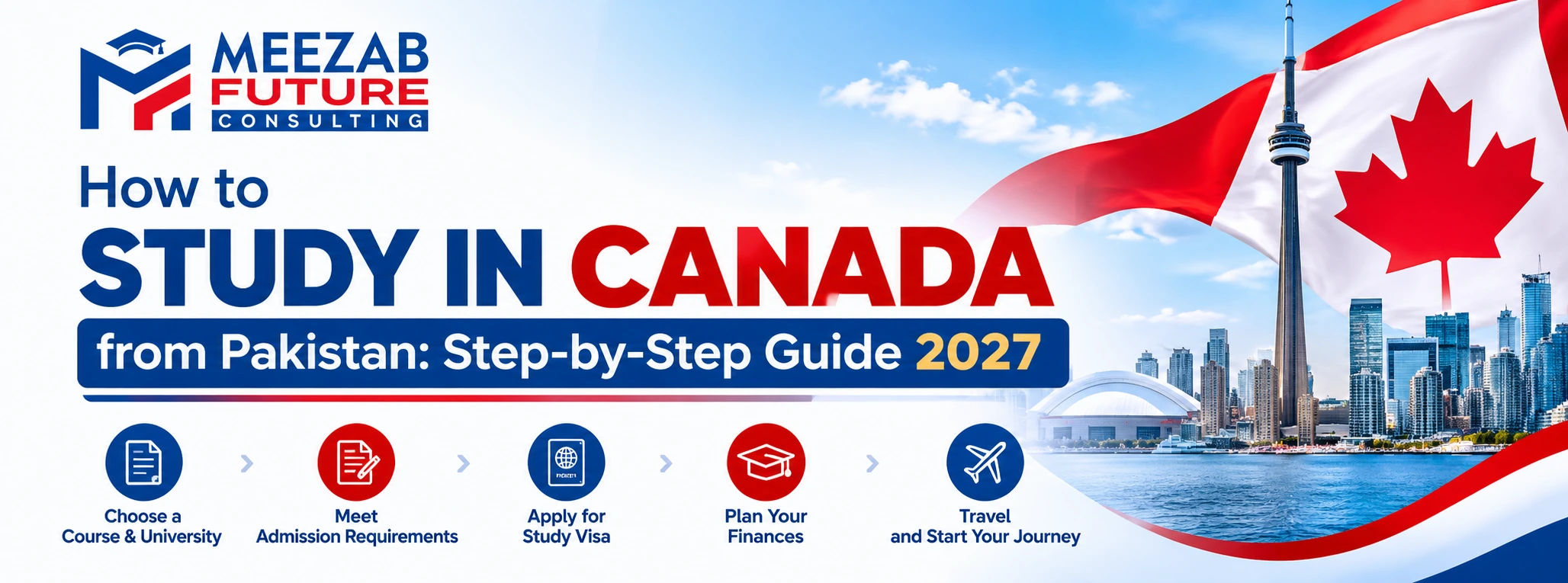
Step-by-Step: How to Study in Canada from Pakistan
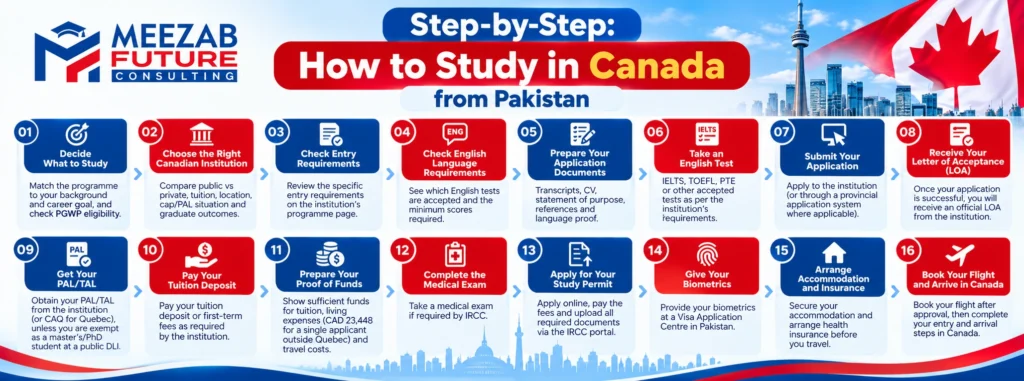
- Decide what to study. Match the programme to your background and career goal, and check PGWP eligibility.
- Choose the right Canadian institution. Compare public vs private, tuition, location, cap/PAL situation and graduate outcomes.
- Check entry requirements on the institution’s programme page.
- Check English language requirements.
- Prepare your application documents. Transcripts, CV, statement of purpose, references, language proof.
- Take an English test (IELTS, TOEFL, PTE, etc.).
- Submit your application to the institution (or through a provincial application system where applicable).
- Receive your Letter of Acceptance (LOA).
- Get your PAL/TAL from the institution (or CAQ for Quebec), unless you are exempt as a master’s/PhD student at a public DLI.
- Pay your tuition deposit or first-term fees as required.
- Prepare your proof of funds and study permit documents.
- Complete the medical exam if required.
- Apply for your study permit online, pay fees and upload documents.
- Give your biometrics at a Visa Application Centre in Pakistan.
- Arrange accommodation and health insurance.
- Book your flight after approval, then complete your entry and arrival steps in Canada.
Documents Required to Study in Canada from Pakistan
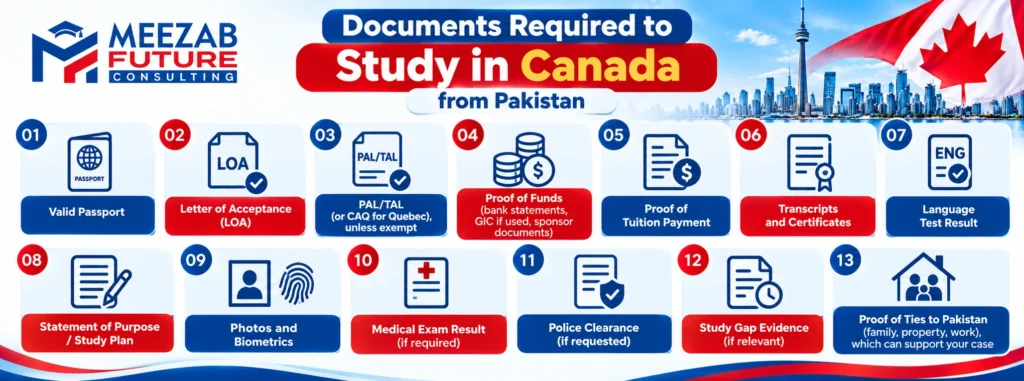
- Valid passport
- Letter of Acceptance (LOA)
- PAL/TAL (or CAQ for Quebec), unless exempt
- Proof of funds (bank statements, GIC if used, sponsor documents)
- Proof of tuition payment
- Transcripts and certificates
- Language test result
- Statement of purpose/study plan
- Photos and biometrics
- Medical exam result (if required)
- Police clearance (if requested)
- Study gap evidence, if relevant
- Proof of ties to Pakistan (family, property, work), which can support your case
Best Canadian Universities for Pakistani Students
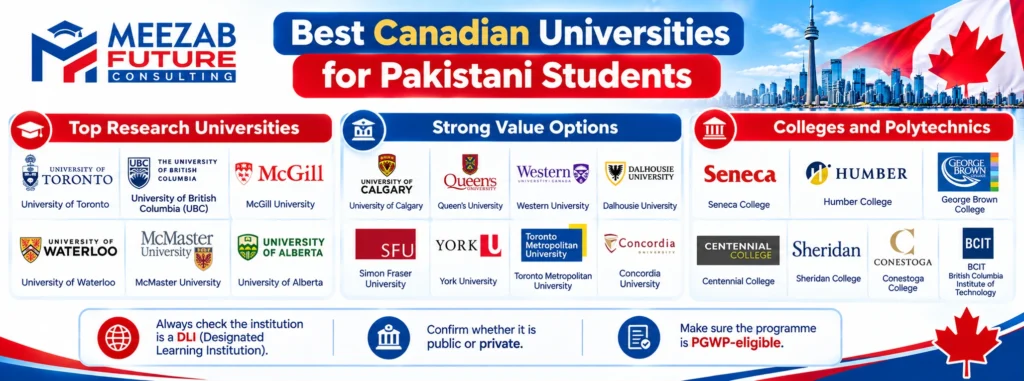
- Top research universities: University of Toronto, University of British Columbia (UBC), McGill University, University of Waterloo, McMaster University, University of Alberta
- Strong value options: University of Calgary, Queen’s University, Western University, Dalhousie University, Simon Fraser University, York University, Toronto Metropolitan University, Concordia University
- Colleges and polytechnics: Seneca, Humber, George Brown, Centennial, Sheridan, Conestoga, BCIT and others, only after checking PGWP field-of-study eligibility
Always check the institution is a DLI, whether it is public or private, and whether the programme is PGWP-eligible.
Popular Courses to Study in Canada
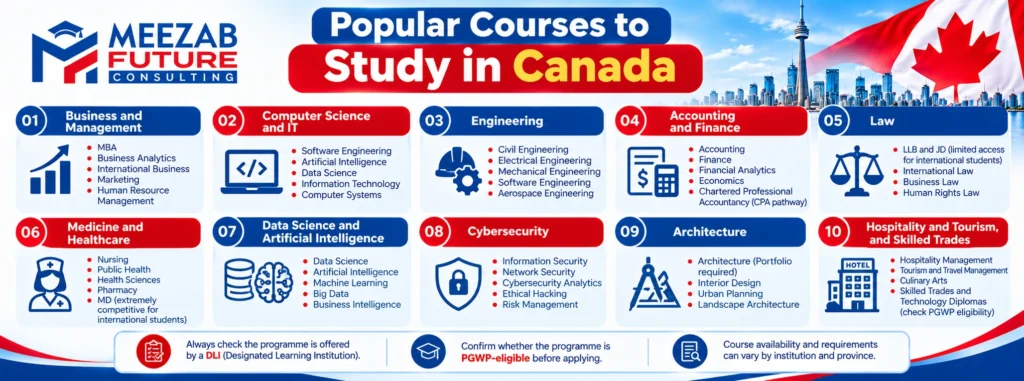
- Business and Management: MBA, business analytics
- Computer Science and IT: Software, AI, data
- Engineering: Civil, electrical, mechanical, software
- Accounting and Finance
- Law: Limited access for international students
- Medicine and Healthcare: Nursing, public health, health sciences (MD is extremely competitive)
- Data Science and Artificial Intelligence
- Cybersecurity
- Architecture: Portfolio required
- Hospitality and Tourism, and skilled trades and technology diplomas at colleges (check PGWP eligibility)
Cost of Studying in Canada from Pakistan
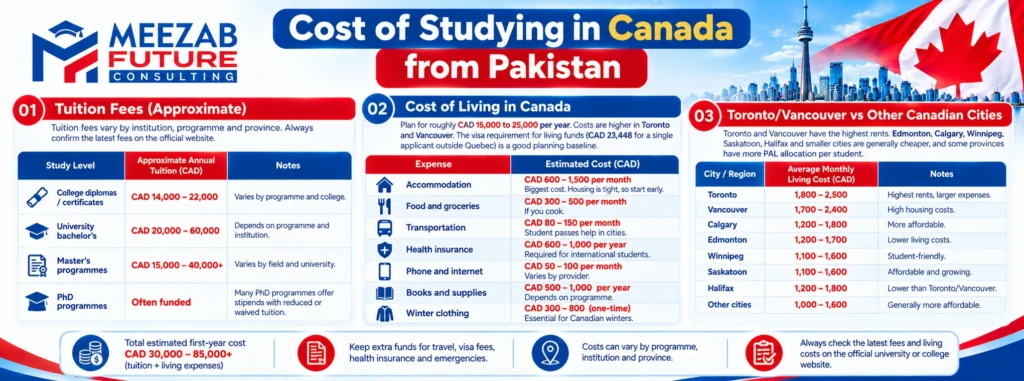
Tuition Fees (approximate, confirm with each institution)
- College diplomas/certificates: roughly CAD 14,000 to 22,000 per year
- University bachelor’s: roughly CAD 20,000 to 60,000 per year, depending on programme and institution
- Master’s programmes: roughly CAD 15,000 to 40,000+ per year
- PhD programmes: Often funded, with reduced or waived tuition through stipends
Cost of Living
Plan for roughly CAD 15,000 to 25,000 per year, with higher costs in Toronto and Vancouver. The visa requirement for living funds (CAD 23,448 for a single applicant outside Quebec) is a good planning baseline.
- Accommodation costs: The biggest cost. Housing is tight, so start early.
- Food and grocery costs: About CAD 300 to 500 per month if you cook.
- Transportation costs: Student passes help in cities.
- Other student expenses: Health insurance, phone, winter clothing, books.
Toronto/Vancouver vs Other Canadian Cities
Toronto and Vancouver have the highest rents. Edmonton, Calgary, Winnipeg, Saskatoon, Halifax and smaller cities are generally cheaper, and some provinces have more PAL allocation per student.
Canada Student Visa Requirements for Pakistani Students
Canada Study Permit Application Process from Pakistan
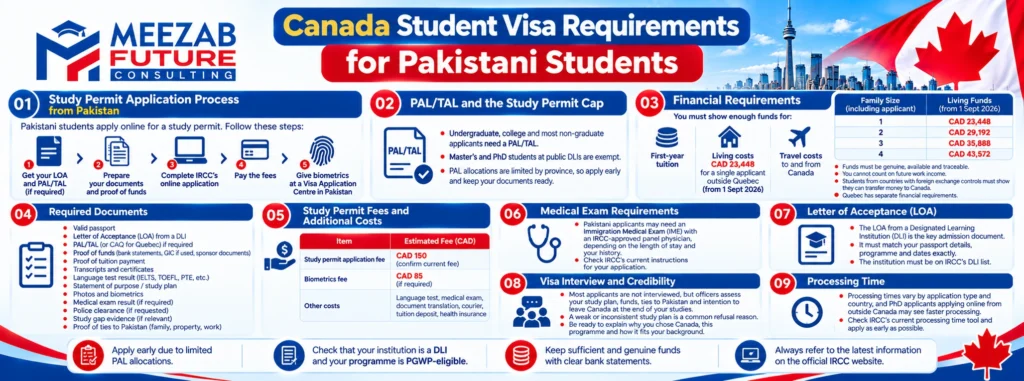
Pakistani students apply online for a study permit (Canada does not use a separate “student visa” for study; the study permit is the main document, and a visitor visa/eTA may be issued with it). Steps include: get your LOA and PAL/TAL (if required), prepare proof of funds, complete IRCC’s online application, pay the fees and give biometrics at a Visa Application Centre in Pakistan.
PAL/TAL and the Study Permit Cap
Undergraduate, college and most non-graduate applicants need a PAL/TAL. Master’s and PhD students at public DLIs are exempt. Because PAL allocations are limited by province, apply early and keep your documents ready.
Financial Requirements for Canada Study Permit
You must show enough funds for:
- First-year tuition
- Living costs: CAD 23,448 for a single applicant outside Quebec (applications submitted on or after 1 September 2026), with higher amounts for family members
- Travel costs to and from Canada
| Family size (including applicant) | Living funds (from 1 Sept 2026) |
| 1 | CAD 23,448 |
| 2 | CAD 29,192 |
| 3 | CAD 35,888 |
| 4 | CAD 43,572 |
Funds must be genuine, available and traceable, and you cannot count on future work income. Students from countries with foreign exchange controls must also show they can transfer money to Canada. Quebec has separate financial requirements.
Study Permit Fees and Additional Costs
- Study permit application fee: about CAD 150 (confirm)
- Biometrics fee: about CAD 85 (if required)
- Other costs: Language test, medical exam, document translation, courier, tuition deposit, health insurance
Medical Exam Requirements
Pakistani applicants may need an Immigration Medical Exam (IME) with an IRCC-approved panel physician, depending on the length of stay and your history. Check IRCC’s current instructions for your application.
Letter of Acceptance: What It Is and Why It Matters
The LOA from a Designated Learning Institution (DLI) is the key admission document. It must match your passport details, programme and dates exactly, and the institution must be on IRCC’s DLI list.
Visa Interview and Credibility Requirements
Most applicants are not interviewed, but officers assess your study plan, funds, ties to Pakistan and intention to leave Canada at the end of your studies. A weak or inconsistent study plan is a common refusal reason. Be ready to explain why you chose Canada, this programme and how it fits your background.
Study Permit Processing Time
Processing times vary by application type and country, and PhD applicants applying online from outside Canada may see faster processing. Check IRCC’s current processing time tool and apply as early as possible.
Scholarships for Pakistani Students in Canada
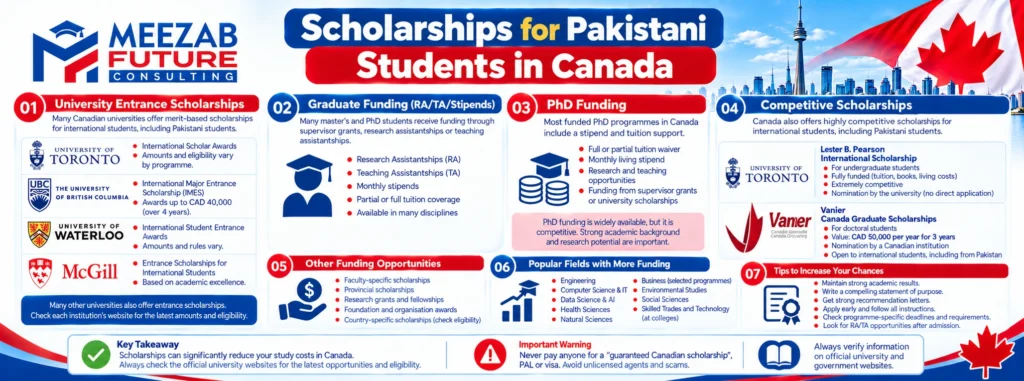
- University entrance scholarships: Merit-based awards at many universities (for example, awards at Waterloo, UBC, Toronto and others, with amounts and rules varying).
- Graduate funding (RA/TA/stipends): Many master’s and PhD students are funded by supervisor grants, research assistantships or teaching assistantships.
- PhD funding: Most funded PhD programmes include a stipend and tuition support.
- Competitive scholarships: Examples include the Lester B. Pearson International Scholarship at the University of Toronto for undergraduates and Vanier scholarships for doctoral students (nomination rules apply). Check eligibility carefully.
- Other funding: Foundation and country-specific awards.
Beware: Never pay anyone for a “guaranteed Canadian scholarship”, PAL or visa, and avoid unlicensed agents.
Intakes and Application Deadlines for 2027
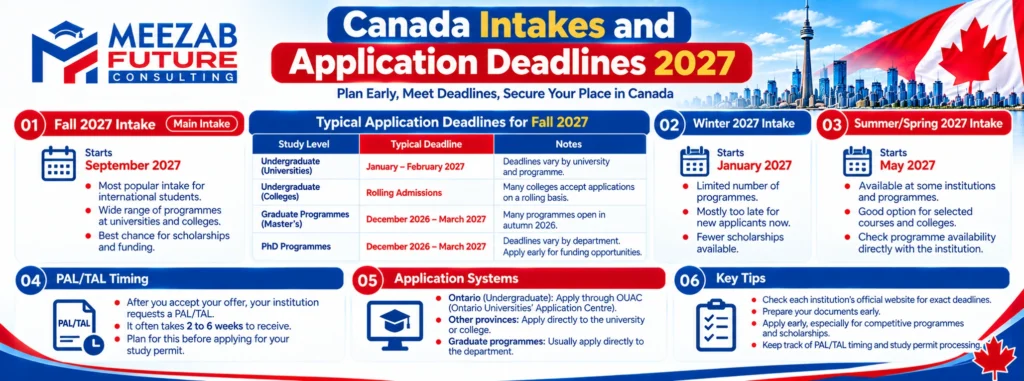
- Fall 2027 (September): The main intake. Graduate programme deadlines commonly fall between December 2026 and March 2027, and many open in autumn 2026. Undergraduate deadlines often fall around January to February for universities, while colleges often use rolling admissions.
- Winter 2027 (January): Limited and mostly too late for new applicants now.
- Summer/Spring (May): Available at some institutions and programmes.
- PAL timing: After you accept your offer, your institution requests a PAL/TAL (often taking 2 to 6 weeks). Plan for this before applying for your permit.
Application systems: Some provinces use central systems (for example, OUAC in Ontario for undergraduates), and graduate programmes usually apply directly to the department.
Best Canadian Cities for Pakistani Students
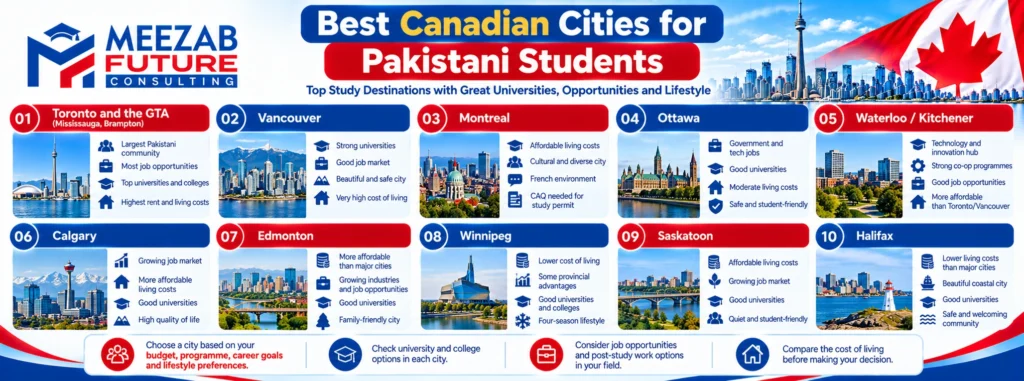
- Toronto and the GTA (Mississauga, Brampton): Largest Pakistani community, most jobs, highest rent
- Vancouver: Strong universities, very high cost
- Montreal: Affordable and cultural, French environment and CAQ needed
- Ottawa: Capital with government and tech jobs
- Waterloo/Kitchener: Technology and co-op hub
- Calgary and Edmonton: More affordable, growing job markets
- Winnipeg and Saskatoon: Lower cost with some provincial advantages
- Halifax: Atlantic university city with lower costs
- London (Ontario): Western University, mid-range costs
- Hamilton: McMaster University, mid-range costs
Accommodation Options for Pakistani Students in Canada
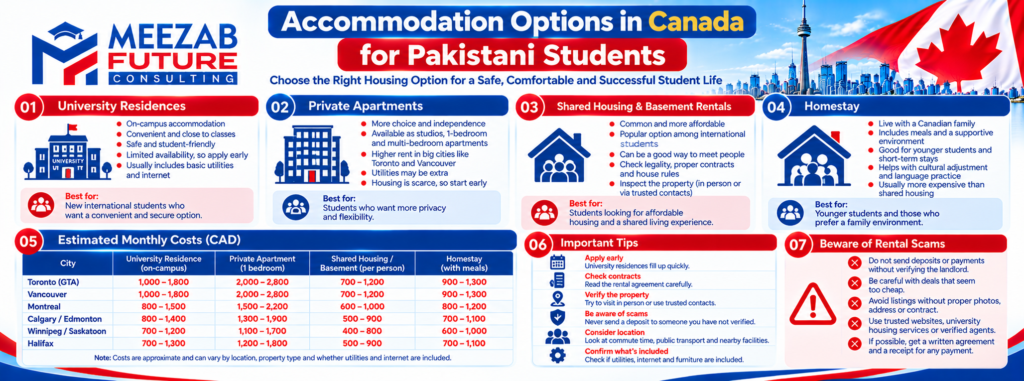
- University residences: Convenient but limited, so apply early.
- Private apartments: More choice, but housing is scarce and expensive in big cities.
- Shared housing and basement rentals: Common and cheaper, but check legality and contracts.
- Homestay: Common for younger students and short-term stays.
Never send a deposit to someone you have not verified, and watch for rental scams.
Part-Time Work for Pakistani Students in Canada
Eligible students can work on campus and off campus up to 24 hours per week during academic sessions, and full-time during scheduled breaks, provided their study permit allows it. Some students cannot work, including those in language-only or prerequisite programmes. You must apply for a Social Insurance Number (SIN), and exceeding the hour limit can put your status and PGWP eligibility at risk. Do not rely on work income to fund your studies.
Post-Study Work Options in Canada
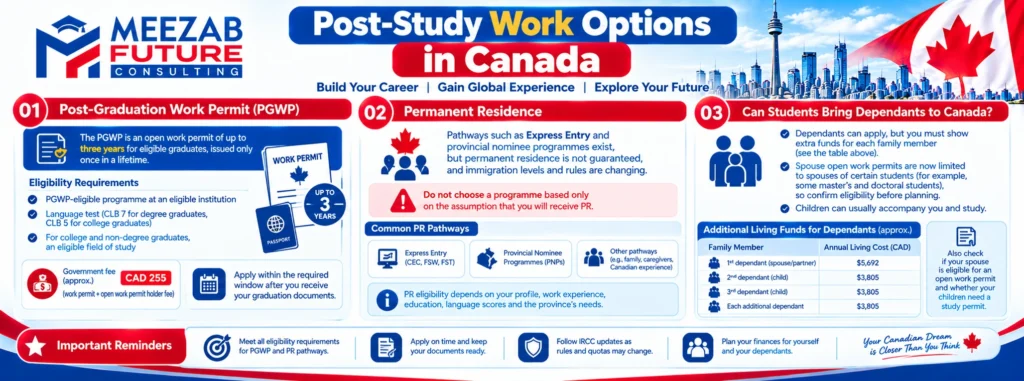
Post-Graduation Work Permit (PGWP)
The PGWP is an open work permit of up to three years for eligible graduates, issued only once in a lifetime. Requirements include a PGWP-eligible programme at an eligible institution, a language test (CLB 7 for degree graduates, CLB 5 for college graduates), and, for college and non-degree graduates, an eligible field of study. The government fee has been about CAD 255 (work permit plus open work permit holder fee). Apply within the required window after you receive your graduation documents.
Permanent Residence
Pathways such as Express Entry and provincial nominee programmes exist, but permanent residence is not guaranteed, and immigration levels and rules are changing. Do not choose a programme based only on the assumption that you will receive PR.
Can Students Bring Dependants to Canada?
Dependants can apply, but you must show extra funds for each family member (see the table above). Spouse open work permits are now limited to spouses of certain students (for example, some master’s and doctoral students), so confirm eligibility before planning. Children can usually accompany you and study.
Life as a Pakistani Student in Canada
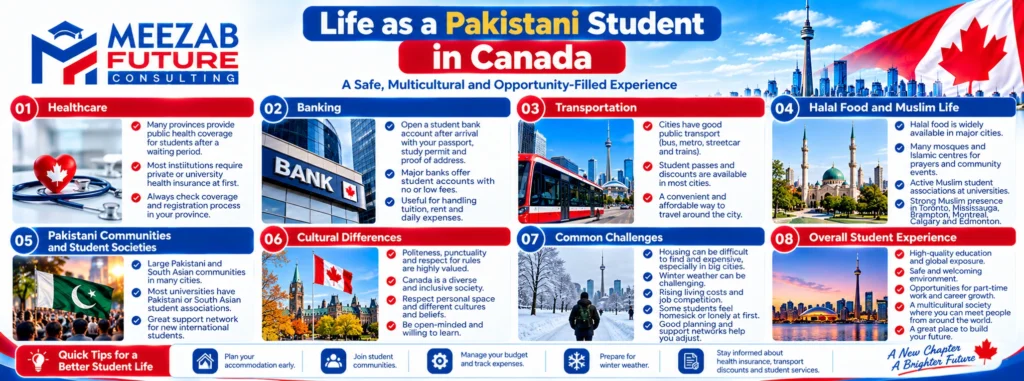
- Healthcare: Many provinces provide public health coverage for students after a waiting period, and most institutions require private or university health insurance at first.
- Banking: Open a student bank account after arrival with your passport, study permit and proof of address.
- Transportation: Cities have good public transport, with student passes and discounts.
- Halal food and Muslim life: Halal food, mosques and Muslim student associations are widely available, especially in Toronto, Mississauga, Brampton, Montreal, Calgary and Edmonton.
- Pakistani communities and student societies: Most universities have Pakistani or South Asian student associations.
- Cultural differences: Politeness, punctuality, diversity and respect for personal space are valued.
- Common challenges: Housing, winter weather, rising costs, job competition and loneliness.
Budget and Practical Tips
- How to manage your budget: Track spending, cook at home, use student discounts and buy second-hand items.
- How to find affordable accommodation: Apply to residence early, share housing and consider smaller cities.
- Common mistakes to avoid:
- Choosing a private college without checking PGWP eligibility
- Ignoring the PAL/TAL requirement (or not knowing you are exempt)
- Submitting unclear, borrowed or fake financial documents
- Using agents who promise guaranteed approval
- A weak or copied study plan
- Exceeding work hours
- Booking flights or housing before the permit is approved
- Not meeting the language requirement for the PGWP
- How to choose the right institution and course: Check DLI status, public vs private, PGWP eligibility, PAL status, funding and graduate outcomes. Compare at least five options.
- How to choose by budget: Look for funded graduate programmes, public institutions and lower-cost provinces.
- Big cities vs smaller cities: Choose big cities for networks, smaller cities for savings.
- Study in Canada on a low budget: Target funded master’s/PhD programmes and lower-cost provinces, and avoid expensive private colleges.
Study in Canada Without IELTS
Can Pakistani Students Study in Canada Without IELTS?
Sometimes. Many institutions accept TOEFL, PTE, CAEL or Duolingo, and some accept a Medium of Instruction (MOI) certificate. However, for the PGWP you must later prove language ability (CLB 7 or 5) with an approved test, so plan for it early.
Quick Answers
- Can Pakistani students work while studying in Canada? Yes, up to 24 hours per week off campus during academic sessions, if their permit allows it.
- Can students bring dependants? Yes, but you must show extra funds, and spouse work permits are limited.
- Can Pakistani students stay in Canada after graduation? Yes, through the PGWP if eligible, and possibly permanent residence later, though PR is not guaranteed.
What to Do After Receiving Your Canada Study Perm
Pre-Departure Checklist for Pakistani Students
- Check your port of entry letter and permit details
- Confirm accommodation and arrival date
- Arrange health insurance
- Prepare your LOA, passport, proof of funds and tuition receipt in hand luggage
- Arrange Canadian dollars and a card
- Check your institution’s orientation and start dates
What to Pack When Moving to Canada
Passport, port of entry letter, LOA, certificates (with copies), warm winter clothing, adaptors (North American plugs), medicines with prescriptions, laptop and some familiar food (check airline and import rules).
First Week in Canada
Complete entry and ID checks at the border, check in with your international student office, attend orientation, apply for a SIN if eligible, open a bank account, get a SIM, register for classes and learn your transport options.
How Meezab Future Consulting Helps Pakistani Students Study in Canada
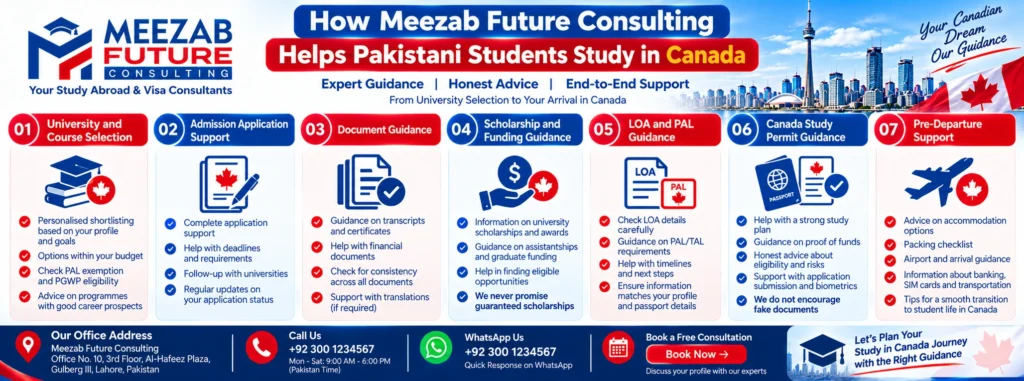
- University and course selection: Realistic shortlisting based on profile, budget, PAL exemption and PGWP eligibility
- Admission application support: Applications, deadlines and follow-up
- Document guidance: Transcripts, financial documents and consistency checks
- Scholarship and funding guidance: University awards, assistantships and graduate funding (we never promise guaranteed scholarships)
- LOA and PAL guidance: Checking details and timelines
- Canada study permit guidance: Study plan, proof of funds and honest advice about risks
- Pre-departure support: Housing, packing and arrival planning
(Add your office address, phone, WhatsApp and booking link. Avoid “guaranteed visa/PAL/PR” claims and never encourage fake documents.)
Study in Canada from Pakistan: Complete Application Timeline (Fall 2027)
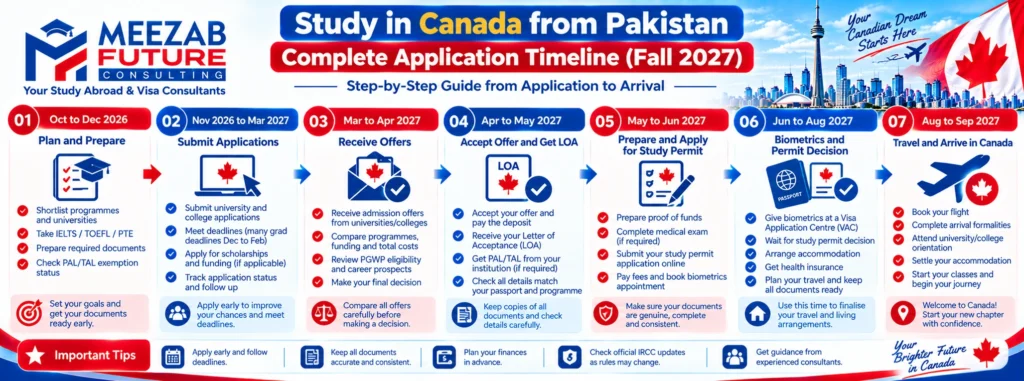
| When | What to do |
| Oct to Dec 2026 | Shortlist programmes, take IELTS/TOEFL/PTE, prepare documents, check PAL/exemption status |
| Nov 2026 to Mar 2027 | Submit applications (many grad deadlines Dec to Feb), apply for funding |
| Mar to Apr 2027 | Receive offers, compare funding and costs |
| Apr to May 2027 | Accept offer, pay deposit, receive LOA and PAL/TAL (if required) |
| May to Jun 2027 | Prepare proof of funds, complete medical exam, apply for study permit |
| Jun to Aug 2027 | Biometrics, permit decision, accommodation, insurance |
| Aug to Sep 2027 | Travel, arrival steps and orientation |
Study in Canada from Pakistan: Complete Cost Breakdown (first year, approximate)
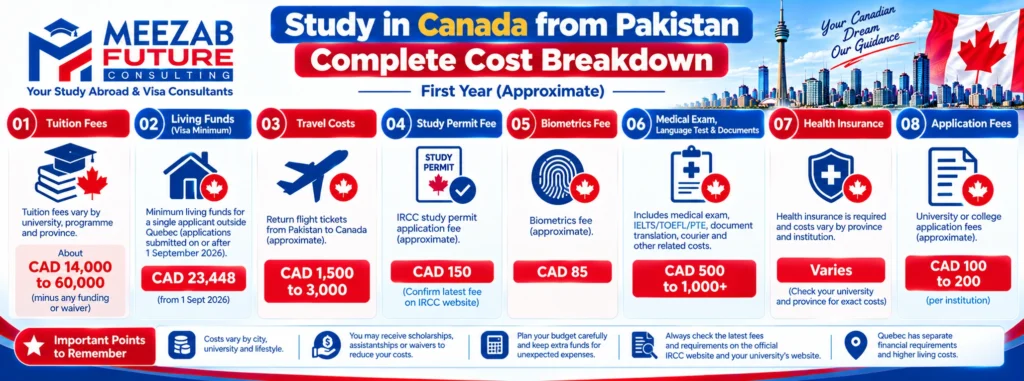
| Item | Estimate |
| Tuition | About CAD 14,000 to 60,000 (minus any funding or waiver) |
| Living funds (visa minimum, single, outside Quebec) | CAD 23,448 (from 1 Sept 2026) |
| Travel costs | About CAD 1,500 to 3,000 |
| Study permit fee | About CAD 150 (confirm) |
| Biometrics fee | About CAD 85 |
| Medical exam, language test, documents | About CAD 500 to 1,000+ |
| Health insurance | Varies by province and institution |
| Application fees | About CAD 100 to 200 per institution |
Study in Canada from Pakistan: Document Checklist
- ☐ Passport
- ☐ Letter of Acceptance (LOA)
- ☐ PAL/TAL (or CAQ), unless exempt
- ☐ Proof of funds
- ☐ Proof of tuition payment
- ☐ Transcripts and certificates
- ☐ Language test result
- ☐ Study plan/statement of purpose
- ☐ Photos and biometrics
- ☐ Medical exam (if required)
- ☐ Police clearance (if requested)
- ☐ Study gap evidence
- ☐ Proof of ties to Pakistan
Study in Canada from Pakistan: Step-by-Step Checklist
- ☐ Course chosen
- ☐ Institutions shortlisted
- ☐ Language test booked
- ☐ Applications submitted
- ☐ LOA received
- ☐ PAL/TAL received (or exempt)
- ☐ Tuition deposit paid
- ☐ Proof of funds prepared
- ☐ Medical exam done
- ☐ Study permit applied
- ☐ Biometrics given
- ☐ Permit approved
- ☐ Accommodation booked
- ☐ Flight booked
Frequently Asked Questions About Studying in Canada from Pakistan (2027)
How can I study in Canada from Pakistan?
Apply to a Designated Learning Institution (DLI), receive your LOA (and PAL/TAL if required), prepare proof of funds, apply for a study permit online and give your biometrics.
How much does it cost to study in Canada from Pakistan?
Costs vary widely. Tuition is roughly CAD 14,000 to 60,000 per year, plus living funds of at least CAD 23,448 for a single applicant outside Quebec for the visa, and travel costs.
What are the requirements to study in Canada?
Academic qualifications, language proof, passport, proof of funds, LOA, PAL/TAL (if required) and a study permit.
Can I study in Canada after FSC?
Yes, but mainly through college diplomas or some bachelor’s programmes, and the PAL/cap system and PGWP rules apply, so check carefully.
Can I study in Canada after a bachelor’s degree?
Yes, for a master’s degree or graduate diploma, and master’s students at public DLIs are exempt from the PAL.
Is IELTS required to study in Canada?
Not always for admission, as many institutions accept TOEFL, PTE, CAEL or Duolingo or an MOI certificate, but you need approved language proof for the PGWP later.
How much bank balance is required for a Canada study permit?
First-year tuition plus CAD 23,448 (single applicant outside Quebec, for applications on or after 1 September 2026), plus travel costs. Higher amounts apply for family members.
How long does a Canada study permit take?
Processing times vary, so check IRCC’s current tool. PhD applicants applying online from outside Canada may see faster processing.
Can Pakistani students work in Canada while studying?
Yes, up to 24 hours per week off campus during academic sessions, if their permit allows it.
Can I get a scholarship to study in Canada?
Yes, through university scholarships, graduate funding (RA/TA) and some competitive awards. Funding is most common at master’s and PhD level.
What are the intakes for international students?
Mainly Fall (September), with Winter (January) and Summer (May) at many institutions.
Can I study in Canada with a study gap?
Yes, if you can explain and document it clearly.
Can I bring my family to Canada as a student?
Yes, but you must show extra funds, and spouse work permits are limited to certain categories.
Can I stay in Canada after completing my studies?
Yes, through the PGWP if eligible, and possibly permanent residence later, but PR is not guaranteed.
Do master’s students need a PAL?
No, if enrolling in a master’s or doctoral programme at a public DLI, from 1 January 2026.
How can Meezab Future Consulting help me study in Canada?
With institution selection, applications, funding preparation, study permit guidance and pre-departure planning, with honest advice about risks.