What’s New for 2027 Students
- CSC scholarship for Pakistan. For 2026-27, the Chinese Government Scholarship offered 75 seats to Pakistani students through HEC (35 bachelor’s, 25 master’s, 15 PhD), with the HEC portal deadline on 5 January 2026. The 2027-28 round is expected to follow a similar timeline, usually announced in late autumn with a deadline around the turn of the year, but confirm the exact dates on the HEC and CSC portals.
- CSCA test for undergraduates. The China Scholastic Competency Assessment (CSCA) is mandatory for all applicants seeking admission to undergraduate programmes in China, including those applying through HEC and those applying directly under other Chinese Government Scholarship categories.
- Visa fee exemption. Pakistani passport holders were reported to be exempt from the Chinese visa fee through 31 December 2026. Check whether this has been extended into 2027.
- X1 visa and residence permit. If you study for more than 180 days, you enter on an X1 visa, which is only a short entry permit. You must convert it into a residence permit within 30 days of arrival.
- Work rules. Students can take part-time jobs or internships only after the university approves and the Exit-Entry Administration adds a work-study notation to the residence permit. There is no automatic post-study work visa.
- Medical degrees. Pakistani MBBS students must verify the university’s recognition by the Pakistan Medical Commission (PMC) and the current licensing rules before paying any fees.
Why Study in China from Pakistan?
Benefits for Pakistani Students
- Affordable tuition and living costs compared with the UK, USA, Canada and Australia
- Fully funded scholarships such as the Chinese Government Scholarship
- Hundreds of English-taught programmes, especially in medicine, engineering and business
- Strong Pakistan-China relations and a large Pakistani student community
- World-class technology, engineering and research universities
- Halal food is widely available, with Muslim canteens on many campuses
Is China a Good Destination?
Yes, especially for engineering, medicine, technology and Chinese language studies, and for students seeking scholarships. The main challenges are the language barrier, internet and app differences, limited post-study work options and the need to carefully verify degree recognition back in Pakistan (especially for MBBS, engineering and law).
Who Can Study in China from Pakistan?
- After Matric: You cannot enrol in a degree directly. Complete FSc/Intermediate or A Levels first.
- After Intermediate/FSc: You can apply for bachelor’s programmes. Chinese-taught programmes usually need a Chinese language preparatory year, and CSC undergraduate applicants must sit the CSCA.
- After A Levels: Strong option for undergraduate admission in English-taught programmes.
- After Bachelor’s: Apply for a master’s degree (usually 2 to 3 years).
- After Master’s: Apply for a PhD (usually 3 to 4 years), often with a supervisor’s acceptance.
- With a study gap: Possible, but explain it clearly with documents. Some scholarship programmes also require you not to be enrolled in an incomplete degree at the deadline.
Chinese Education System Explained
- Undergraduate degrees: Usually 4 years (medicine 5 to 6 years, including internship).
- Postgraduate degrees: Master’s takes 2 to 3 years.
- Doctoral studies: 3 to 4 years.
- Chinese language preparatory year: Required for most Chinese-taught programmes and for scholarship students who need language training.
- Language of instruction: Chinese-taught programmes are more numerous and cheaper, while English-taught programmes are fewer but growing, especially at master’s level and in medicine.
- Types of universities: Project 985/211 and Double First-Class universities are the top research institutions. Other provincial and specialised universities may offer easier admission and good value.
Study Requirements for Pakistani Students in China
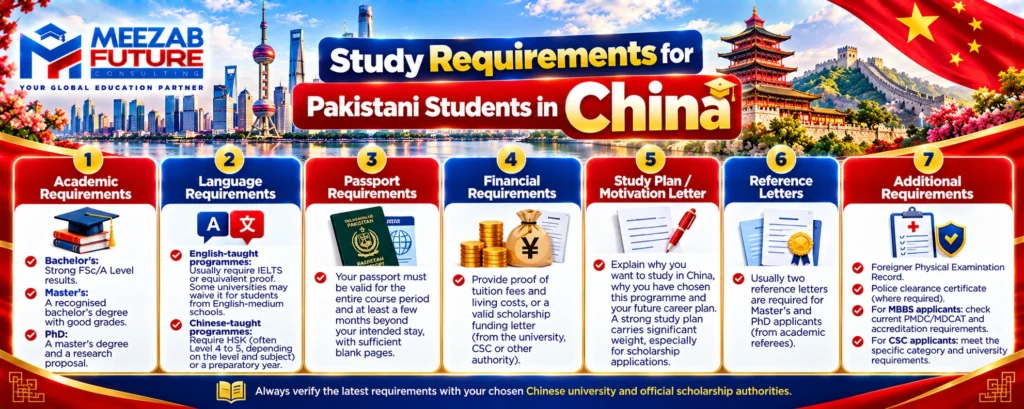
Academic requirements: Bachelor’s applicants need strong FSc/A Level results. Master’s applicants need a recognised bachelor’s degree with good grades, and PhD applicants usually need a master’s degree and a research proposal.
Language requirements: English-taught programmes usually ask for IELTS or equivalent proof, although some universities waive it for students from English-medium schools. Chinese-taught programmes require HSK (often HSK 4 to 5, depending on level and subject) or a preparatory year.
Passport requirements: Valid for the whole course and at least a few months more, with blank pages.
Financial requirements: Proof of tuition plus living costs, or a scholarship letter.
Study plan/motivation letter requirements: Explain why China, why this programme and your career plan. For scholarships, it carries significant weight.
Reference letter requirements: Usually two for master’s and PhD applicants.
Additional requirements: Foreigner Physical Examination Record, police clearance (for many programmes), MDCAT and PMC checks for MBBS, and for CSC applicants, the specific category and university requirements.
Step-by-Step: How to Study in China from Pakistan
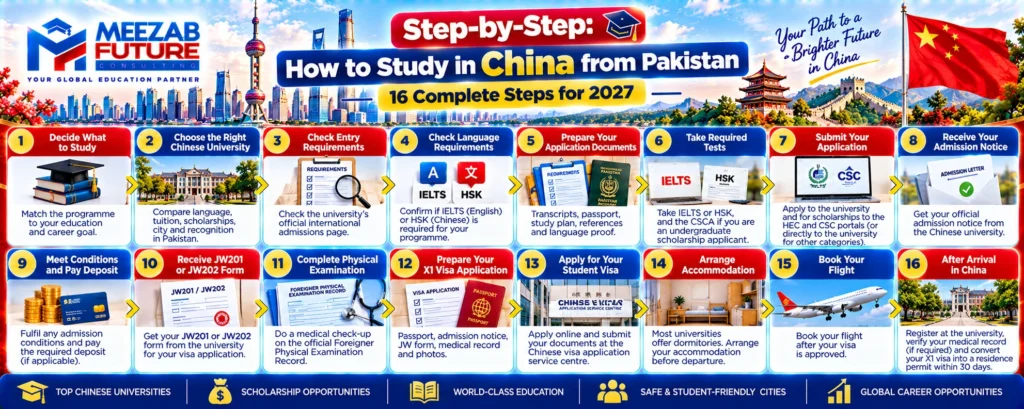
- Decide what to study. Match the programme to your education and career goal.
- Choose the right Chinese university. Compare language, tuition, scholarships, city and recognition in Pakistan.
- Check entry requirements on the university’s international admissions page.
- Check language requirements (English or Chinese).
- Prepare your application documents. Transcripts, passport, study plan, references, language proof.
- Take a language test (IELTS or HSK), and the CSCA if you are an undergraduate scholarship applicant.
- Submit your application to the university, and for scholarships to the HEC and CSC portals (or directly to the university for other categories).
- Receive your admission notice.
- Meet your admission conditions and pay any required deposit.
- Receive your JW201 or JW202 form from the university.
- Complete the physical examination on the official Foreigner Physical Examination Record.
- Prepare your X1 visa application. Passport, admission notice, JW form, medical record, photos.
- Apply for your student visa online and through the visa application service centre.
- Arrange accommodation (most universities offer dormitories).
- Book your flight after the visa is approved.
- After arrival: register at the university, verify your medical record if required and convert your X1 visa into a residence permit within 30 days.
Documents Required to Study in China from Pakistan
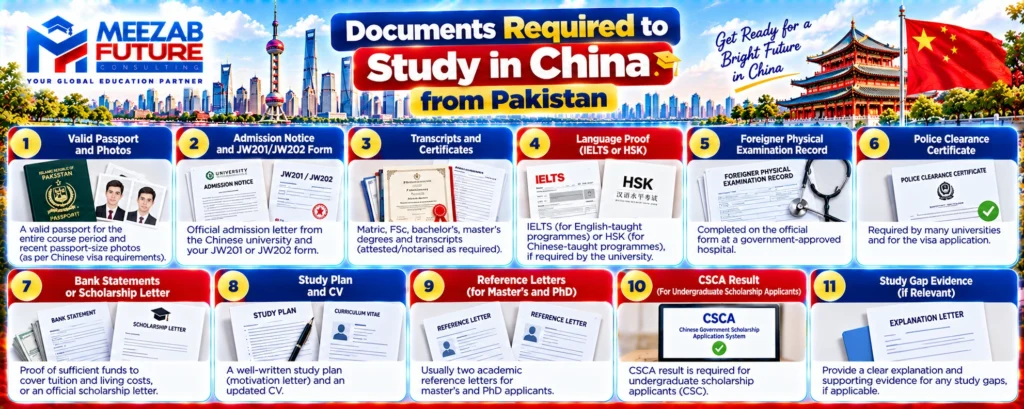
- Valid passport and photos
- Admission notice and JW201/JW202 form
- Transcripts and certificates (attested/notarised as required)
- Language proof (IELTS or HSK) if required
- Foreigner Physical Examination Record
- Police clearance certificate (if required)
- Bank statements or scholarship letter
- Study plan and CV
- Reference letters (for master’s and PhD)
- CSCA result (for undergraduate scholarship applicants)
- Study gap evidence, if relevant
Best Chinese Universities for Pakistani Students
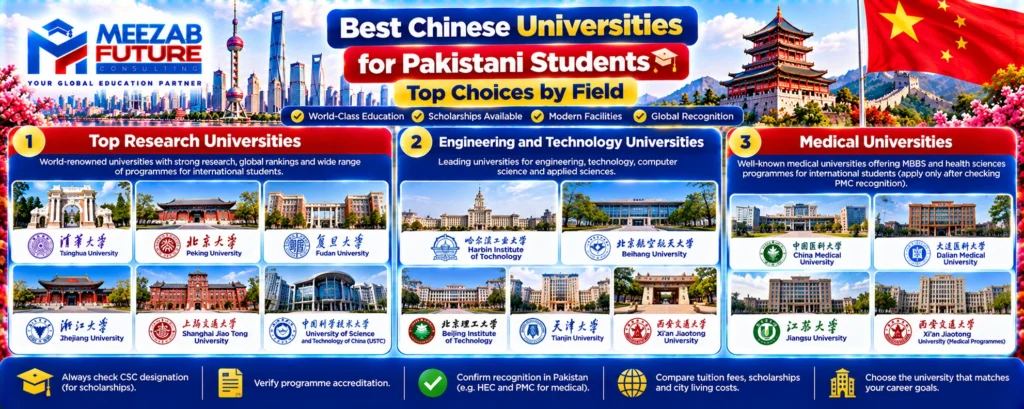
- Top research universities: Tsinghua University, Peking University, Fudan University, Zhejiang University, Shanghai Jiao Tong University, University of Science and Technology of China (USTC)
- Engineering and technology: Harbin Institute of Technology, Beihang University, Beijing Institute of Technology, Tianjin University, Xi’an Jiaotong University
- Medical universities: China Medical University, Dalian Medical University, Jiangsu University, Xi’an Jiaotong University and others, only after checking PMC recognition
Always check CSC designation (for scholarships), programme accreditation and recognition in Pakistan.
Popular Courses to Study in China

- Business and Management: International business, MBA
- Computer Science and IT: AI, software, big data
- Engineering: Civil, mechanical, electrical, electronics (check PEC recognition)
- Accounting and Finance
- Law: Mostly Chinese-taught (check PBC recognition)
- Medicine and Healthcare: MBBS is the most popular choice, but needs careful PMC recognition checks
- Data Science and Artificial Intelligence
- Cybersecurity
- Architecture: Portfolio often required
- Hospitality and Tourism, and Chinese language studies
Cost of Studying in China from Pakistan
Tuition Fees (approximate, confirm with each university)
- Chinese-taught bachelor’s: often around RMB 15,000 to 30,000 per year
- English-taught master’s/PhD: roughly RMB 25,000 to 60,000 per year, depending on subject
- MBBS (English-taught): often around RMB 25,000 to 50,000+ per year, varying widely
- CSC scholarship holders: tuition waived, plus accommodation support and a monthly stipend (reported at roughly CNY 2,500 for undergraduates, CNY 3,000 for master’s and CNY 3,500 for doctoral students)
Cost of Living
Many students plan on roughly RMB 1,800 to 4,000 per month, lower in smaller cities and higher in Beijing, Shanghai and Shenzhen.
- Accommodation costs: University dormitories are the cheapest option.
- Food and grocery costs: Campus canteens are cheap, and halal options are available.
- Transportation costs: Metro and buses are cheap and efficient.
- Other student expenses: Phone, health insurance, residence permit fees, books.
Beijing/Shanghai vs Other Chinese Cities
Beijing, Shanghai and Shenzhen have the highest rents and costs. Wuhan, Xi’an, Harbin, Chengdu, Dalian and Changchun are generally cheaper while still offering strong universities.
China Student Visa Requirements for Pakistani Students
China Student Visa Application Process from Pakistan
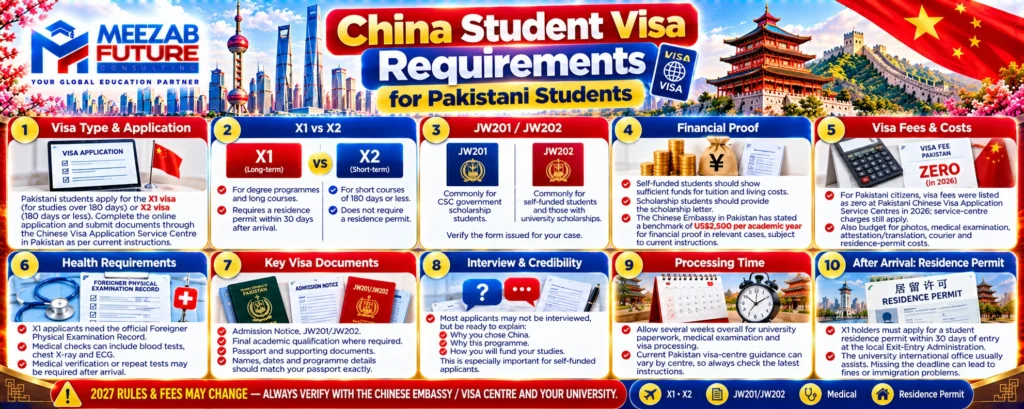
Pakistani students apply for the X1 visa (for studies over 180 days) or X2 visa (180 days or less). The usual process is to complete the online visa application, then submit documents in person at the Chinese Visa Application Service Centre in Pakistan, following the Chinese Embassy’s current instructions. Regular processing has been reported at around 4 working days, with express options available.
X1 vs X2 Visa
- X1: For degree programmes and long courses. It is only an entry visa, and you must apply for a residence permit within 30 days of arrival.
- X2: For short courses of 180 days or less. No residence permit is needed, but part-time work is not allowed.
JW201 vs JW202 Form
- JW201: Issued to CSC government scholarship students.
- JW202: Issued to self-funded students and those with university scholarships.
Financial Requirements
Self-funded students should be ready to show enough funds for tuition and living costs, and scholarship students need their scholarship letter. Requirements differ by embassy and university, so confirm before applying.
Visa Fees and Additional Costs
The visa fee for Pakistani passport holders was reported as waived through 31 December 2026, so check the current position for 2027. Also budget for photos, medical examination, document attestation, translation and courier, and the residence permit fee after arrival (about RMB 400 for a one-year permit at one university).
Health Requirements
All X1 applicants need the Foreigner Physical Examination Record, completed at an approved clinic and in the official format. It typically includes blood tests, chest X-ray and ECG. After arrival, you may need to have the medical record verified or repeat parts of the exam within 30 days, which costs around RMB 600 at some universities.
Admission Notice and JW Form: What They Are and Why They Matter
Your admission notice and JW201/JW202 form are the key documents for the visa. Names, dates and programmes must match your passport exactly.
Visa Interview and Credibility
Most applicants are not interviewed, but be ready to explain why you chose China, this programme and how you will fund your studies, especially for self-funded applicants.
Visa Processing Time
Regular processing is usually a few working days, but plan several weeks for documents, medical examination and university paperwork.
Residence Permit After Arrival (very important)
You must convert your X1 visa into a student residence permit within 30 days of entry, at the local Exit-Entry Administration. The university’s international office usually helps. Missing the deadline can lead to fines or immigration problems. Visa type changes inside China are generally not allowed for students.
Scholarships for Pakistani Students in China
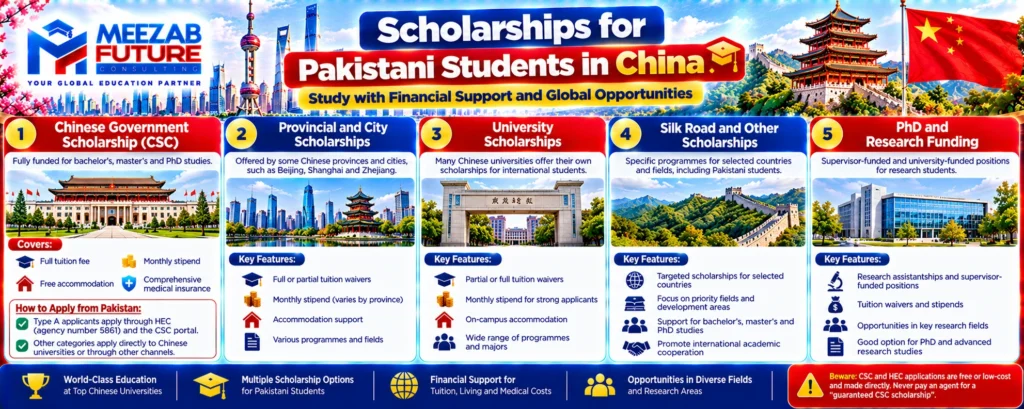
- Chinese Government Scholarship (CSC): Fully funded for bachelor’s, master’s and PhD studies. It normally covers tuition, accommodation, a monthly stipend and comprehensive medical insurance. In Pakistan, Type A applicants apply through HEC (agency number 5861) and the CSC portal, while other categories apply directly to universities or through other channels.
- Provincial and city scholarships: Offered by some Chinese provinces and cities, such as Beijing, Shanghai and Zhejiang.
- University scholarships: Partial or full tuition waivers and stipends for strong applicants.
- Silk Road and other scholarships: Specific programmes for selected countries and fields.
- PhD and research funding: Supervisor-funded and university-funded positions.
Beware: CSC and HEC applications are free or low-cost and made directly. Never pay an agent for a “guaranteed CSC scholarship”.
Intakes and Application Deadlines for 2027
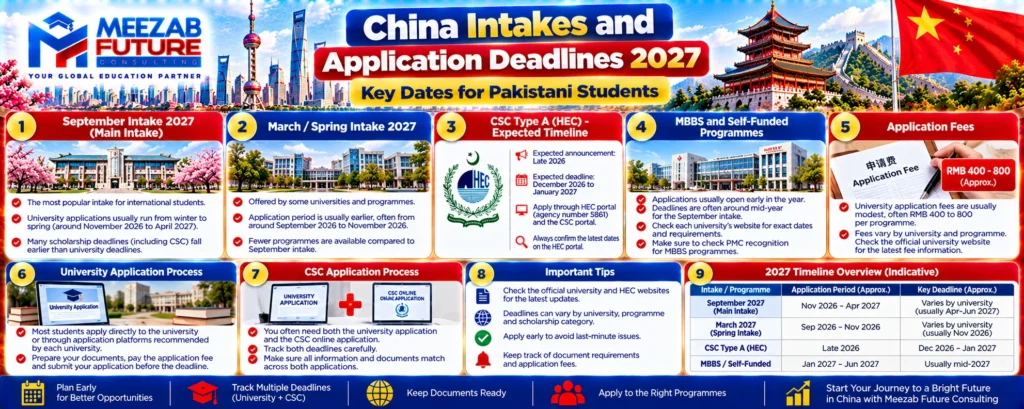
- September intake (2027): The main intake. University applications usually run from winter to spring, and many scholarship deadlines fall earlier.
- March/spring intake: Offered by some universities and programmes.
- CSC Type A (HEC): Expected announcement in late 2026, with a deadline around December 2026 to January 2027. Confirm on the HEC portal.
- MBBS and self-funded programmes: Applications usually open around early in the year and close around mid-year for the September intake.
University applications: Most apply directly or through application platforms recommended by each university. Application fees are usually modest (often RMB 400 to 800). CSC applications: You often need both the university application and the CSC online application, so track both deadlines.
Best Chinese Cities for Pakistani Students
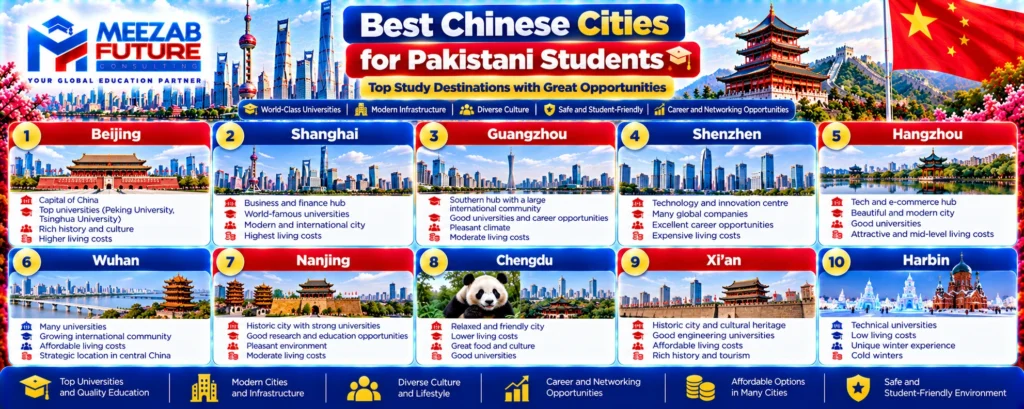
- Beijing: Capital, top universities, higher cost
- Shanghai: Business and finance hub, highest living costs
- Guangzhou: Southern hub with a large international community
- Shenzhen: Technology centre, expensive
- Hangzhou: Tech and e-commerce, attractive and mid-cost
- Wuhan: Many universities, affordable
- Nanjing: Historic city and strong universities
- Chengdu: Relaxed city with lower costs
- Xi’an: Historic city, good engineering universities
- Harbin: Cold winters, technical universities, low cost
Accommodation Options for Pakistani Students in China
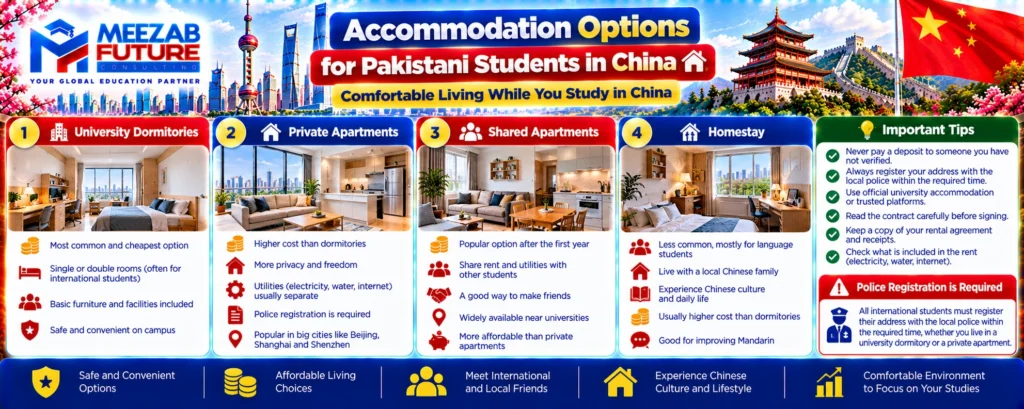
- University dormitories: Most common and cheapest, often with single or double rooms for international students.
- Private apartments: Higher cost, more freedom, but need police registration.
- Shared apartments: Popular after the first year.
- Homestay: Less common, mostly for language students.
Never pay a deposit to someone you have not verified, and always register your address with the local police within the required time.
Part-Time Work for Pakistani Students in China
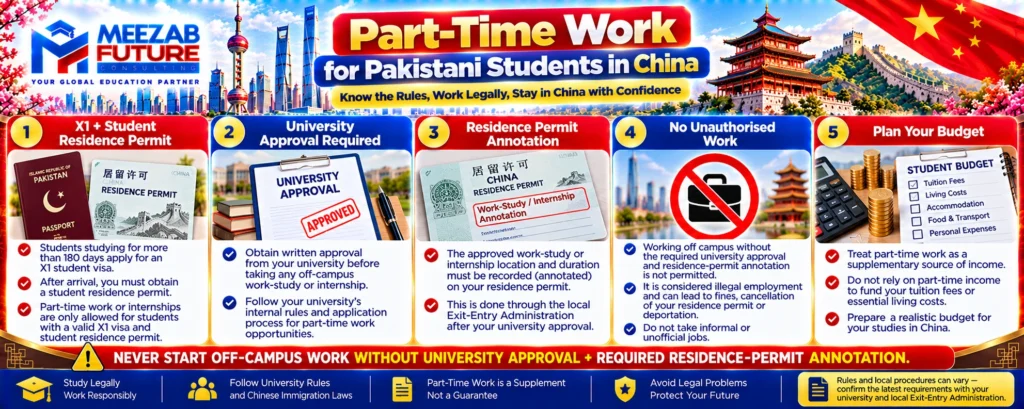
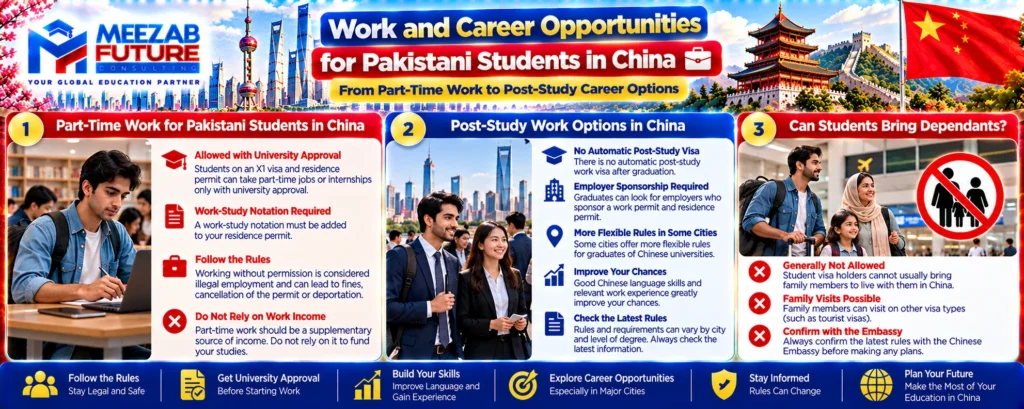
Students on an X1 visa and residence permit can take part-time jobs or internships only with university approval and a work-study notation added to their residence permit. Working without permission is considered illegal employment and can lead to fines, cancellation of the permit or deportation. Do not rely on work income to fund your studies.
Post-Study Work Options in China
After Graduation
There is no automatic post-study work visa. Graduates can look for employers who sponsor a work permit and residence permit, and some cities offer more flexible rules for graduates of Chinese universities. Language skills and work experience greatly improve your chances. Check current rules, as they differ by city and level of degree.
Can Students Bring Dependants?
Generally no. Student visa holders cannot usually bring family members to live with them, though family can visit on other visa types. Confirm with the embassy before planning.
Life as a Pakistani Student in China
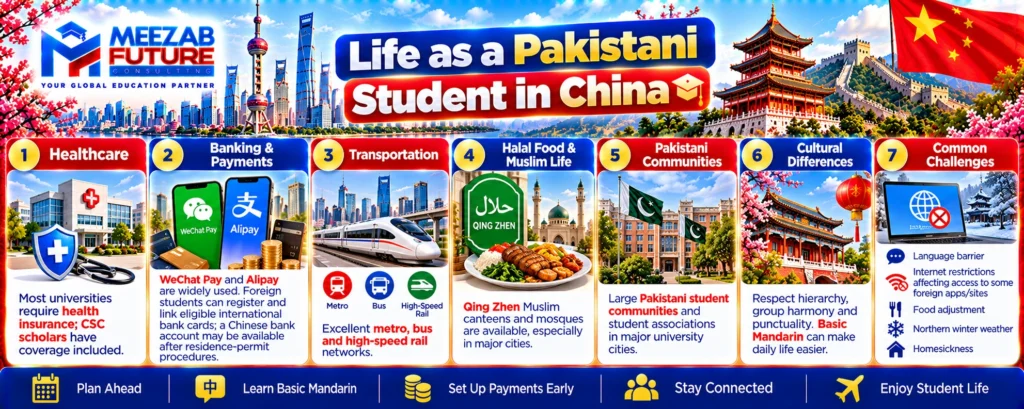
- Healthcare: Most universities require health insurance, and CSC scholars have it included.
- Banking and payments: WeChat Pay and Alipay are used almost everywhere, so set them up early. A Chinese bank account may be possible after you receive your residence permit.
- Transportation: Excellent metro, bus and high-speed rail networks.
- Halal food and Muslim life: Muslim canteens (often labelled Qing Zhen) and mosques are widely available, especially in bigger cities.
- Pakistani communities and student societies: China has a large Pakistani student community, with active associations in most major university cities.
- Cultural differences: Respect for hierarchy, group harmony and punctuality are important. Basic Mandarin greatly improves daily life.
- Common challenges: Language barrier, internet restrictions (some foreign apps and sites are not accessible without special arrangements), food adjustment, winter weather in northern cities and homesickness.
Budget and Practical Tips
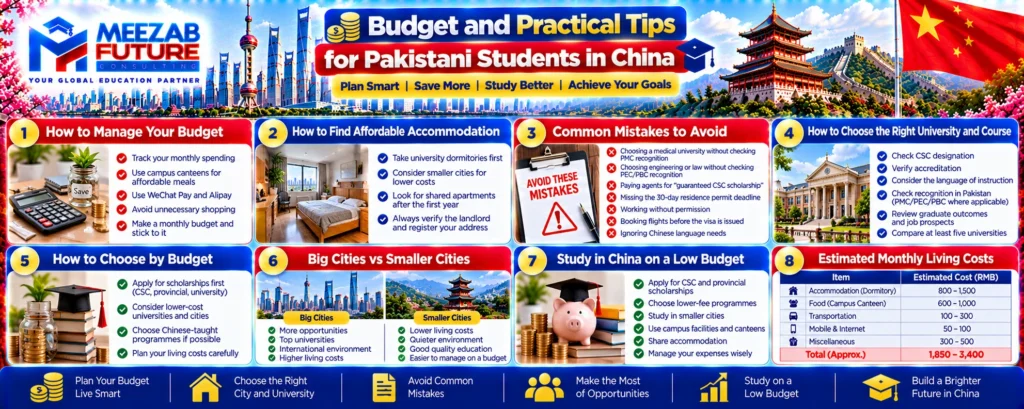
- How to manage your budget: Track spending, use campus canteens, use mobile payments and avoid unnecessary shopping.
- How to find affordable accommodation: Take university dormitories first and consider smaller cities.
- Common mistakes to avoid:
- Choosing a medical university without checking PMC recognition
- Choosing an engineering or law degree without checking PEC/PBC recognition
- Paying agents for “guaranteed CSC scholarship”
- Missing the 30-day residence permit deadline
- Working without permission
- Booking flights before the visa is issued
- Ignoring Chinese language needs
- How to choose the right university and course: Check CSC designation, accreditation, language of instruction, recognition in Pakistan and graduate outcomes. Compare at least five options.
- How to choose by budget: Scholarship first, then lower-cost universities and cities.
- Big cities vs smaller cities: Choose Beijing or Shanghai for opportunities, smaller cities for savings.
- Study in China on a low budget: Apply for CSC and provincial scholarships, choose Chinese-taught or lower-fee programmes, and live in a smaller city.
Study in China Without IELTS
Can Pakistani Students Study in China Without IELTS?
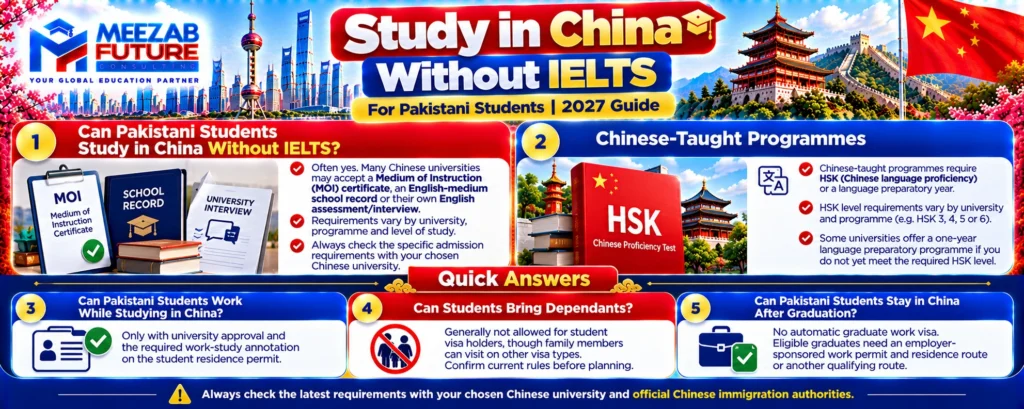
Often yes. Many universities accept a Medium of Instruction certificate, an English-medium school record or their own English interview. Chinese-taught programmes require HSK or a language preparatory year instead. Always check each university’s rule.
Quick Answers
- Can Pakistani students work while studying in China? Only with university approval and a work-study notation on the residence permit.
- Can students bring dependants? Generally no.
- Can Pakistani students stay in China after graduation? Only through an employer-sponsored work permit or another residence route, not an automatic graduate visa.
What to Do After Receiving Your China Student Visa
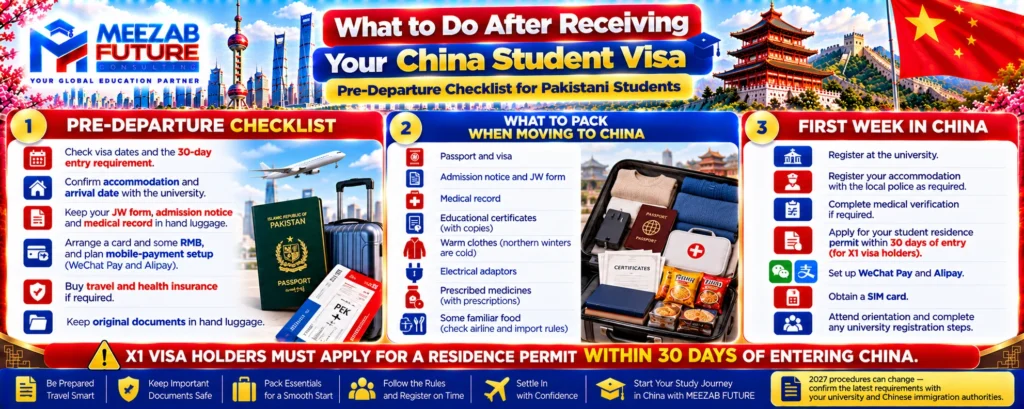
Pre-Departure Checklist for Pakistani Students
- Check visa dates and the 30-day entry window
- Confirm accommodation and arrival date with the university
- Keep your JW form, admission notice and medical record in hand luggage
- Arrange money (a card and some RMB), and plan mobile payment setup
- Buy travel and health insurance if required
- Keep originals in hand luggage
What to Pack When Moving to China
Passport, visa, admission notice, JW form, medical record, certificates (with copies), warm clothes (northern winters are cold), adaptors, medicines with prescriptions and some familiar food (check airline and import rules).
First Week in China
Register at the university, register your accommodation with the police, complete medical verification if required, apply for your residence permit within 30 days, set up WeChat and Alipay, get a SIM and attend orientation.
How Meezab Future Consulting Helps Pakistani Students Study in China
- University and course selection: Language, tuition, scholarship and recognition fit
- Admission application support: Applications, deadlines and follow-up
- Document guidance: Attestation, translations, medical record and consistency checks
- Scholarship guidance: CSC (HEC Type A and other categories) and university scholarship preparation (we never promise guaranteed scholarships)
- JW form and admission guidance: Checking details before the visa
- China student visa guidance: Application support and preparation
- Pre-departure and arrival support: Residence permit steps, accommodation and arrival planning
- MBBS guidance: Honest advice on PMC recognition and licensing steps
(Add your office address, phone, WhatsApp and booking link. Avoid “guaranteed visa/scholarship/PMC approval” claims in your copy.)
Study in China from Pakistan: Complete Application Timeline (2027)
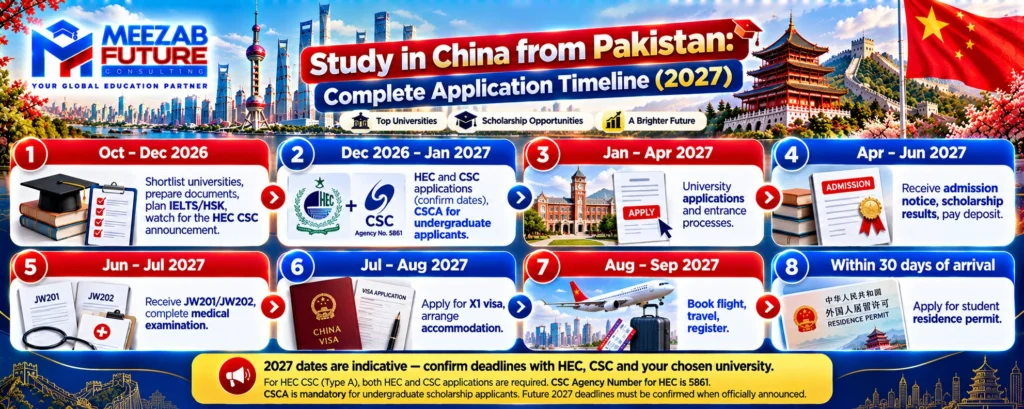
| When | What to do |
| Oct to Dec 2026 | Shortlist universities, prepare documents, plan IELTS/HSK, watch for the HEC CSC announcement |
| Dec 2026 to Jan 2027 | HEC and CSC applications (confirm dates), CSCA for undergraduate applicants |
| Jan to Apr 2027 | University applications and entrance processes |
| Apr to Jun 2027 | Receive admission notice, scholarship results, pay deposit |
| Jun to Jul 2027 | Receive JW201/JW202, complete medical examination |
| Jul to Aug 2027 | Apply for X1 visa, arrange accommodation |
| Aug to Sep 2027 | Book flight, travel, register |
| Within 30 days of arrival | Residence permit application |
Study in China from Pakistan: Complete Cost Breakdown (first year, approximate)
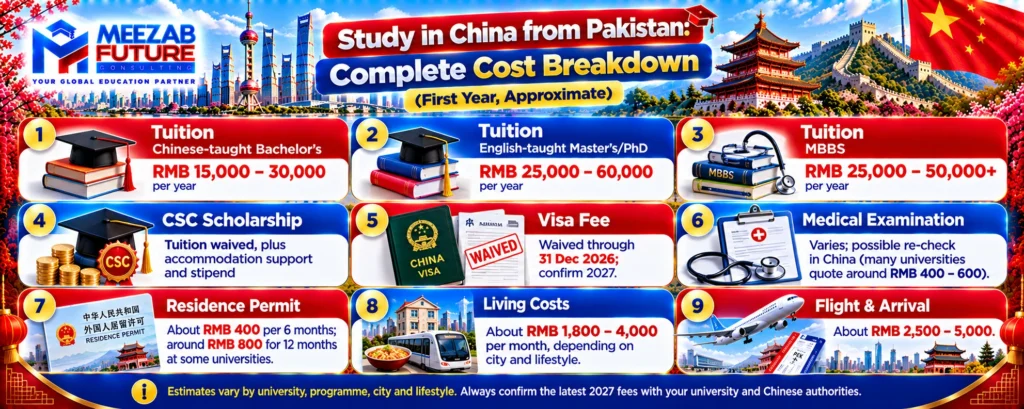
| Item | Estimate |
| Tuition (Chinese-taught bachelor’s) | About RMB 15,000 to 30,000 |
| Tuition (English-taught master’s/PhD) | About RMB 25,000 to 60,000 |
| Tuition (MBBS) | About RMB 25,000 to 50,000+ |
| CSC scholarship | Tuition waived, plus accommodation support and stipend |
| Visa fee | Waived through 31 Dec 2026 (confirm for 2027) |
| Medical examination | Varies (and possible re-check in China) |
| Residence permit | About RMB 400 (one-year permit) |
| Living costs | About RMB 1,800 to 4,000 per month |
| Flight and arrival | About RMB 2,500 to 5,000 |
Study in China from Pakistan: Document Checklist
- ☐ Passport
- ☐ Admission notice
- ☐ JW201/JW202 form
- ☐ Transcripts and certificates
- ☐ Language proof
- ☐ Foreigner Physical Examination Record
- ☐ Police clearance
- ☐ Bank statements/sponsor documents
- ☐ Study plan and CV
- ☐ References
- ☐ CSCA result
- ☐ Photos
- ☐ Study gap evidence
Study in China from Pakistan: Step-by-Step Checklist
- ☐ Course chosen
- ☐ Universities shortlisted
- ☐ Language test booked
- ☐ Application submitted
- ☐ Scholarship applied
- ☐ Admission notice received
- ☐ JW form received
- ☐ Medical examination done
- ☐ Visa applied
- ☐ Visa received
- ☐ Accommodation booked
- ☐ Flight booked
- ☐ Residence permit applied
Frequently Asked Questions About Studying in China from Pakistan (2027)
How can I study in China from Pakistan?
Choose a university, apply (and for scholarships apply through HEC and CSC), receive your admission notice and JW form, complete the medical examination, apply for your X1 visa, then convert it into a residence permit within 30 days of arrival.
How much does it cost to study in China from Pakistan?
Costs vary widely. Tuition is often roughly RMB 15,000 to 60,000 per year, depending on the programme, plus living costs of about RMB 1,800 to 4,000 per month. CSC scholarship holders do not pay tuition.
What are the requirements to study in China?
Academic qualifications, language proof, passport, medical record, funds or scholarship and a visa.
Can I study in China after FSC?
Yes, for a bachelor’s degree. Scholarship undergraduate applicants must also take the CSCA.
Can I study in China after a bachelor’s degree?
Yes, for a master’s degree.
Is IELTS required to study in China?
Not always. Many universities accept an MOI certificate or their own test. Chinese-taught programmes need HSK or a preparatory year.
How much bank balance is required for a China student visa?
There is no single fixed figure. Self-funded students should show tuition plus living costs, and scholarship students show their scholarship letter. Confirm with the embassy and university.
How long does a China student visa take?
Regular processing is often a few working days, but plan several weeks for the admission, JW form and medical steps.
Can Pakistani students work in China while studying?
Only with university approval and a work-study notation on the residence permit.
Can I get a scholarship to study in China?
Yes, through the Chinese Government Scholarship (CSC) via HEC, plus provincial and university scholarships.
What are the intakes for international students?
Mainly September, with some March intakes.
Can I study in China with a study gap?
Yes, if you can explain and document it.
Can I bring my family to China as a student?
Generally no.
Can I stay in China after completing my studies?
Only through an employer-sponsored work permit or another residence route, not an automatic graduate visa.
Is an MBBS from China valid in Pakistan?
Only if the university is recognised by PMC and you meet the current licensing requirements, so verify before paying any fees.
How can Meezab Future Consulting help me study in China?
With university selection, admissions, scholarship preparation, visa guidance, PMC checks for MBBS and pre-departure planning.