What’s New for 2027 Students
- Türkiye Bursları 2027. The Turkish government’s fully funded scholarship usually runs one application round a year. Reports point to a 2027 window of roughly mid-January to 20 February 2027, but you should confirm the official dates on the official Türkiye Scholarships website before planning. Around 5,000 international students are selected each year from over 165,000 applicants in 170+ countries, so it is highly competitive.
- Residence permit is the key step. After arriving on a student visa, you must apply for a student residence permit through the online e-ikamet system. All international students must obtain this permit under Turkish law.
- Health insurance is compulsory. By law, every international student must have valid health insurance covering their stay.
- Currency volatility. The Turkish lira has been unstable, so many private universities quote tuition in USD or EUR. Fees and permit costs in lira can change often, so always get fees in writing.
- No UK-style graduate visa. Turkey does not have a dedicated post-study work visa, so plan your career route early (see below).
Why Study in Turkey from Pakistan?
Benefits for Pakistani Students
- Affordable tuition compared with the UK, USA, Canada and Australia
- Low cost of living, especially outside Istanbul
- Strong Pakistan-Turkey cultural and religious ties, with halal food, mosques and a welcoming environment
- Hundreds of universities, with growing English-taught programmes
- A generous government scholarship (Türkiye Bursları) plus university scholarships
- A location between Europe and Asia, with easy travel to Europe and the Middle East
Is Turkey a Good Destination?
Yes, especially for students with a limited budget or those who want a scholarship. The main challenges are the language barrier outside universities, currency swings and a more limited post-study work route. Choose carefully and confirm that your degree is recognised for your future plans.
Who Can Study in Turkey from Pakistan?
- After Matric: You cannot enrol in a degree directly. Complete FSc/Intermediate or A Levels first.
- After Intermediate/FSc: You can apply for a bachelor’s degree. Some universities require entrance exams or a Turkish language preparatory year.
- After A Levels: Strong option for undergraduate admission, often with better scholarship chances.
- After Bachelor’s: Apply for a master’s degree. A 16-year degree is generally preferred.
- After Master’s: Apply for a PhD, usually with a research proposal and supervisor.
- With a study gap: Possible, but explain it with documents. Visa officers and universities look for a clear reason.
Turkish Education System Explained
- Undergraduate degrees: 4 years (medicine 6, dentistry and pharmacy 5).
- Postgraduate degrees: Master’s takes 2 years (with thesis) or 1 to 1.5 years (non-thesis). Check which one the university offers.
- PhD: 3 to 5 years.
- Preparatory programmes: Many courses include a Turkish language or English preparatory year.
- Public vs private (foundation) universities: Public universities have very low tuition but are competitive and often more Turkish-taught. Private universities charge more but offer more English-taught programmes and larger scholarships.
- Admission tools: Universities may accept your FSc/A Level results, SAT, their own exam or a national exam such as YÖS, depending on the university.
Study Requirements for Pakistani Students in Turkey
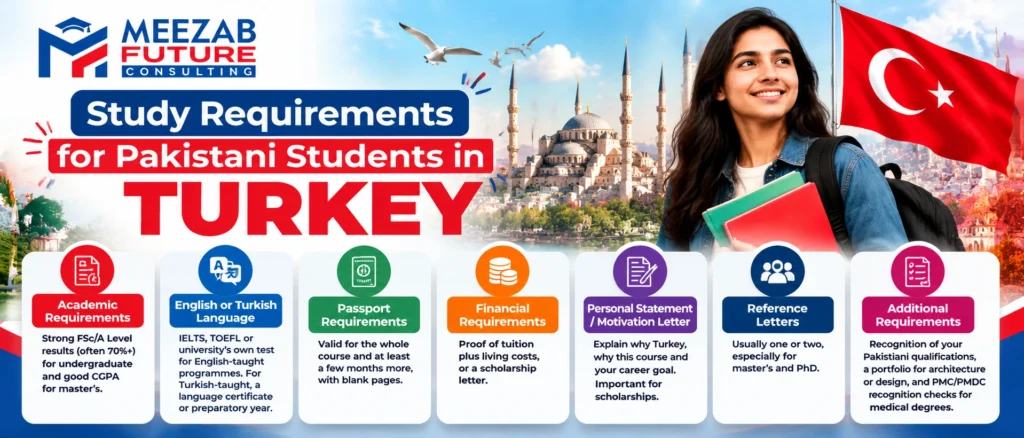
Academic requirements: Strong FSc/A Level results for undergraduate (often 70% or more for competitive programmes) and a good CGPA for master’s. Medicine, dentistry and engineering are the most competitive.
English or Turkish language requirements: English-taught programmes usually ask for IELTS, TOEFL or the university’s own English test. Turkish-taught programmes require a Turkish proficiency certificate or a language preparatory year.
Passport requirements: Valid for the whole course and at least a few months more, with blank pages.
Financial requirements: Proof of tuition plus living costs, or a scholarship letter.
Personal statement/motivation letter: Explain why Turkey, why this course and your career goal. For scholarships, this is a major part of your score.
Reference letters: Usually one or two, especially for master’s and PhD.
Additional requirements: Recognition of your Pakistani qualifications, a portfolio for architecture or design, and PMC/PMDC recognition checks for medical degrees (very important, see below).
Step-by-Step: How to Study in Turkey from Pakistan
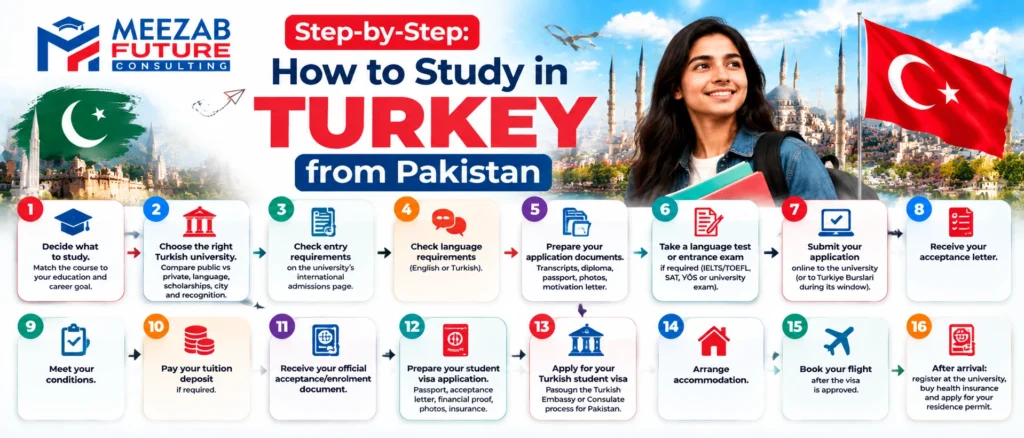
- Decide what to study. Match the course to your education and career goal.
- Choose the right Turkish university. Compare public vs private, language of instruction, scholarships, city and recognition.
- Check entry requirements on the university’s international admissions page.
- Check language requirements (English or Turkish).
- Prepare your application documents. Transcripts, diploma, passport, photos, motivation letter.
- Take a language test or entrance exam if required (IELTS/TOEFL, SAT, YÖS or university exam).
- Submit your application online to the university (or to Türkiye Bursları during its window).
- Receive your acceptance letter.
- Meet your conditions.
- Pay your tuition deposit if required.
- Receive your official acceptance/enrolment document.
- Prepare your student visa application. Passport, acceptance letter, financial proof, photos, insurance.
- Apply for your Turkish student visa through the Turkish Embassy or Consulate process for Pakistan.
- Arrange accommodation.
- Book your flight after the visa is approved.
- After arrival: register at the university, buy health insurance and apply for your residence permit.
Documents Required to Study in Turkey from Pakistan
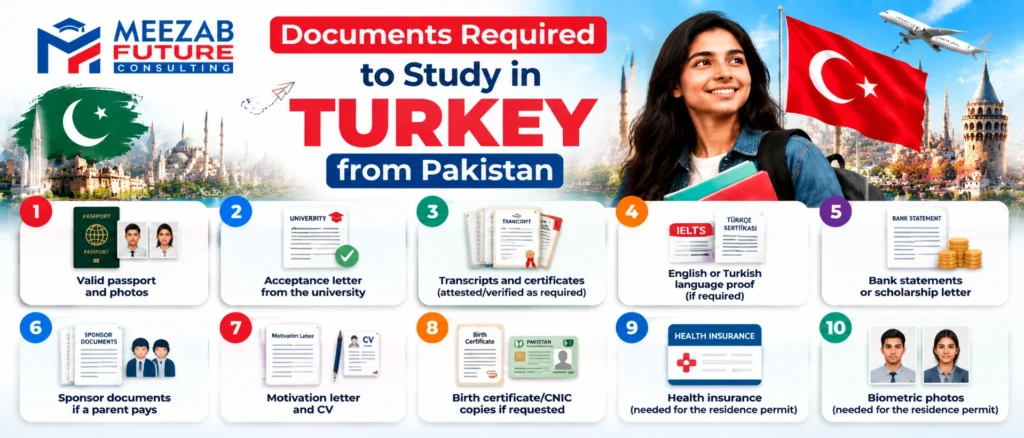
- Valid passport and photos
- Acceptance letter from the university
- Transcripts and certificates (attested/verified as required)
- English or Turkish language proof (if required)
- Bank statements or scholarship letter
- Sponsor documents if a parent pays
- Motivation letter and CV
- Birth certificate/CNIC copies if requested
- Health insurance (needed for the residence permit)
- Biometric photos (needed for the residence permit)
Best Turkish Universities for Pakistani Students
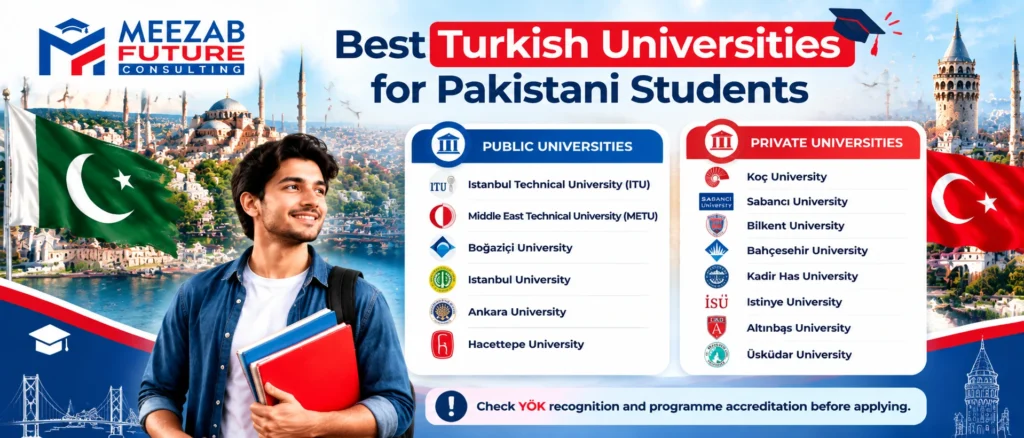
- Public: Istanbul Technical University (ITU), Middle East Technical University (METU), Boğaziçi University, Istanbul University, Ankara University, Hacettepe University.
- Private: Koç University, Sabancı University, Bilkent University, Bahçeşehir University, Kadir Has University, Istinye University, Altınbaş University, Üsküdar University.
Check the official YÖK recognition and the exact programme accreditation for your field.
Popular Courses to Study in Turkey
- Business and Management: BBA, MBA, International Trade
- Computer Science and IT: Software and AI, many in English
- Engineering: Civil, mechanical, electrical, industrial
- Accounting and Finance
- Law: Mostly Turkish-taught
- Medicine and Healthcare: Popular but needs careful PMC recognition checks and heavy competition
- Data Science and Artificial Intelligence
- Cybersecurity
- Architecture: Portfolio often required
- Hospitality and Tourism: Strong, given Turkey’s tourism industry
Cost of Studying in Turkey from Pakistan
Tuition Fees (approximate, confirm with each university)
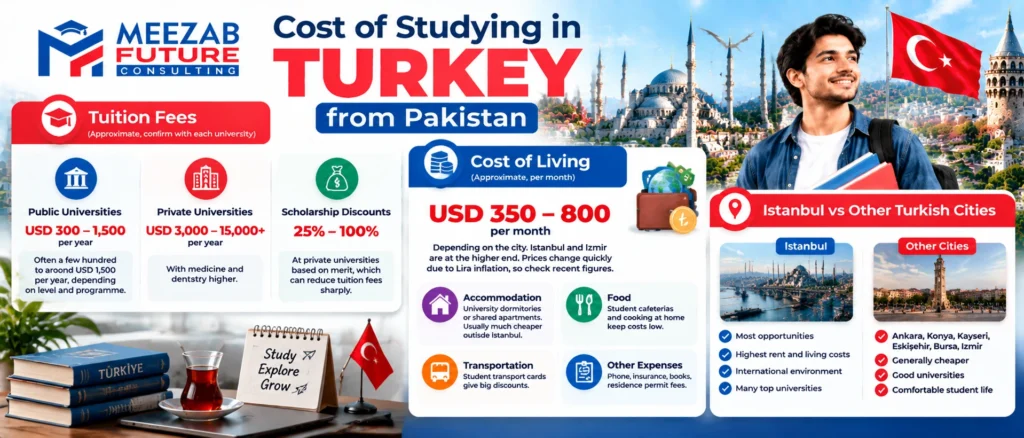
- Public universities: often a few hundred to around USD 1,500 per year, depending on level and programme
- Private universities: roughly USD 3,000 to 15,000+ per year, with medicine and dentistry higher
- Scholarship discounts at private universities can reduce this sharply (25% to 100% depending on merit)
Cost of Living
- Accommodation: university dormitories or shared apartments, usually much cheaper outside Istanbul
- Food: student cafeterias and cooking at home keep costs low
- Transportation: student transport cards give big discounts
- Other student expenses: phone, insurance, books, residence permit fees
A reasonable planning range is USD 350 to 800 per month depending on the city, with Istanbul and Izmir at the higher end. Lira inflation means prices change quickly, so check recent figures.
Istanbul vs Other Turkish Cities
Istanbul has the most opportunities and the highest rent. Ankara, Konya, Kayseri, Eskişehir, Bursa and Izmir are generally cheaper and still have good universities.
Turkey Student Visa Requirements for Pakistani Students
Turkey Student Visa Application Process from Pakistan
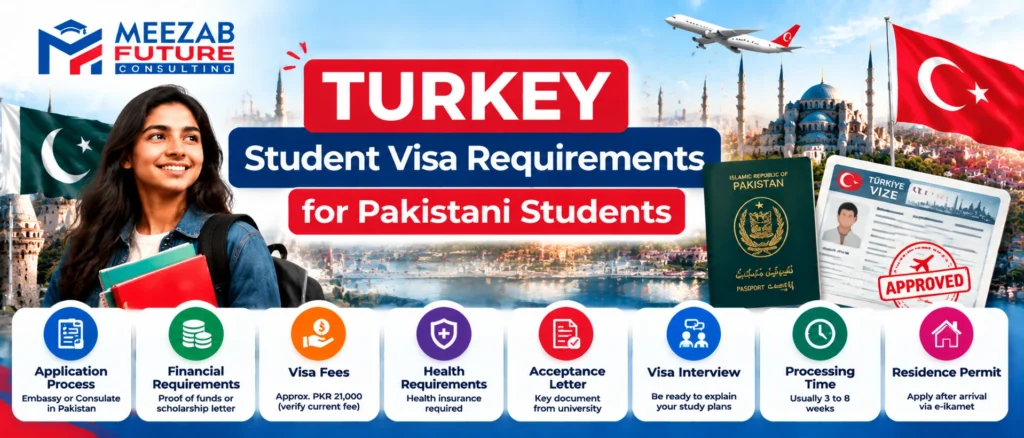
Pakistani nationals need a visa to enter Turkey for study. Applicants apply for the student visa through the Turkish Embassy in Islamabad or the Turkish Consulate in Karachi. Check the embassy’s current instructions on whether submission is through an authorised visa application centre, and book biometrics if required.
Financial Requirements
You must show enough funds for tuition and living costs, or a scholarship letter. There is no single fixed national figure, so confirm the exact amount the embassy and your university expect.
Visa Fees and Additional Costs
The visa fee is paid in PKR and has been reported at roughly PKR 21,000 for a single-entry student visa, but confirm the current fee. Also budget for photos, document attestation, translation and courier.
Health Requirements
Turkey does not normally require a TB test for study visa applications from Pakistan, but requirements can change, so confirm with the embassy. Health insurance is required in Turkey (see below).
Acceptance Letter: What It Is and Why It Matters
Instead of a UK-style CAS, your official acceptance letter (and a student certificate after enrolment) is the key document. It must match your passport name, programme and dates exactly.
Visa Interview and Credibility
Some applicants face a short consular interview. Be ready to explain why you chose Turkey, why this course and university, how you will pay and what you plan afterwards. Answers must match your documents.
Visa Processing Time
Typical processing is a few weeks and can stretch to around 3 to 8 weeks, so apply early.
Residence Permit After Arrival (very important)
After you arrive, you must apply for a student residence permit. The application starts through the online e-ikamet system, and universities usually tell you the exact deadline (often within days to weeks of registration). Typical documents include your passport, photos, health insurance, a student certificate, proof of address, financial proof and the fee receipt. Do not leave Turkey before your permit process is complete unless your university confirms it is safe.
Scholarships for Pakistani Students in Turkey
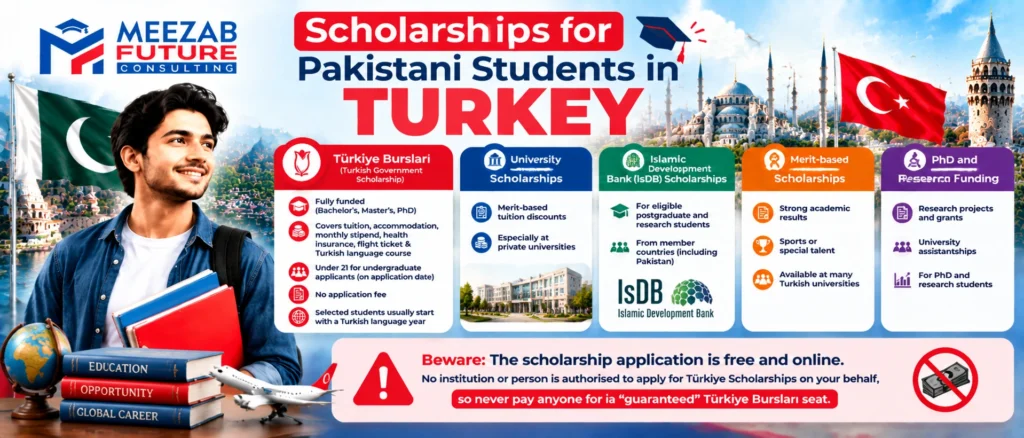
- Türkiye Bursları (Turkish Government Scholarship): Fully funded for bachelor’s, master’s and PhD. It normally covers tuition, accommodation, monthly stipend, health insurance, flight ticket and Turkish language course. Undergraduate applicants must be under 21 on the date of application, and there is no application fee. Selected students typically start with a Turkish language year.
- University scholarships: Merit-based tuition discounts, especially at private universities.
- Islamic Development Bank (IsDB) scholarships: For eligible postgraduate and research students from member countries.
- Merit-based scholarships: Strong results, sports or special talent.
- PhD and research funding: University assistantships and research projects.
Beware: The scholarship application is free and online. No institution or person is authorised to apply for Türkiye Scholarships on your behalf, so never pay anyone for a “guaranteed” Türkiye Bursları seat.
Intakes and Application Deadlines for 2027
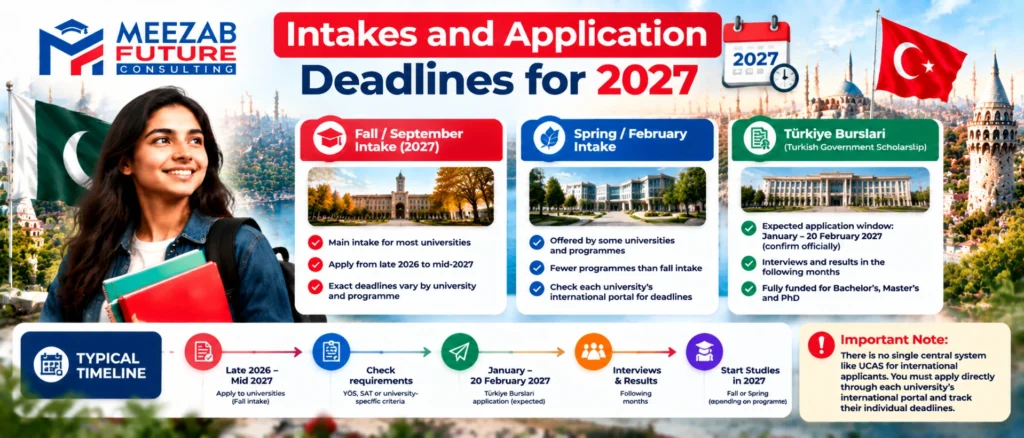
- Fall/September intake (2027): The main intake. Apply from late 2026 to mid-2027, depending on the university.
- Spring/February intake: Offered by some universities and programmes.
- Türkiye Bursları: Expected application window around January to 20 February 2027 (confirm officially), with interviews and results in the following months.
University applications: Most apply directly through each university’s international portal, and some use YÖS or SAT. There is no single central system like UCAS for international applicants, so track each university’s deadline.
Best Turkish Cities for Pakistani Students
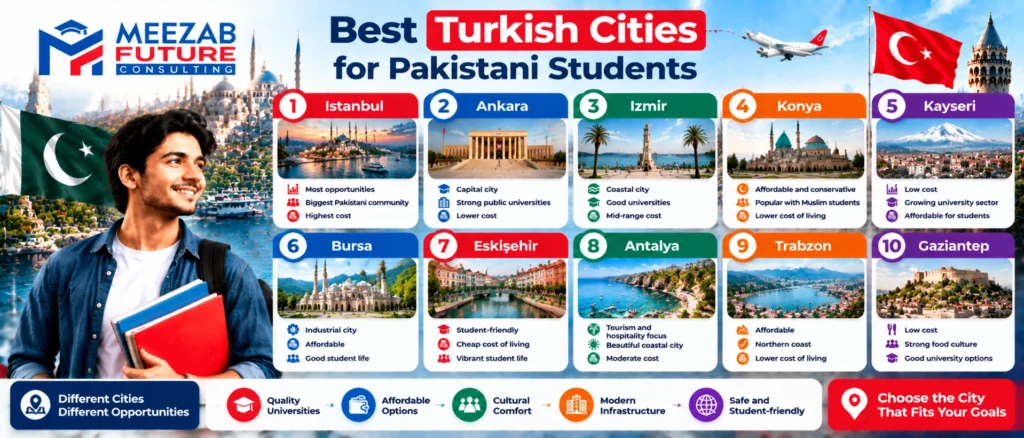
- Istanbul: Most opportunities, biggest Pakistani community, highest cost
- Ankara: Capital, strong public universities, lower cost
- Izmir: Coastal, good universities, mid-range cost
- Konya: Affordable and conservative, popular with Muslim students
- Kayseri: Low cost, growing university sector
- Bursa: Industrial and affordable
- Eskişehir: Student-friendly and cheap
- Antalya: Tourism and hospitality focus
- Trabzon: Affordable, northern coast
- Gaziantep: Low cost, strong food culture
Accommodation Options for Pakistani Students in Turkey
- University dormitories: Affordable and convenient, but limited places. Apply early.
- State (KYK) dormitories: Very low cost, but access for international students is limited. Check eligibility.
- Private student accommodation: More comfortable, higher price.
- Shared apartments: Popular and cheaper. Check the contract and the landlord.
- Homestay: Less common, but possible.
Never send a deposit to someone you have not verified.
Part-Time Work for Pakistani Students in Turkey
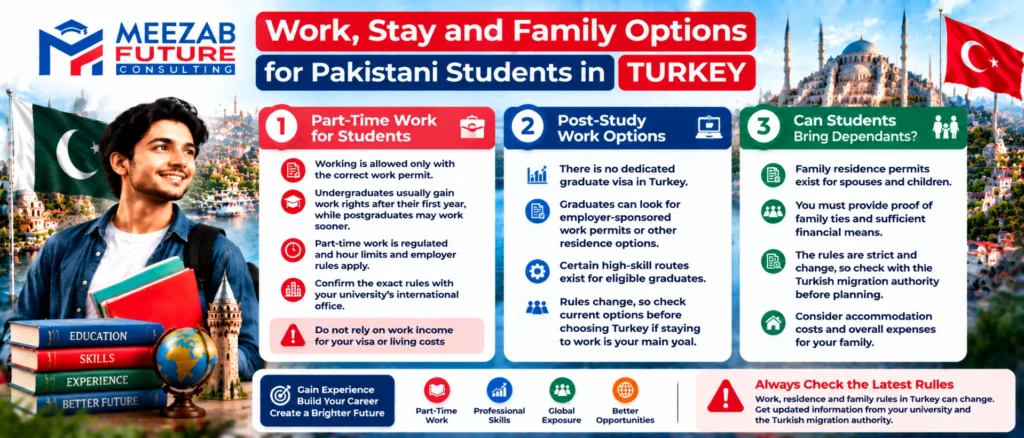
Working is allowed only with the correct work permit. Working part-time is regulated, and undergraduates typically gain work rights after their first year, while postgraduates may work sooner. Hour limits and employer rules apply, so confirm with your university’s international office. Do not rely on work income for your visa or living costs.
Post-Study Work Options in Turkey
There is no dedicated graduate visa. Graduates can look for employer-sponsored work permits or other residence options, and certain high-skill routes exist. Rules change, so check current options before choosing Turkey if staying to work is your main goal.
Can Students Bring Dependants?
Family residence permits exist, but they require proof of family ties and sufficient financial means. The rules are strict and change, so check with the migration authority before planning.
Life as a Pakistani Student in Turkey
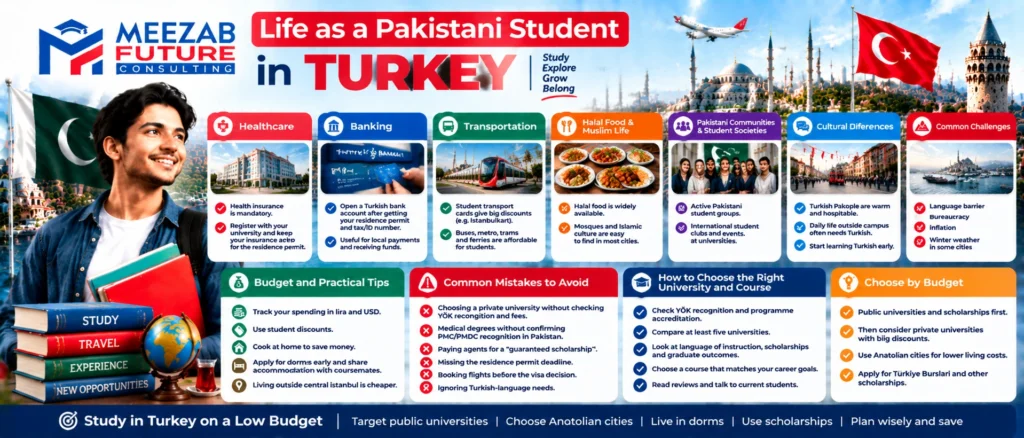
- Healthcare: Health insurance is mandatory. Register with your university and keep your insurance active for the permit.
- Banking: Open a Turkish bank account after getting your residence permit and tax/ID number.
- Transportation: Student transport cards (for example in Istanbul) reduce costs.
- Halal food and Muslim life: Halal food, mosques and Islamic culture are widely available.
- Pakistani communities and student societies: Look for Pakistani student groups and international student clubs at your university.
- Cultural differences: Turkish culture is warm and hospitable, but daily life outside campus often needs Turkish, so start learning early.
- Common challenges: Language barrier, bureaucracy, inflation and winter weather in some cities.
Budget and Practical Tips
- How to manage your budget: Track spending in lira and USD, use student discounts and cook at home.
- How to find affordable accommodation: Apply for dorms early, share with coursemates and live outside central Istanbul.
- Common mistakes to avoid:
- Choosing a private university without checking YÖK recognition and fees
- Medical degrees without confirming PMC/PMDC recognition in Pakistan
- Paying agents for a “guaranteed scholarship”
- Missing the residence permit deadline
- Booking flights before the visa decision
- Ignoring Turkish-language needs
- How to choose the right university and course: Check accreditation, language of instruction, scholarships and graduate outcomes. Compare at least five options.
- How to choose by budget: Public universities and scholarships first, then private with big discounts.
- Istanbul vs other cities: Choose Istanbul for opportunities, other cities for savings.
- Study in Turkey on a low budget: Target public universities, Anatolian cities, dorms and the Türkiye Bursları.
Study in Turkey Without IELTS
Can Pakistani Students Study in Turkey Without IELTS?
Often yes. Many universities accept their own English proficiency exam, a Medium of Instruction certificate or a preparatory year. Türkiye Bursları also allows alternative proof of English in some cases, but confirm each university’s rule.
Quick Answers
- Can Pakistani students work while studying in Turkey? Yes, with a work permit and within limits.
- Can students bring dependants? Possible only under strict conditions.
- Can Pakistani students stay in Turkey after graduation? Only through another residence or work route, not an automatic graduate visa.
What to Do After Receiving Your Turkey Student Visa
Pre-Departure Checklist for Pakistani Students
- Check visa details and dates
- Confirm accommodation and arrival date with the university
- Buy health insurance (needed for the residence permit)
- Prepare biometric photos and copies of documents
- Arrange money (USD cash and a card)
- Keep originals in hand luggage
What to Pack When Moving to Turkey
Passport, visa, acceptance letter, certificates (with copies), warm clothing (winters can be cold), adaptors (Turkey uses European plugs), medicines with prescriptions and some familiar food.
First Week in Turkey
Register at the university, collect your student certificate, buy health insurance, start your e-ikamet application, open a bank account, get a SIM and student transport card, and attend orientation.
How Meezab Future Consulting Helps Pakistani Students Study in Turkey
- University and course selection: Public vs private, language and budget fit
- Admission application support: Applications, deadlines and follow-up
- Document guidance: Attestation, translations and consistency checks
- Scholarship guidance: Türkiye Bursları and university scholarship preparation (we never apply on your behalf for the government scholarship, and you should never pay for a guaranteed seat)
- Acceptance letter guidance: Making sure details match your documents
- Turkey student visa guidance: Application support and interview preparation
- Residence permit and pre-departure support: e-ikamet preparation, accommodation and arrival planning
(Add your office address, phone, WhatsApp and booking link. Avoid “guaranteed visa/scholarship” claims in your copy.)
Study in Turkey from Pakistan: Complete Application Timeline (2027)
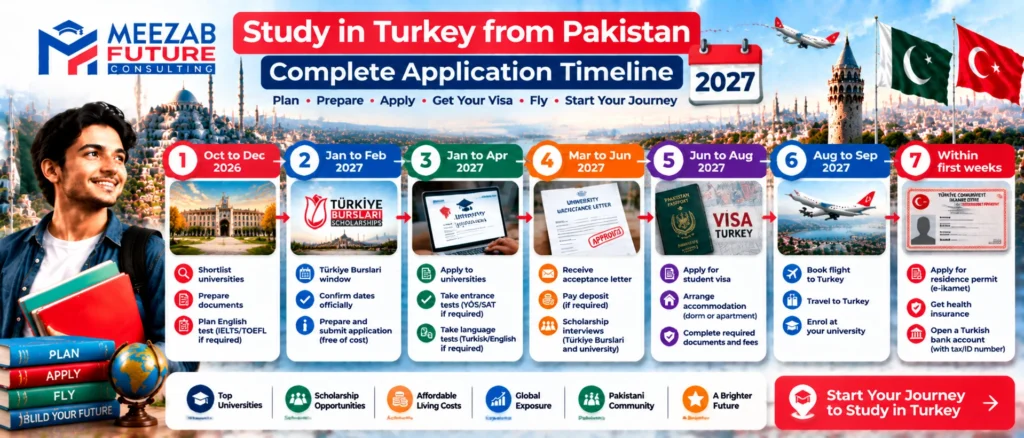
| When | What to do |
|---|---|
| Oct to Dec 2026 | Shortlist universities, prepare documents, plan English test |
| Jan to Feb 2027 | Türkiye Bursları window (confirm dates officially) |
| Jan to Apr 2027 | Apply to universities, take entrance/language tests |
| Mar to Jun 2027 | Receive acceptance, pay deposit, scholarship interviews |
| Jun to Aug 2027 | Apply for student visa, arrange accommodation |
| Aug to Sep 2027 | Book flight, travel, enrol |
| Within first weeks | Residence permit application, insurance, bank account |
Study in Turkey from Pakistan: Complete Cost Breakdown (first year, approximate)
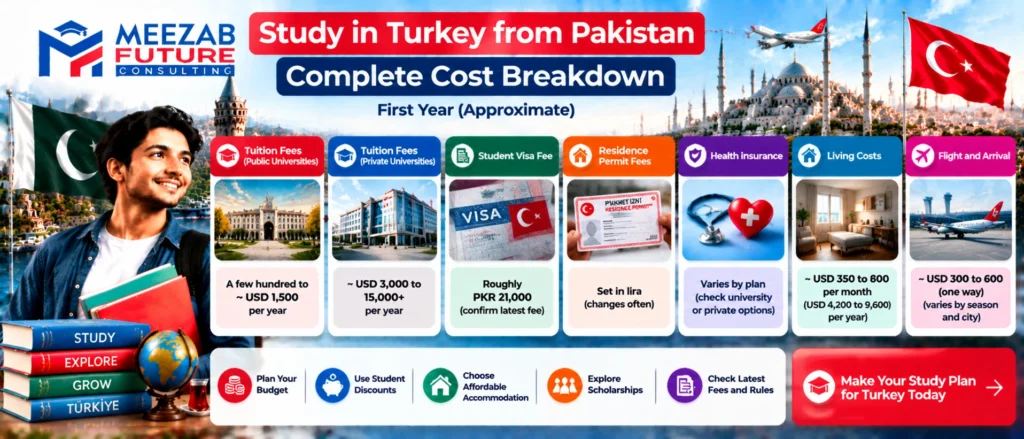
| Item | Estimate |
|---|---|
| Tuition (public) | A few hundred to ~USD 1,500 |
| Tuition (private) | ~USD 3,000 to 15,000+ |
| Visa fee | Roughly PKR 21,000 (confirm) |
| Residence permit fees | Set in lira, changes often |
| Health insurance | Varies by plan |
| Living costs | ~USD 350 to 800 per month |
| Flight and arrival | ~USD 300 to 600 |
Study in Turkey from Pakistan: Document Checklist
- Passport
- Acceptance letter
- Transcripts and degrees
- Language proof
- Bank statements/sponsor documents
- Motivation letter
- References
- Photos (biometric)
- Health insurance
- Study gap evidence
- Birth certificate/CNIC copies
Study in Turkey from Pakistan: Step-by-Step Checklist
- Course chosen
- Universities shortlisted
- Test/exam booked
- Application submitted
- Acceptance received
- Deposit paid
- Visa applied
- Visa received
- Accommodation booked
- Flight booked
- Insurance bought
- Residence permit applied
Frequently Asked Questions About Studying in Turkey from Pakistan (2027)
How can I study in Turkey from Pakistan?
Choose a university, apply, get your acceptance letter, apply for a student visa, then apply for a residence permit after arrival.
How much does it cost to study in Turkey from Pakistan?
Public universities are very low in tuition, private universities cost more. With living costs, many students spend roughly USD 3,000 to 8,000 a year at public universities and more at private ones, depending on city and course.
What are the requirements to study in Turkey?
Academic qualifications, language proof, passport, financial proof or scholarship, and a visa.
Can I study in Turkey after FSC?
Yes, for a bachelor’s degree, subject to the university’s admission rules and exams.
Can I study in Turkey after a bachelor’s degree?
Yes, for a master’s degree.
Is IELTS required to study in Turkey?
Not always. Many universities accept their own exam or a preparatory year.
How much bank balance is required for a Turkey student visa?
There is no single fixed figure. Show tuition plus living costs, or a scholarship letter, and confirm with the embassy and university.
How long does a Turkey student visa take?
Often a few weeks, sometimes up to around 8 weeks.
Can Pakistani students work in Turkey while studying?
Yes, with a work permit and within limits.
Can I get a scholarship to study in Turkey?
Yes, through Türkiye Bursları, universities and other schemes.
What are the intakes for international students?
Mainly September/fall, with some February/spring intakes.
Can I study in Turkey with a study gap?
Yes, if you can explain and document it.
Can I bring my family to Turkey as a student?
Only under strict conditions, so confirm before planning.
Can I stay in Turkey after completing my studies?
Only through another residence or work route.
How can Meezab Future Consulting help me study in Turkey?
With university selection, admission, scholarship preparation, visa guidance and pre-departure planning.