What’s New for 2027 Students
- End of “duration of status.” DHS finalised a rule in July 2026 that replaces open-ended F-1 stays with a fixed admission period of up to four years. The rule took effect from 15 September 2026, so students starting in 2027 are covered. Staying longer needs an Extension of Stay approved by the US government, and changing programmes or transferring schools is more restricted than before. The grace period after your studies is now 30 days (it used to be 60), during which you must leave or change status.
- Visa fees. The US visa application (MRV) fee is $185. A separate $250 Visa Integrity Fee was enacted in July 2025, but as of the latest information I found (September 2026) it had not yet started being collected, so check before you pay. You also pay the SEVIS I-901 fee (currently $350 for F-1, confirm on the official site).
- Social media vetting. F-1 applicants must list their social media handles on the DS-160 form and set profiles to public so consular officers can review them.
- Tighter interviews. Interview waivers have been sharply limited since September 2025, so plan for an in-person interview.
- Pakistan and travel restrictions. Pakistan was included in the January 2026 pause on immigrant visa issuance, but that pause does not apply to student (nonimmigrant) visas. Separate travel-ban lists restrict F visas for named countries, so confirm Pakistan’s current status with the US Embassy before applying.
- Work after graduation is uncertain. Reports in August 2026 said DHS was preparing a proposed rule that could add a very large fee (reported as high as $100,000) for OPT. It was not final at the time of writing, so monitor developments. Separately, a $100,000 fee applies to new H-1B petitions for workers outside the US, but F-1/OPT students changing status inside the US are not subject to it, and the H-1B lottery is moving toward a wage-weighted selection.
- Fulbright timing. The 2027 Fulbright programme in Pakistan closed on 1 April 2026 (for study starting in 2027). The next round is expected to have a deadline around 1 April 2027 for 2028 study, so confirm on the USEFP site.
Why Study in USA from Pakistan?
Benefits for Pakistani Students
- Home to many of the world’s top universities and research programmes
- Flexible degrees with choice of courses and specialisations
- Assistantships and scholarships (especially for master’s and PhD students) that can cover tuition and a stipend
- STEM OPT work experience for eligible graduates
- Strong career networks in technology, finance, healthcare and engineering
- Large Pakistani and Muslim communities with halal food and mosques in many cities
Is the USA a Good Destination?
Yes, for students with strong profiles and good funding, especially at the graduate level. The main challenges are high costs, visa uncertainty, policy changes affecting work and fees, and the need to prove you will return home after studies. Plan carefully, have a backup, and never depend on unverified promises.
Who Can Study in USA from Pakistan?
- After Matric: You cannot enter a US degree directly. Complete FSc/Intermediate or A Levels first.
- After Intermediate/FSc: You can apply for bachelor’s programmes (4 years) through the Common Application or university portals, and some universities admit FSc students into undergraduate programmes (check each university’s credit and entry rules).
- After A Levels: Strong route for undergraduate admission, often with transfer credit.
- After Bachelor’s: Apply for a master’s degree. Most universities accept a 16-year degree (for example BS or BE), and some may want extra courses for shorter degrees.
- After Master’s: Apply for a PhD, often with a funded assistantship.
- With a study gap: Possible, but explain it clearly with documents, and be ready to explain it at the visa interview.
US Education System Explained
- Undergraduate degrees: Bachelor’s takes 4 years. Community colleges offer 2-year associate degrees that can transfer to universities.
- Postgraduate degrees: Master’s takes 1 to 2 years (MS, MBA, MEng).
- PhD: Usually 4 to 6 years, often funded by assistantships and stipends.
- Types of institutions: Public universities (often cheaper for residents, higher for international students), private universities (higher tuition but more aid at some), and liberal arts colleges.
- Accreditation and SEVP certification: Only SEVP-certified schools can issue the I-20 needed for the F-1 visa, so check this before applying.
- Intakes: Fall (August/September) is the main intake, and Spring (January) is smaller.
Study Requirements for Pakistani Students in USA
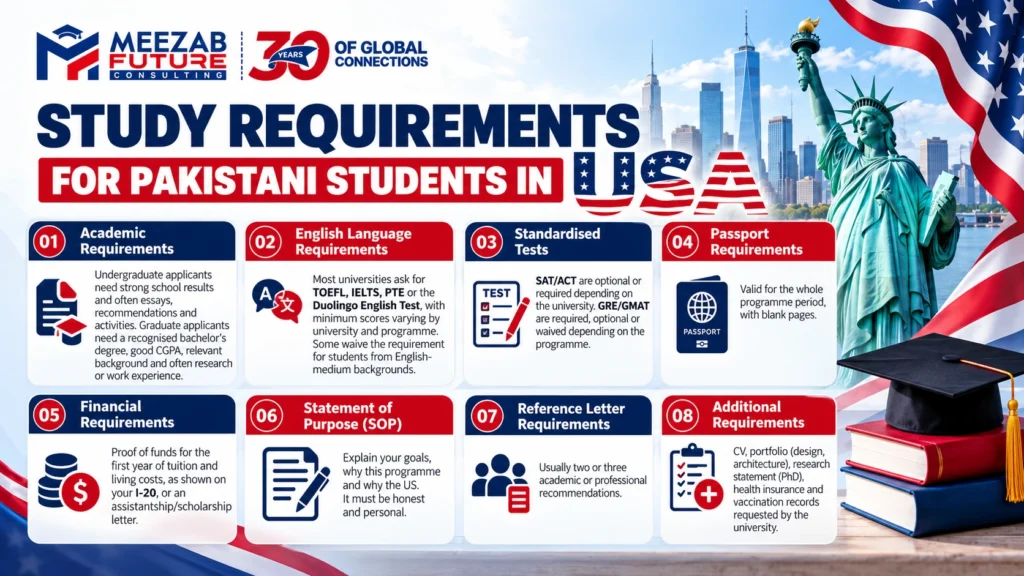
Academic requirements: Undergraduate applicants need strong school results and often essays, recommendations and activities. Graduate applicants need a recognised bachelor’s degree, good CGPA, relevant background and often research or work experience.
English language requirements: Most universities ask for TOEFL, IELTS, PTE or the Duolingo English Test, with minimum scores varying by university and programme. Some waive the requirement for students from English-medium backgrounds.
Standardised tests: SAT/ACT are optional or required depending on the university. GRE/GMAT are required, optional or waived depending on the programme.
Passport requirements: Valid for the whole programme period, with blank pages.
Financial requirements: Proof of funds for the first year of tuition and living costs, as shown on your I-20, or an assistantship/scholarship letter.
Statement of purpose/essay requirements: Explain your goals, why this programme and why the US. It must be honest and personal.
Reference letter requirements: Usually two or three academic or professional recommendations.
Additional requirements: CV, portfolio (design, architecture), research statement (PhD), health insurance and vaccination records requested by the university.
Step-by-Step: How to Study in USA from Pakistan
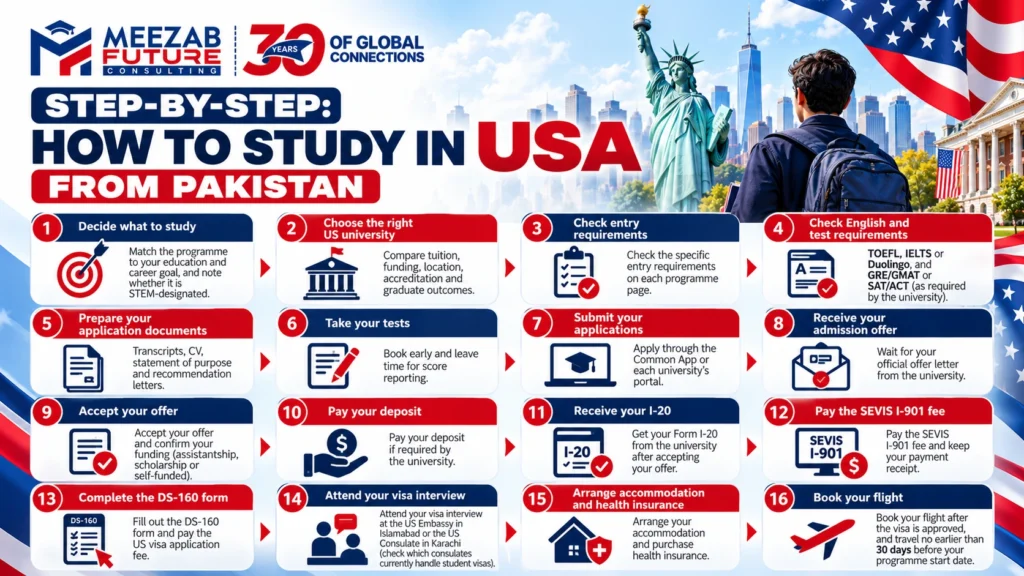
- Decide what to study. Match the programme to your education and career goal, and note whether it is STEM-designated.
- Choose the right US university. Compare tuition, funding, location, accreditation and graduate outcomes.
- Check entry requirements on each programme page.
- Check English and test requirements (TOEFL/IELTS/Duolingo, GRE/GMAT, SAT/ACT).
- Prepare your application documents. Transcripts, CV, statement of purpose, recommendations.
- Take your tests. Book early and leave time for score reporting.
- Submit your applications through the Common App or each university’s portal.
- Receive your admission offer.
- Accept your offer and confirm your funding (assistantship, scholarship or self-funded).
- Pay your deposit if required.
- Receive your I-20 from the university.
- Pay the SEVIS I-901 fee.
- Complete the DS-160 form and pay the visa fee.
- Attend your visa interview at the US Embassy in Islamabad or the US Consulate in Karachi (check which consulates currently handle student visas).
- Arrange accommodation and health insurance.
- Book your flight after the visa is approved, and travel no earlier than 30 days before your programme start date.
Documents Required to Study in USA from Pakistan
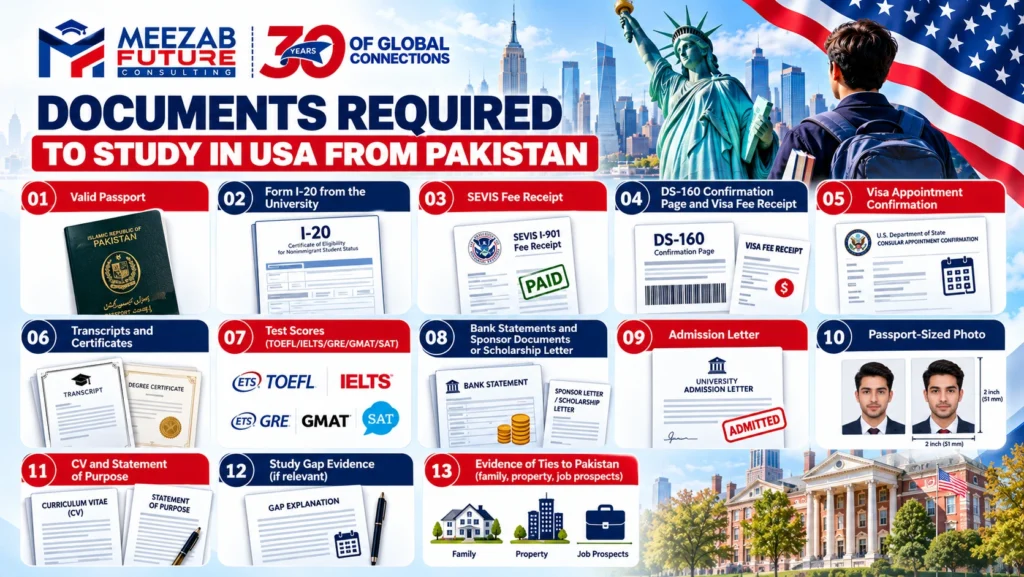
- Valid passport
- Form I-20 from the university
- SEVIS fee receipt
- DS-160 confirmation page and visa fee receipt
- Visa appointment confirmation
- Transcripts and certificates
- Test scores (TOEFL/IELTS/GRE/GMAT/SAT, as relevant)
- Bank statements and sponsor documents, or an assistantship/scholarship letter
- Admission letter
- Passport-sized photo meeting US requirements
- CV and statement of purpose
- Study gap evidence, if relevant
- Evidence of ties to Pakistan (family, property, job prospects), which can help at the interview
Best US Universities for Pakistani Students
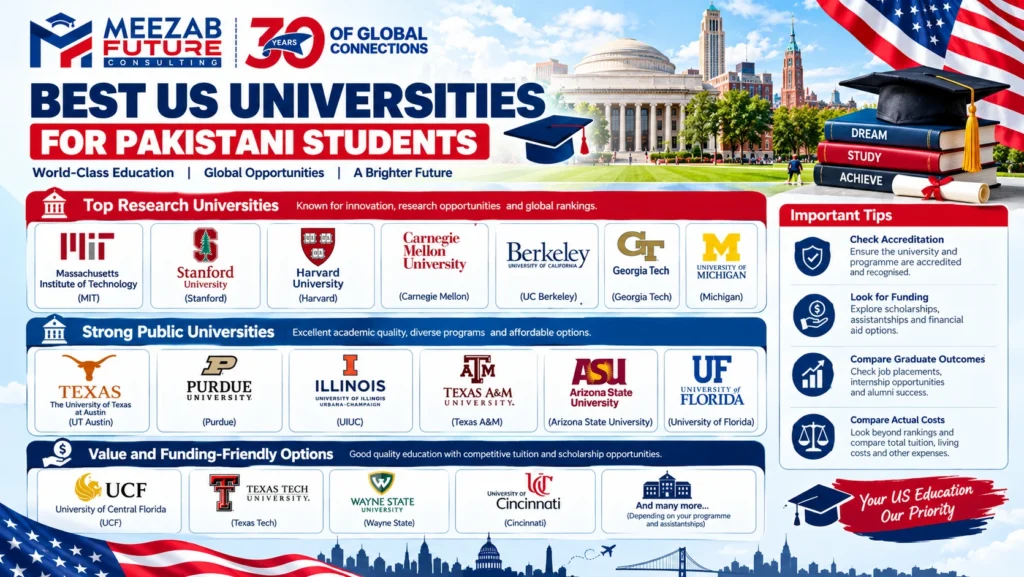
- Top research universities: MIT, Stanford, Harvard, Carnegie Mellon, UC Berkeley, Georgia Tech, University of Michigan
- Strong public universities: UT Austin, Purdue, UIUC, Texas A&M, Arizona State University, University of Florida
- Value and funding-friendly options: University of Central Florida, Texas Tech, Wayne State, University of Cincinnati and others, depending on programme and assistantships
Always check accreditation, funding availability and graduate outcomes, and compare actual costs rather than ranking alone.
Popular Courses to Study in USA
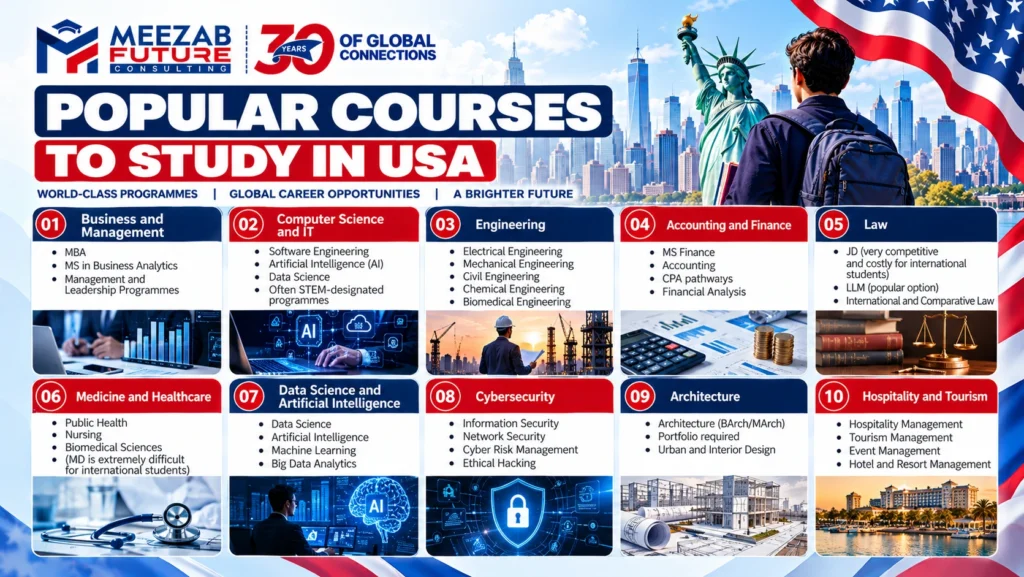
- Business and Management: MBA, MS in business analytics
- Computer Science and IT: Software, AI, data (often STEM-designated)
- Engineering: Electrical, mechanical, civil, chemical, biomedical
- Accounting and Finance: MS Finance, accounting, CPA pathways
- Law: JD (very competitive and costly) or LLM
- Medicine and Healthcare: Public health, nursing, biomedical (the MD is extremely difficult for international students)
- Data Science and Artificial Intelligence
- Cybersecurity
- Architecture: Portfolio required
- Hospitality and Tourism
Cost of Studying in USA from Pakistan
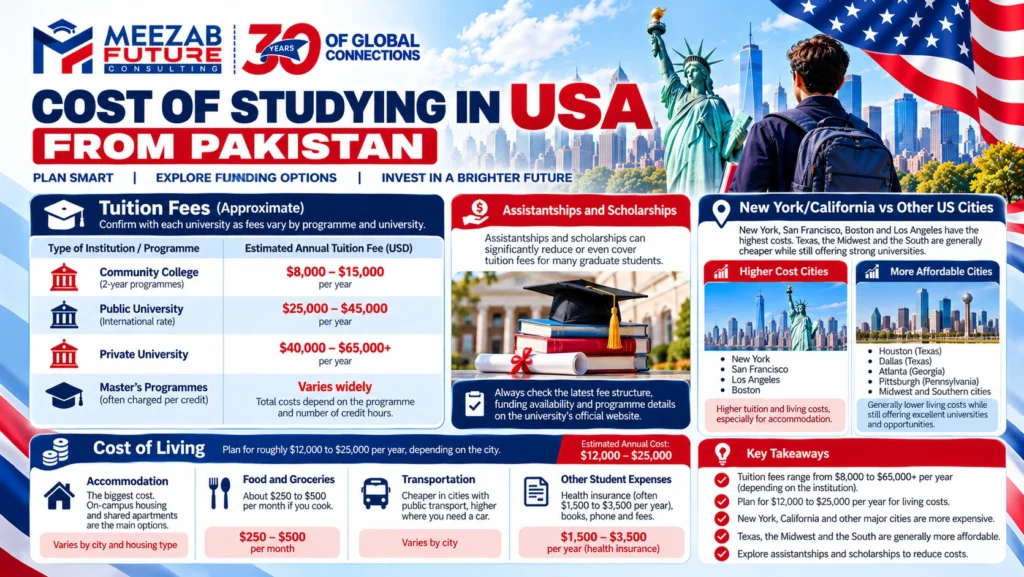
Tuition Fees (approximate, confirm with each university)
- Community college: roughly $8,000 to $15,000 per year
- Public university (international rate): roughly $25,000 to $45,000 per year
- Private university: roughly $40,000 to $65,000+ per year
- Master’s programmes: often charged per credit, with total costs varying widely
- Assistantships and scholarships can reduce or cover tuition for many graduate students
Cost of Living
Plan for roughly $12,000 to $25,000 per year, depending on the city.
- Accommodation costs: The biggest cost. On-campus housing and shared apartments are the main options.
- Food and grocery costs: About $250 to $500 per month if you cook.
- Transportation costs: Cheaper in cities with public transport, higher where you need a car.
- Other student expenses: Health insurance (often $1,500 to $3,500 per year), books, phone and fees.
New York/California vs Other US Cities
New York, San Francisco, Boston and Los Angeles have the highest costs. Texas, the Midwest and the South (for example Houston, Dallas, Atlanta, Pittsburgh) are generally cheaper while still offering strong universities.
USA Student Visa Requirements for Pakistani Students
USA Student Visa Application Process from Pakistan
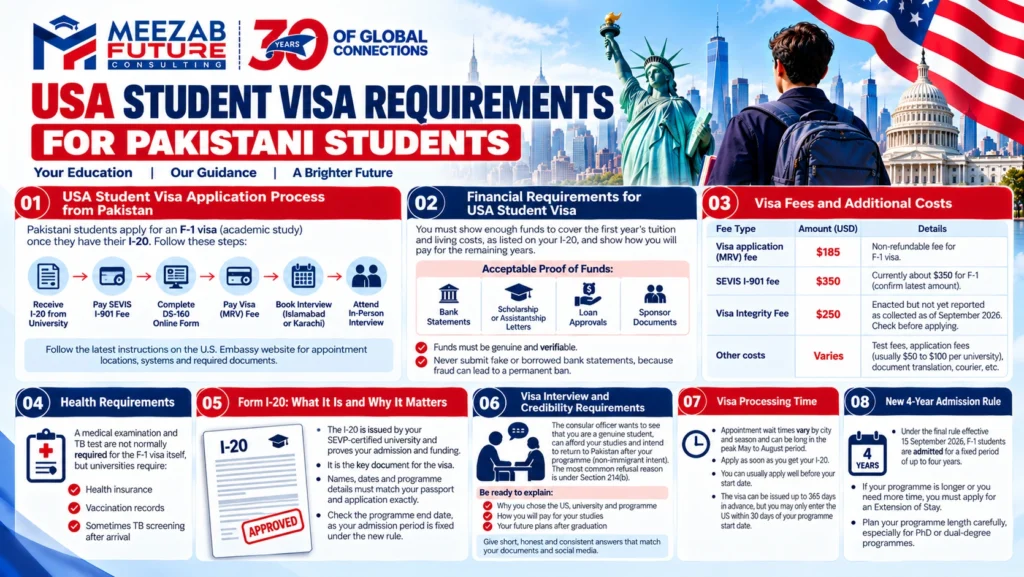
Pakistani students apply for an F-1 visa (academic study) once they have their I-20. The process is: pay the SEVIS fee, complete the DS-160, pay the visa fee, book an interview at the US Embassy in Islamabad or the US Consulate in Karachi, and attend the in-person interview. Follow the Embassy’s current instructions on locations, appointment systems and documents.
Financial Requirements for USA Student Visa
You must show enough funds to cover the first year’s tuition and living costs, as listed on your I-20, and show how you will pay for the remaining years. Acceptable proof includes bank statements, scholarship or assistantship letters, loan approvals and sponsor documents. Funds must be genuine and verifiable. Never submit fake or borrowed bank statements, because fraud can lead to a permanent ban.
Visa Fees and Additional Costs
- Visa application (MRV) fee: $185
- SEVIS I-901 fee: currently about $350 for F-1 (confirm)
- Visa Integrity Fee: $250, enacted but not yet reported as collected as of September 2026, so check before applying
- Other costs: Test fees, application fees (often $50 to $100 per university), document translation, courier
Health Requirements
A medical examination and TB test are not normally required for the F-1 visa itself, but universities require health insurance, vaccination records and sometimes TB screening after arrival.
Form I-20: What It Is and Why It Matters
The I-20 is the document issued by your SEVP-certified university that proves your admission and funding. It is the key document for the visa. Names, dates and programmes must match your passport and application exactly. Check the programme end date, because under the new rule your admission period is fixed.
Visa Interview and Credibility Requirements
The consular officer wants to see that you are a genuine student, can afford your studies and intend to return to Pakistan after your programme (this is called non-immigrant intent, and the most common refusal reason is under Section 214(b)). Be ready to explain why you chose the US, your university and programme, how you will pay and what you plan to do afterwards. Answers should be short, honest and consistent with your documents and social media.
Visa Processing Time
Appointment wait times vary by city and season and can be long in the peak May to August period. Apply as soon as you get your I-20, and you can usually apply well before your start date (the visa can be issued up to 365 days in advance, but you may only enter the US within 30 days of your programme start).
New 4-Year Admission Rule
Under the final rule effective 15 September 2026, F-1 students are admitted for a fixed period of up to four years. If your programme is longer or you need more time, you must apply for an Extension of Stay. Plan your programme length carefully, especially for PhD or dual-degree programmes.
Scholarships for Pakistani Students in USA
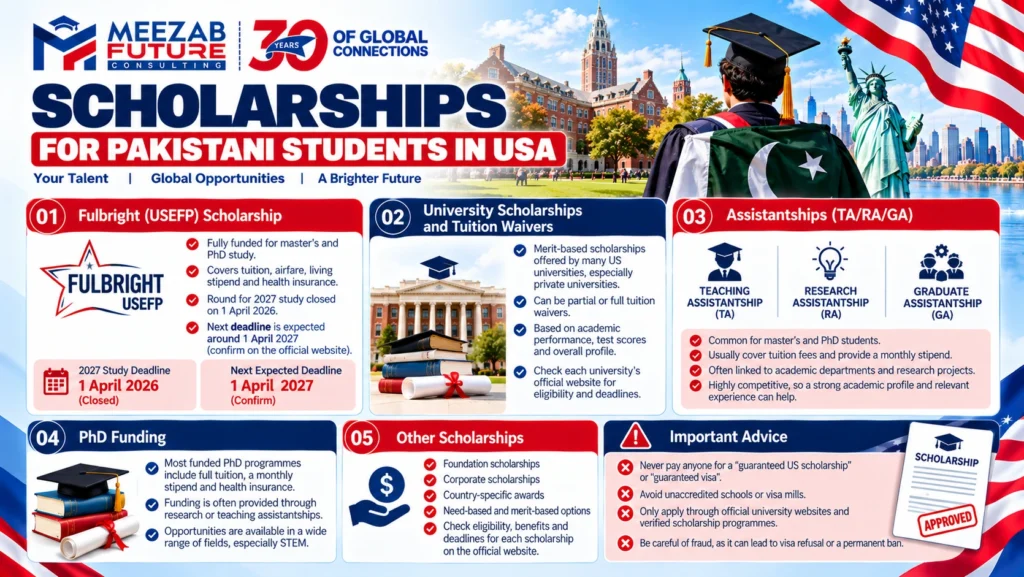
- Fulbright (USEFP): Fully funded for master’s and PhD study, covering tuition, airfare, living stipend and health insurance. The round for 2027 study closed on 1 April 2026, and the next deadline is expected around 1 April 2027 (confirm).
- University scholarships and tuition waivers: Merit-based awards, especially at private universities.
- Assistantships (TA/RA/GA): Common for master’s and PhD students, covering tuition and a stipend.
- PhD funding: Most funded PhD programmes include tuition, stipend and insurance.
- Other scholarships: Foundation, corporate and country-specific awards. Check each carefully.
Beware: Never pay anyone for a “guaranteed US scholarship” or “guaranteed visa”, and avoid unaccredited schools or visa mills.
Intakes and Application Deadlines for 2027
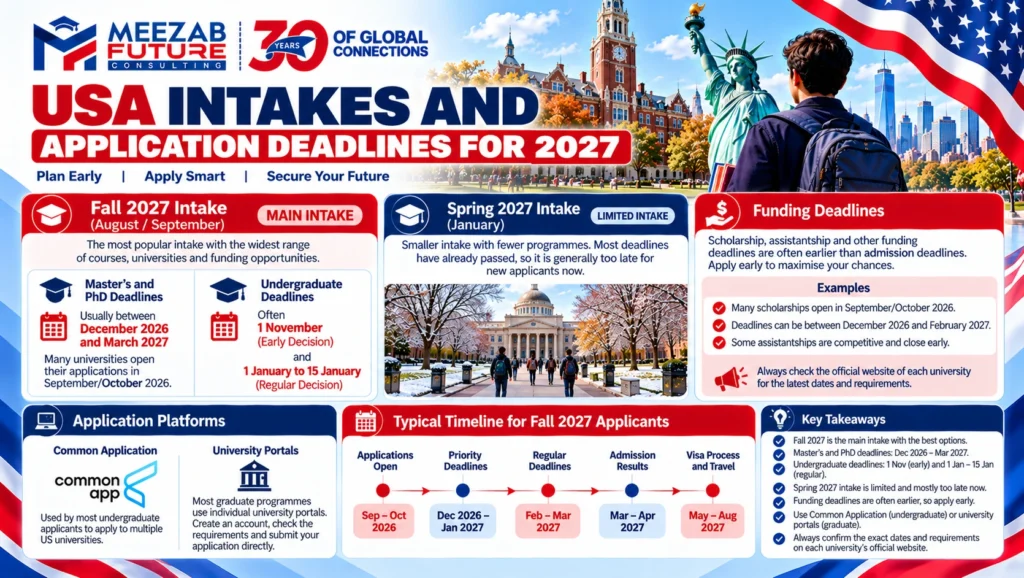
- Fall 2027 (August/September): The main intake. Master’s and PhD deadlines usually fall between December 2026 and March 2027, and many open in September/October 2026. Undergraduate deadlines are often 1 November (early) and January 1 to 15 (regular).
- Spring 2027 (January): Limited and mostly too late for new applicants now.
- Funding deadlines: Often earlier than admission deadlines, so apply early for assistantships.
Application platforms: Common Application for most undergraduate applications, and university portals for graduate programmes. Check each programme’s own deadline and requirements.
Best US Cities for Pakistani Students
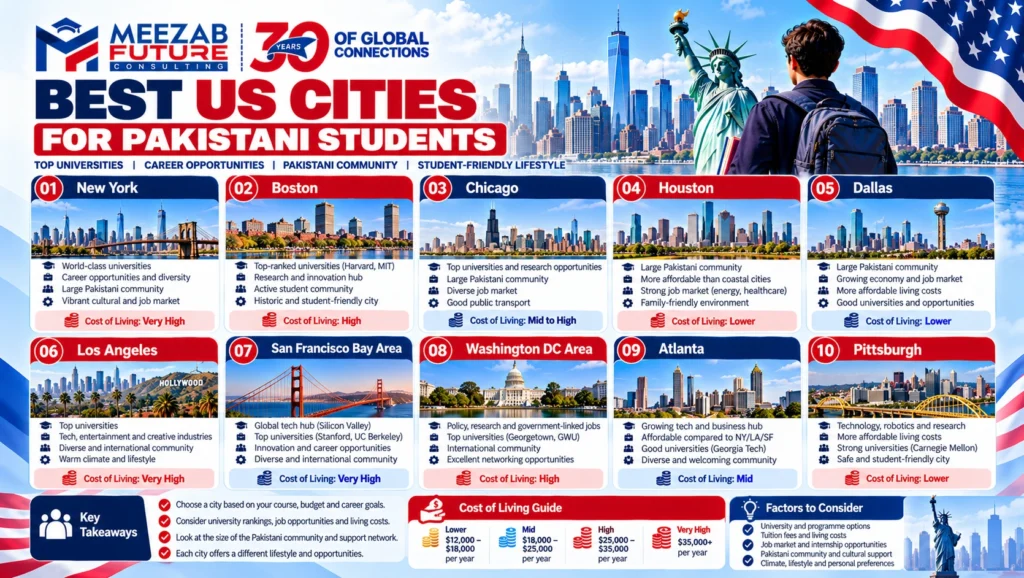
- New York: Opportunities and diversity, very high cost
- Boston: Top universities, high cost
- Chicago: Large Pakistani community, mid-high cost
- Houston and Dallas: Large Pakistani communities, lower costs
- Los Angeles and San Francisco Bay Area: Tech and entertainment, very high rents
- Washington DC area: Policy, research and government-linked jobs
- Atlanta: Growing tech and business hub
- Austin: Tech and strong public university
- Pittsburgh: Technology and robotics, lower cost
- Seattle: Technology centre, high cost
Accommodation Options for Pakistani Students in USA
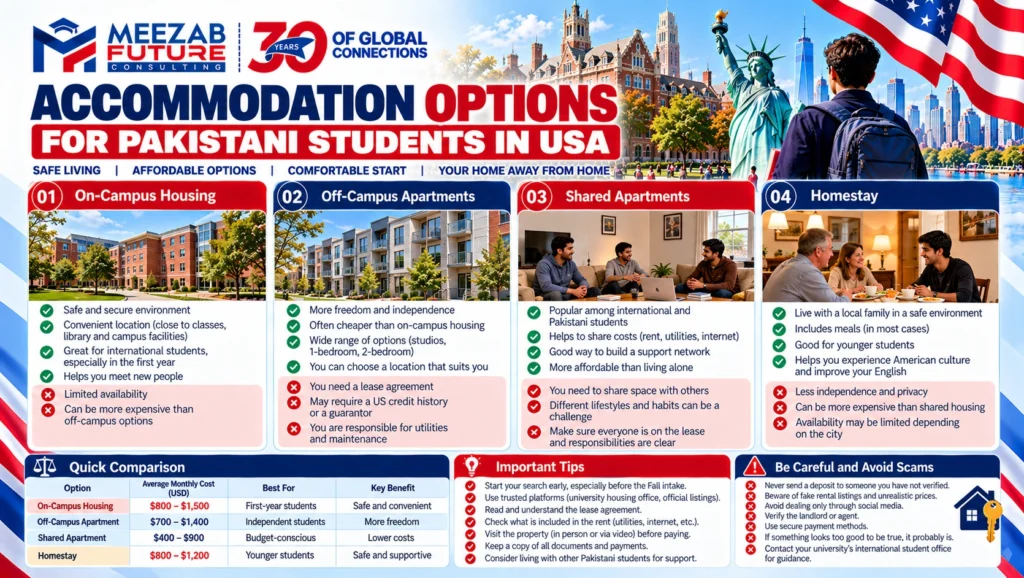
- On-campus housing: Safe and convenient, especially in year one, but limited.
- Off-campus apartments: More freedom and often cheaper, but need a lease and sometimes a US credit history or guarantor.
- Shared apartments: Popular for sharing costs.
- Homestay: Common for younger students.
Never send a deposit to someone you have not verified, and beware of fake rental listings.
Part-Time Work for Pakistani Students in USA
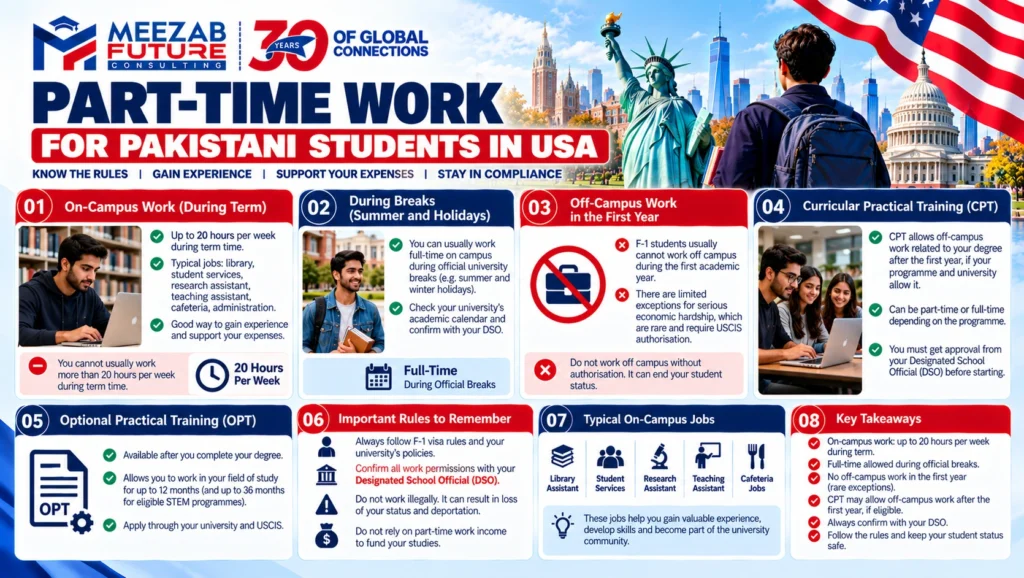
F-1 students can work on campus for up to 20 hours per week during term and full-time during breaks, and usually cannot work off campus in the first year. Curricular Practical Training (CPT) may allow work related to your degree after the first year, if the programme and university allow it. Working illegally can end your status, so always confirm with your Designated School Official (DSO) first. Do not rely on work income to fund your studies.
Post-Study Work Options in USA
OPT and STEM OPT
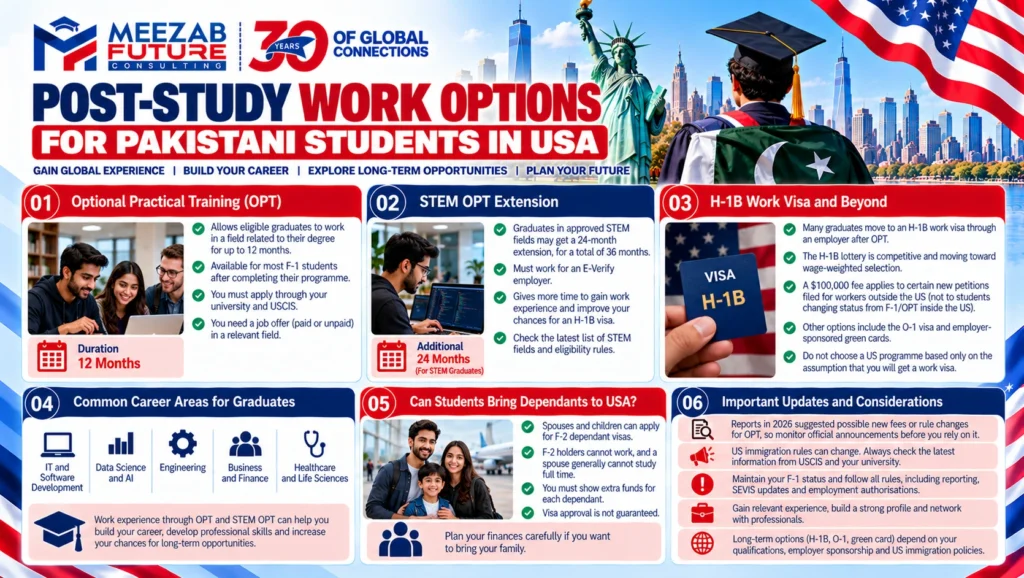
Optional Practical Training (OPT) allows eligible graduates to work for 12 months in a field related to their degree. Graduates in approved STEM fields may get a 24-month STEM OPT extension. Reports in 2026 suggested possible new fees or rule changes for OPT, so monitor official announcements before you rely on it.
H-1B and Beyond
After OPT, many students move to an H-1B work visa through an employer. The H-1B lottery is competitive and moving toward wage-weighted selection, and a $100,000 fee applies to certain new petitions filed for workers outside the US (not to students changing status from F-1/OPT inside the US). Other routes include the O-1 and employer-sponsored green cards. Do not choose a US programme based only on the assumption that you will get a work visa.
Can Students Bring Dependants to USA?
Spouses and children can apply for F-2 dependant visas, but F-2 holders cannot work, and a spouse generally cannot study full time. You must show extra funds for each dependant, and visa approval is not guaranteed.
Life as a Pakistani Student in USA
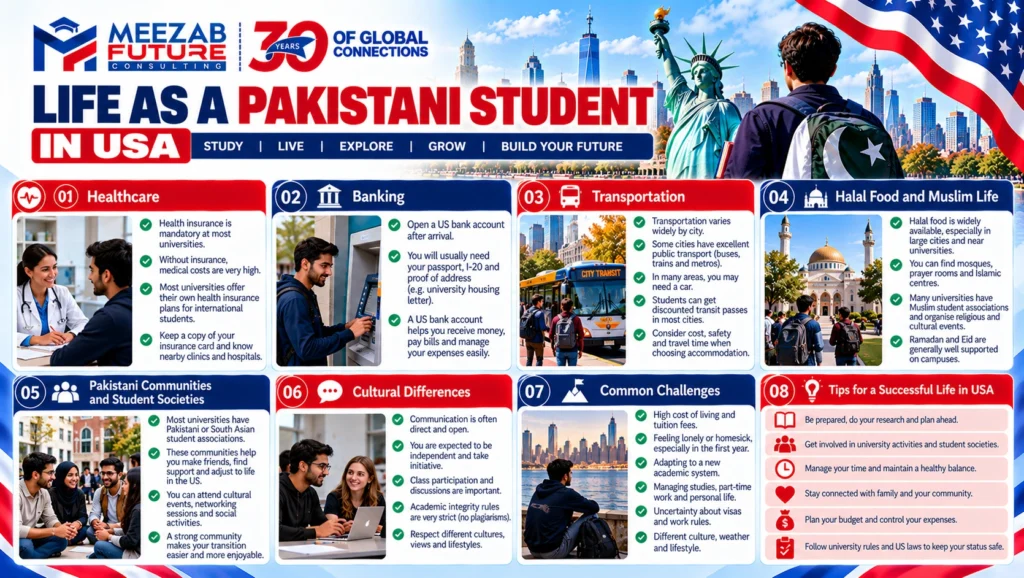
- Healthcare: Health insurance is mandatory at most universities, and costs are high without it.
- Banking: Open a US bank account after arrival with your passport, I-20 and proof of address.
- Transportation: Varies widely. Some cities have good transit, others require a car.
- Halal food and Muslim life: Halal food, mosques and Muslim student associations are widely available, especially in large cities and near universities.
- Pakistani communities and student societies: Most universities have Pakistani or South Asian student associations.
- Cultural differences: Direct communication, independence, class participation and strict academic integrity rules.
- Common challenges: Cost, loneliness, adapting to a new academic system and uncertainty about visas and work rules.
Budget and Practical Tips
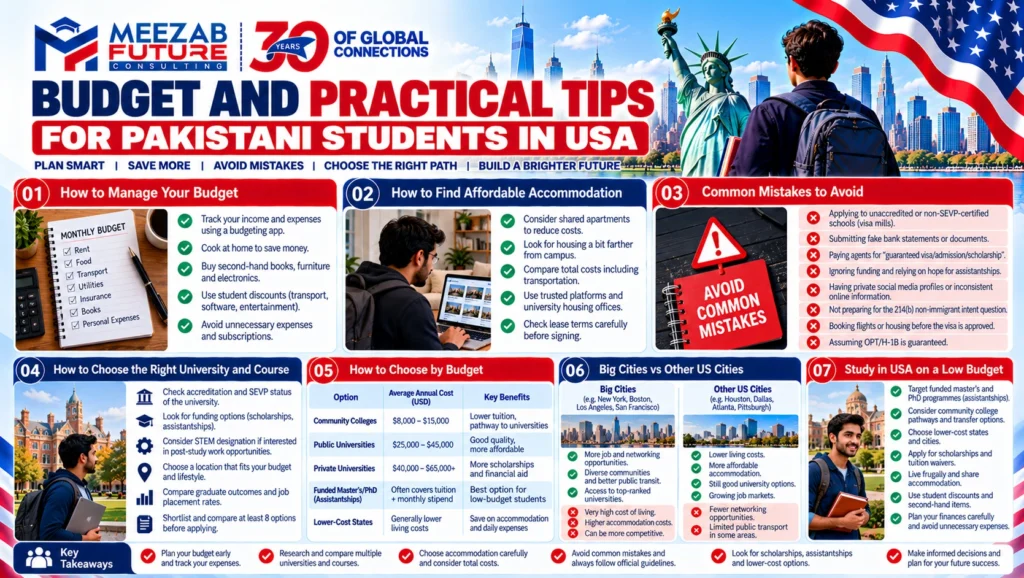
- How to manage your budget: Track spending, cook at home, buy second-hand items and use student discounts.
- How to find affordable accommodation: Share an apartment, live farther from campus and compare total costs including transport.
- Common mistakes to avoid:
- Applying to unaccredited or non-SEVP-certified schools (visa mills)
- Submitting fake bank statements or documents
- Paying agents for “guaranteed visa/admission/scholarship”
- Ignoring funding and relying on hope for assistantships
- Having private social media profiles or inconsistent online information
- Not preparing for the 214(b) non-immigrant intent question
- Booking flights or housing before the visa is approved
- Assuming OPT/H-1B is guaranteed
- How to choose the right university and course: Check accreditation, funding, STEM designation, location and graduate outcomes. Compare at least eight options.
- How to choose by budget: Look for assistantships, scholarships, public universities and lower-cost cities.
- Big cities vs other US cities: Choose big cities for networks, and smaller cities for savings.
- Study in USA on a low budget: Target funded master’s and PhD programmes, community college pathways and lower-cost states.
Study in USA Without IELTS
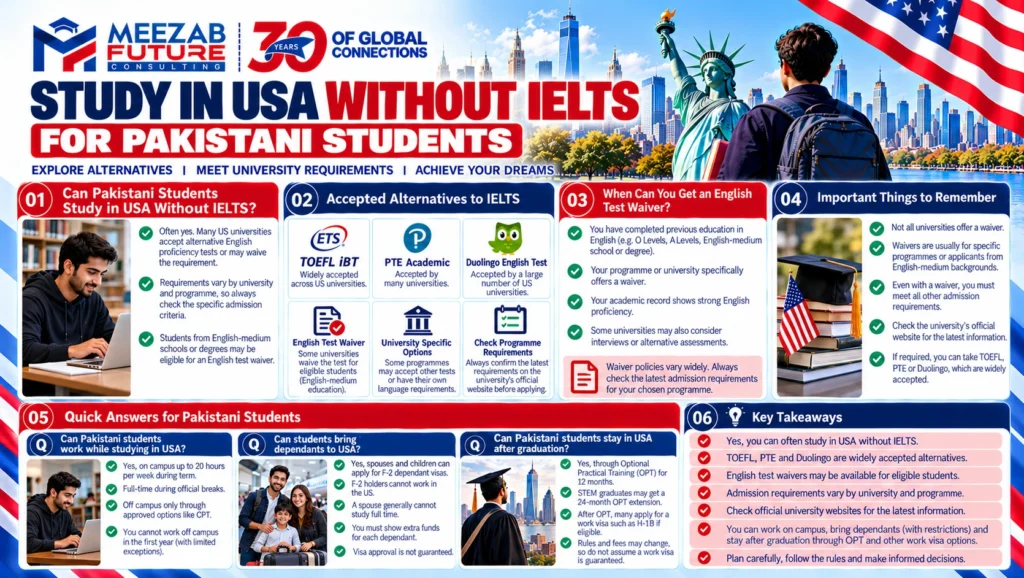
Can Pakistani Students Study in USA Without IELTS?
Often yes. Most US universities accept TOEFL, PTE or the Duolingo English Test as alternatives, and some waive English tests for students from English-medium schools or degrees. Requirements vary by programme, so check each one.
Quick Answers
- Can Pakistani students work while studying in USA? Yes, on campus up to 20 hours per week in term, and off campus only through approved options like CPT.
- Can students bring dependants? Yes, on F-2 visas, but they cannot work.
- Can Pakistani students stay in USA after graduation? Yes, through OPT/STEM OPT and then a work visa such as H-1B if eligible, but rules are uncertain.
What to Do After Receiving Your USA Student Visa
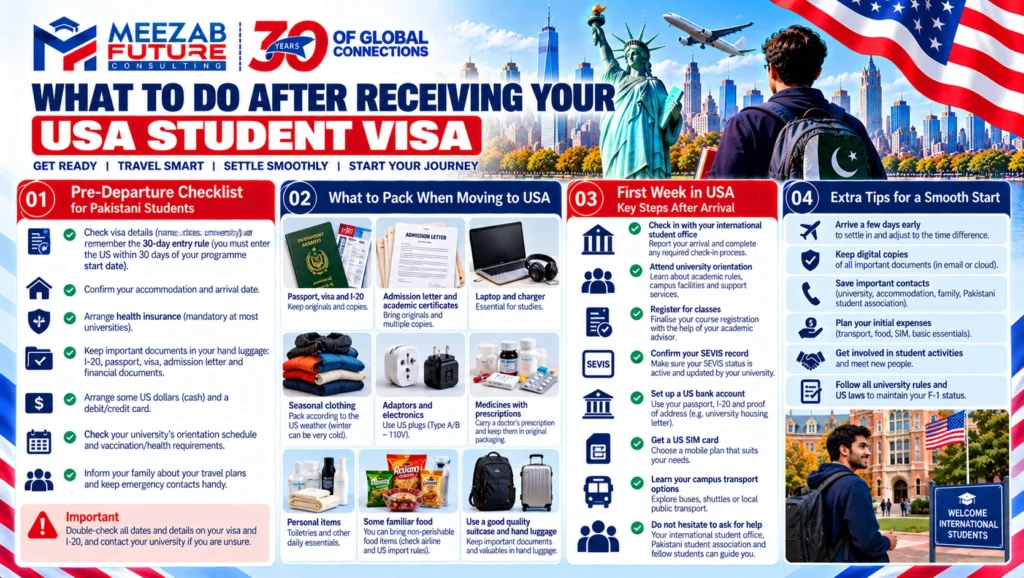
Pre-Departure Checklist for Pakistani Students
- Check visa details and the 30-day entry rule
- Confirm accommodation and arrival date
- Arrange health insurance
- Keep your I-20, passport, admission letter and financial documents in hand luggage
- Arrange some US dollars and a card
- Check university orientation and vaccination requirements
What to Pack When Moving to USA
Passport, visa, I-20, admission letter, certificates (with copies), seasonal clothing, adaptors (US plugs), medicines with prescriptions, laptop and some familiar food (check airline and import rules).
First Week in USA
Check in with your international student office, complete orientation, register for classes, confirm your SEVIS record, set up a bank account, get a SIM, and learn your campus transport options.
How Meezab Future Consulting Helps Pakistani Students Study in USA
- University and course selection: Realistic shortlisting based on profile, budget and funding
- Admission application support: Applications, essays, recommendations and deadline tracking
- Document guidance: Transcripts, financial documents and consistency checks
- Scholarship and funding guidance: Assistantships, university aid and Fulbright preparation (we never promise guaranteed scholarships)
- I-20 guidance: Checking details and conditions
- USA student visa guidance: DS-160, interview preparation and honest advice about risks
- Pre-departure support: Housing, packing and arrival planning
(Add your office address, phone, WhatsApp and booking link. Avoid “guaranteed visa/admission” claims and never encourage fake documents.)
Study in USA from Pakistan: Complete Application Timeline (Fall 2027)
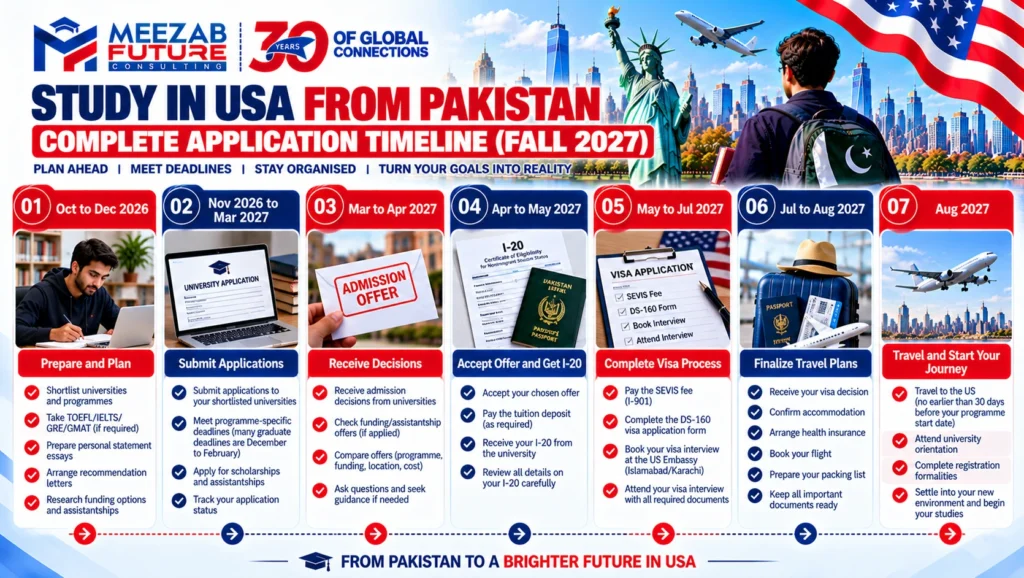
| When | What to do |
|---|---|
| Oct to Dec 2026 | Shortlist programmes, take TOEFL/IELTS/GRE/GMAT, prepare essays and recommendations |
| Nov 2026 to Mar 2027 | Submit applications (many grad deadlines Dec to Feb), apply for assistantships |
| Mar to Apr 2027 | Receive admission and funding decisions, compare offers |
| Apr to May 2027 | Accept offer, pay deposit, receive I-20 |
| May to Jul 2027 | Pay SEVIS fee, complete DS-160, book and attend visa interview |
| Jul to Aug 2027 | Visa decision, accommodation, insurance, flight |
| Aug 2027 | Travel (no earlier than 30 days before programme start) and orientation |
Study in USA from Pakistan: Complete Cost Breakdown (first year, approximate)
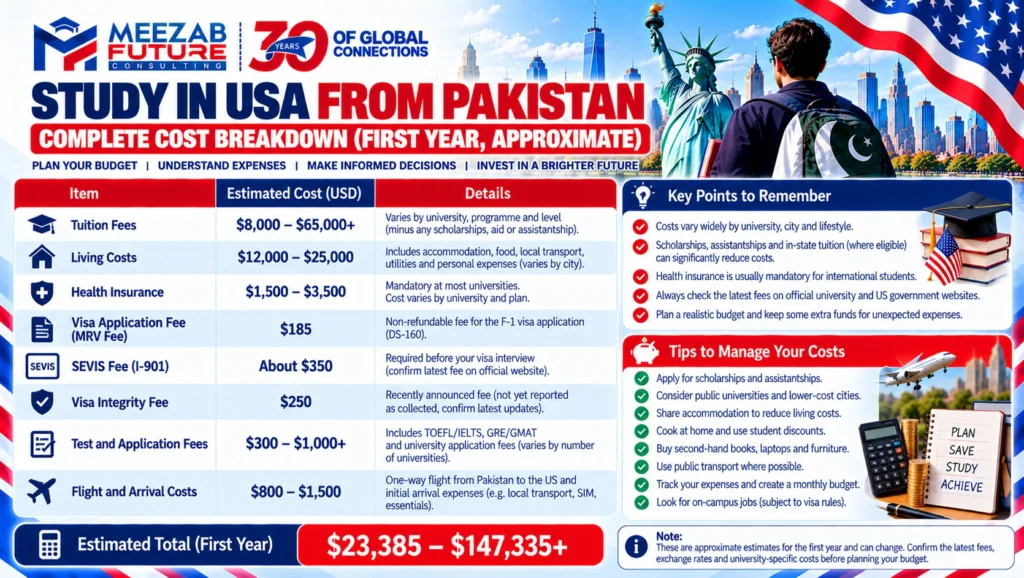
| Item | Estimate |
|---|---|
| Tuition | About $8,000 to $65,000+ (minus any aid or assistantship) |
| Living costs | About $12,000 to $25,000 |
| Health insurance | About $1,500 to $3,500 |
| Visa application fee | $185 |
| SEVIS fee | About $350 (confirm) |
| Visa Integrity Fee | $250 (not yet reported as collected, confirm) |
| Test and application fees | About $300 to $1,000+ |
| Flight and arrival | About $800 to $1,500 |
Study in USA from Pakistan: Document Checklist
- ☐ Passport
- ☐ I-20
- ☐ SEVIS fee receipt
- ☐ DS-160 confirmation
- ☐ Visa fee receipt
- ☐ Interview appointment letter
- ☐ Transcripts and certificates
- ☐ Test scores
- ☐ Bank statements/sponsor documents
- ☐ Admission and funding letters
- ☐ Photo
- ☐ CV and statement of purpose
- ☐ Study gap evidence
- ☐ Proof of ties to Pakistan
Study in USA from Pakistan: Step-by-Step Checklist
- ☐ Course chosen
- ☐ Universities shortlisted
- ☐ Tests booked
- ☐ Applications submitted
- ☐ Admission received
- ☐ Funding confirmed
- ☐ I-20 received
- ☐ SEVIS fee paid
- ☐ DS-160 completed
- ☐ Visa interview attended
- ☐ Visa received
- ☐ Accommodation booked
- ☐ Insurance arranged
- ☐ Flight booked
Frequently Asked Questions About Studying in USA from Pakistan (2027)
How can I study in USA from Pakistan?
Apply to SEVP-certified universities, receive your admission and I-20, pay the SEVIS fee, apply for an F-1 visa and attend the in-person interview.
How much does it cost to study in USA from Pakistan?
Many students spend roughly $20,000 to $80,000+ per year in total (tuition plus living costs), depending on university and city. Assistantships and scholarships can reduce this significantly.
What are the requirements to study in USA?
Academic qualifications, English proof, standardised tests where required, passport, funds, I-20 and a visa.
Can I study in USA after FSC?
Yes, for a bachelor’s degree, subject to each university’s rules, tests and credit policies.
Can I study in USA after a bachelor’s degree?
Yes, for a master’s degree, usually with a 16-year degree.
Is IELTS required to study in USA?
Not always. Many universities accept TOEFL, PTE or Duolingo instead, and some waive tests for English-medium backgrounds.
How much bank balance is required for a USA student visa?
There is no single fixed figure. You must show funds for at least the first year of tuition and living costs as listed on your I-20, plus how you will fund later years.
How long does a USA student visa take?
Appointment wait times vary, and peak season is May to August. Apply as soon as you receive your I-20.
Can Pakistani students work in USA while studying?
Yes, on campus up to 20 hours per week during term, and off campus only through approved options such as CPT.
Can I get a scholarship to study in USA?
Yes, through university scholarships, assistantships and Fulbright, with the next Fulbright deadline expected around 1 April 2027 (confirm).
What are the intakes for international students?
Mainly Fall (August/September) and Spring (January).
Can I study in USA with a study gap?
Yes, if you can explain and document it, and prepare to discuss it at the visa interview.
Can I bring my family to USA as a student?
Yes, on F-2 visas, but they cannot work and must be financially supported.
Can I stay in USA after completing my studies?
Yes, through OPT/STEM OPT and possibly a work visa such as H-1B, but rules and fees may change.
What is the new 4-year rule for F-1 students?
Since 15 September 2026, F-1 students are admitted for a fixed period of up to four years instead of “duration of status”, and need an Extension of Stay if they need longer.
How can Meezab Future Consulting help me study in USA?
With university selection, applications, funding preparation, visa interview guidance and pre-departure planning, with honest advice about risks.