Business and Management is the most in-demand subject among international students heading to the UK, with 18% of interest in the 2026 QS International Student Survey. Creative Arts and Design, Engineering and Technology, Law and health subjects follow. This guide covers the most popular courses, what they cost, and what to think about before you choose.
1. Business and Management
Business and Management is the single most popular subject for international students in the UK. The 2026 QS survey puts it at 18% of UK-bound interest, well ahead of any other subject. At taught postgraduate level it is also the largest subject by head count: in 2021-22 HESA data, about 132,900 students took it, and 73% of them were international.
Popular options: MSc Management, International Business, Marketing, Human Resource Management, Accounting and Finance, and the MBA.
Why students choose it: The courses are widely available, many universities accept students from a range of academic backgrounds, and the degree fits many career paths.
What to watch: Because so many students take it, the subject is crowded. A degree from a university with strong employer links, placements or an accredited programme (such as ACCA or CIMA exemptions in accounting) helps you stand out. The MBA is the most expensive option, as the fee table below shows.
2. Computer Science, AI and Data Science
Computing is the second-largest taught postgraduate subject for international students, with about 32,900 students in 2021-22, of whom 69% were international. Interest in artificial intelligence is rising fast: one 2025 report cited a 42% increase in AI-related degree enrolments in the UK.
Popular options: BSc Computer Science, MSc Computer Science, Artificial Intelligence, Data Science, Cyber Security and Software Engineering.
Why students choose it: Data and digital skills are in demand across almost every industry, and some digital and data roles appear on the UK government’s Temporary Shortage List for the Skilled Worker visa.
What to watch: Check the course content, not just the title. Some universities teach hands-on programming and machine learning, while others focus on theory or business use. Maths and programming experience are often expected for entry.
3. Engineering and Technology
Engineering and Technology draws 9% of UK-bound international interest in the 2026 QS survey, down from 12% in 2024 and 11% in 2025. It remains a core subject for international students: in 2021-22, 75% of taught postgraduate students in this area were international.
Popular options: Civil, Mechanical, Electrical and Electronic, Aerospace, Chemical and Biomedical Engineering, plus fast-growing areas such as renewable energy and robotics.
Why students choose it: UK engineering degrees are often accredited by professional bodies, which helps with professional registration, and the subject is practical and project-based.
What to watch: Engineering has some of the highest tuition fees outside medicine. Some courses in sensitive technical fields also need an ATAS certificate before you can apply for a visa, so ask the university early. Also check that the programme is accredited by the right institution, such as the IMechE, ICE or IET.
4. Law
Law attracts 8% of UK-bound international interest in the 2026 QS survey, up from 6% in 2022. English law has a global reputation, and the UK is a major centre for international commercial law.
Popular options: LLB (undergraduate law), LLM in International Commercial Law, Human Rights Law, Corporate Law and Intellectual Property Law.
Why students choose it: UK law degrees are respected worldwide, and an LLM can be completed in about one year.
What to watch: An LLM does not by itself qualify you to practise in the UK. To work as a solicitor or barrister you need further qualifications, and international students should check the current routes on the Solicitors Regulation Authority and Bar Standards Board websites. If you plan to practise in Pakistan, confirm the local recognition rules before you choose.
5. Health, Nursing and Medicine
Subjects allied to medicine draw 6% of UK-bound international interest, and Medicine and Dentistry also draw 6%, according to the 2026 QS survey. Nursing and allied health courses are mostly taken by UK students, with 16% of taught postgraduate students in nursing and allied health international in 2021-22, so the competition for places is different from business or computing.
Popular options: Nursing, Public Health, Pharmacy, Physiotherapy, Biomedical Science, Psychology, and Medicine or Dentistry.
Why students choose it: Health careers are tied to clear job roles and professional registration. One 2025 report cited over 94% of UK nursing graduates in work within six months of graduating.
What to watch: Medicine and Dentistry are the most expensive and most competitive courses, with international fees from about £30,000 a year. Clinical courses also need professional registration, extra checks and sometimes extra tests, so confirm the requirements with the university and the regulator before applying.
6. Creative Arts, Design and Media
Creative Arts and Design is the fastest-rising subject on the list: it drew 9% of UK-bound international interest in 2026, up from 5% in 2022. More than half of taught postgraduate students in design and the creative and performing arts were international in 2021-22 (54%).
Popular options: Fashion, Graphic Design, Animation, Film and Media, Architecture, Music and Performing Arts.
Why students choose it: London and other UK cities have strong creative industries, and courses are often portfolio-based and project-led.
What to watch: Most courses ask for a portfolio or an audition. Creative roles are among those the Migration Advisory Committee recommended removing from the Temporary Shortage List, so think about how you would build a career path through work experience, internships and your portfolio.
Tuition fees compared
International fees depend on the subject and the university. These are typical yearly ranges for 2026 from one cost guide, and individual universities can charge less or more. Oxford and Cambridge sit at the top of the undergraduate range, and more affordable universities can charge well below it.
| Subject | Undergraduate (per year) | Master’s (per year) |
|---|---|---|
| Arts, Humanities, Social Sciences | £15,000 to £25,000 | £16,000 to £28,000 |
| Nursing and Health Sciences | £16,000 to £26,000 | £18,000 to £28,000 (MPH) |
| Business and Management | £17,000 to £30,000 | £35,000 to £75,000 (MBA) |
| Computer Science | £18,000 to £32,000 | £22,000 to £35,000 |
| Law | £18,000 to £32,000 | £20,000 to £40,000 (LLM) |
| Engineering | £19,000 to £33,000 | £22,000 to £35,000 |
| Medicine (MBBS) | £30,000 to £55,000 | Not listed |
Master’s courses in Finance and Economics are typically £25,000 to £40,000 a year. Remember to add your living costs, which you must also show for your visa, plus the visa fee and health surcharge.
How to choose the right course
A popular course is not automatically the right one for you. Use these checks before you commit:
- Start from your goal. Decide whether you want a job in the UK, a job in Pakistan, or further study, and pick a course that supports it.
- Check accreditation and recognition. Professional courses (engineering, law, accounting, health) should be recognised by the right professional body, and your degree should be recognised where you plan to work.
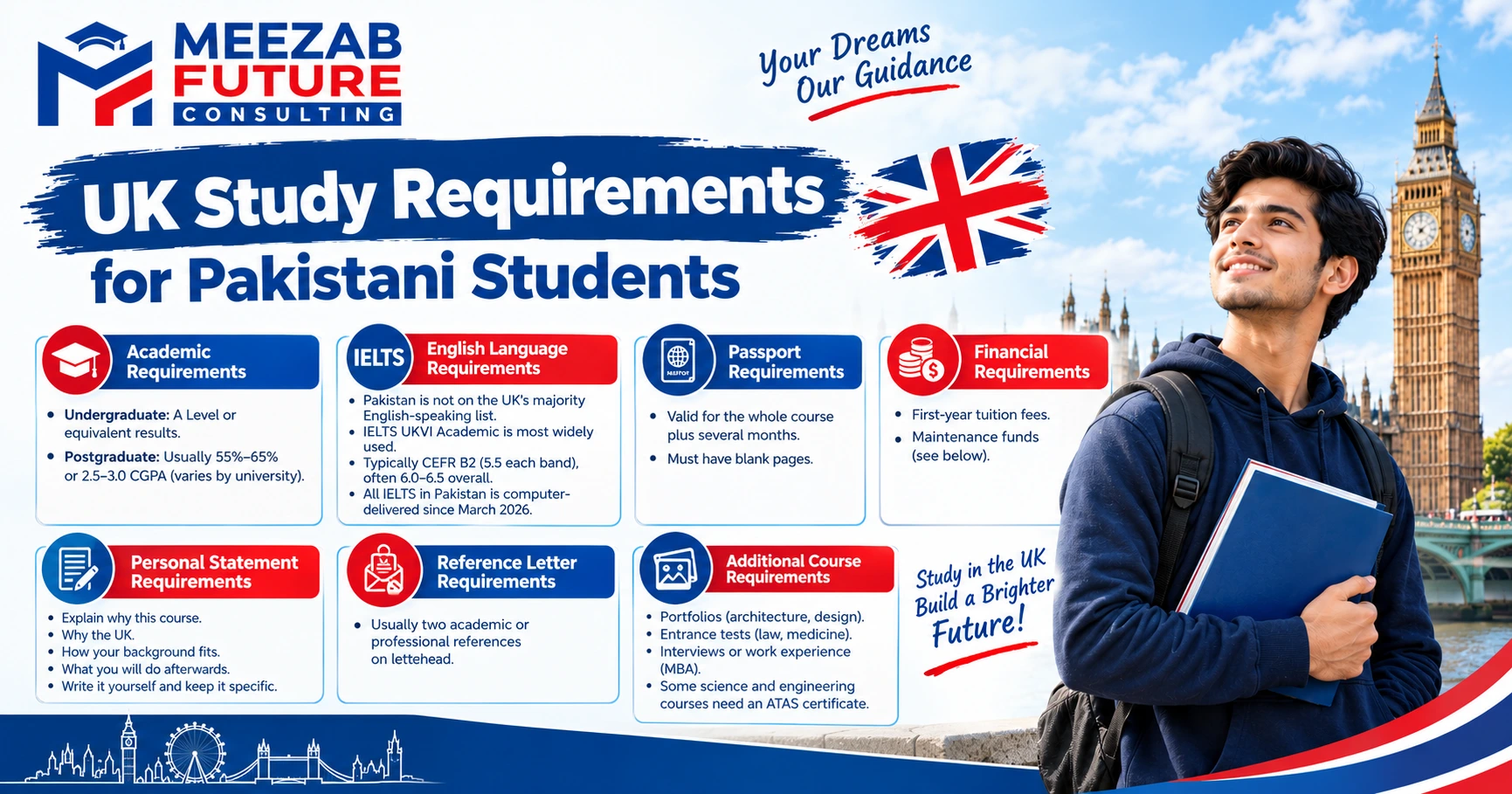
- Compare total cost. Add tuition, the visa fee, the health surcharge and living funds. From 30 November 2026 you must show £1,203 a month outside London or £1,570 a month in London, for up to nine months.
- Look at the university, not only the subject. Compare employer links, placements, location and teaching style.
- Check scholarships. Some universities fund a share of fees for strong applicants, and deadlines can be early.
Staying to work after your degree
The Graduate Route lets bachelor’s and master’s graduates stay for 18 months if they apply on or after 1 January 2027 (2 years if they apply before then), and PhD graduates for 3 years. After that, most people need a Skilled Worker visa, which generally requires a job at degree level (RQF Level 6), although some shortage occupations below that level have qualified.
The Migration Advisory Committee recommended in July 2026 cutting the Temporary Shortage List from 52 to 28 occupations from 1 January 2027, keeping areas such as data analysis, digital infrastructure and engineering and construction roles, and dropping roles such as business sales, HR, legal and creative jobs. At the time of that report the government had not confirmed the change, so check the current list before you rely on it.
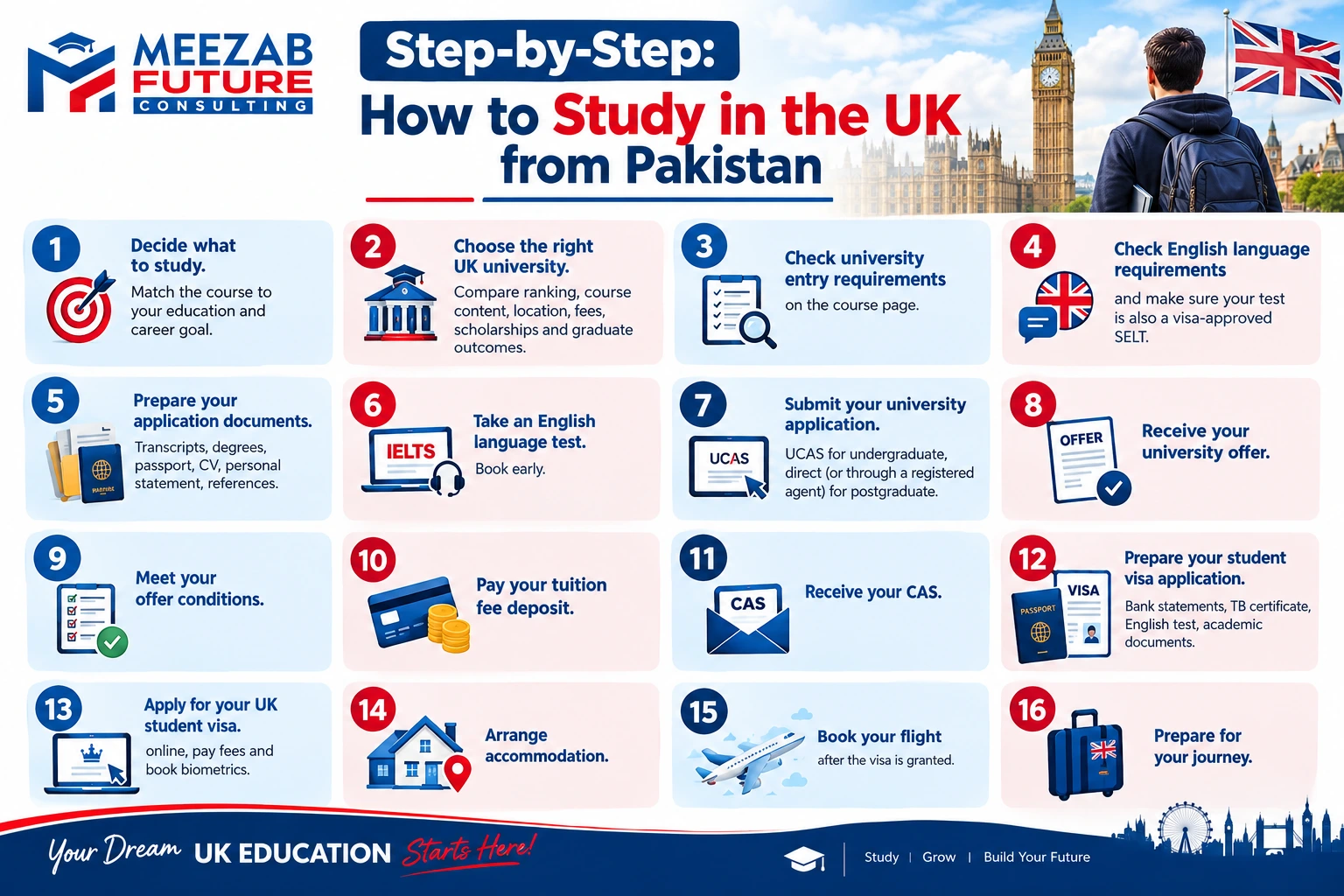
If you are ready to apply, see our step-by-step guide to studying in the UK from Pakistan.