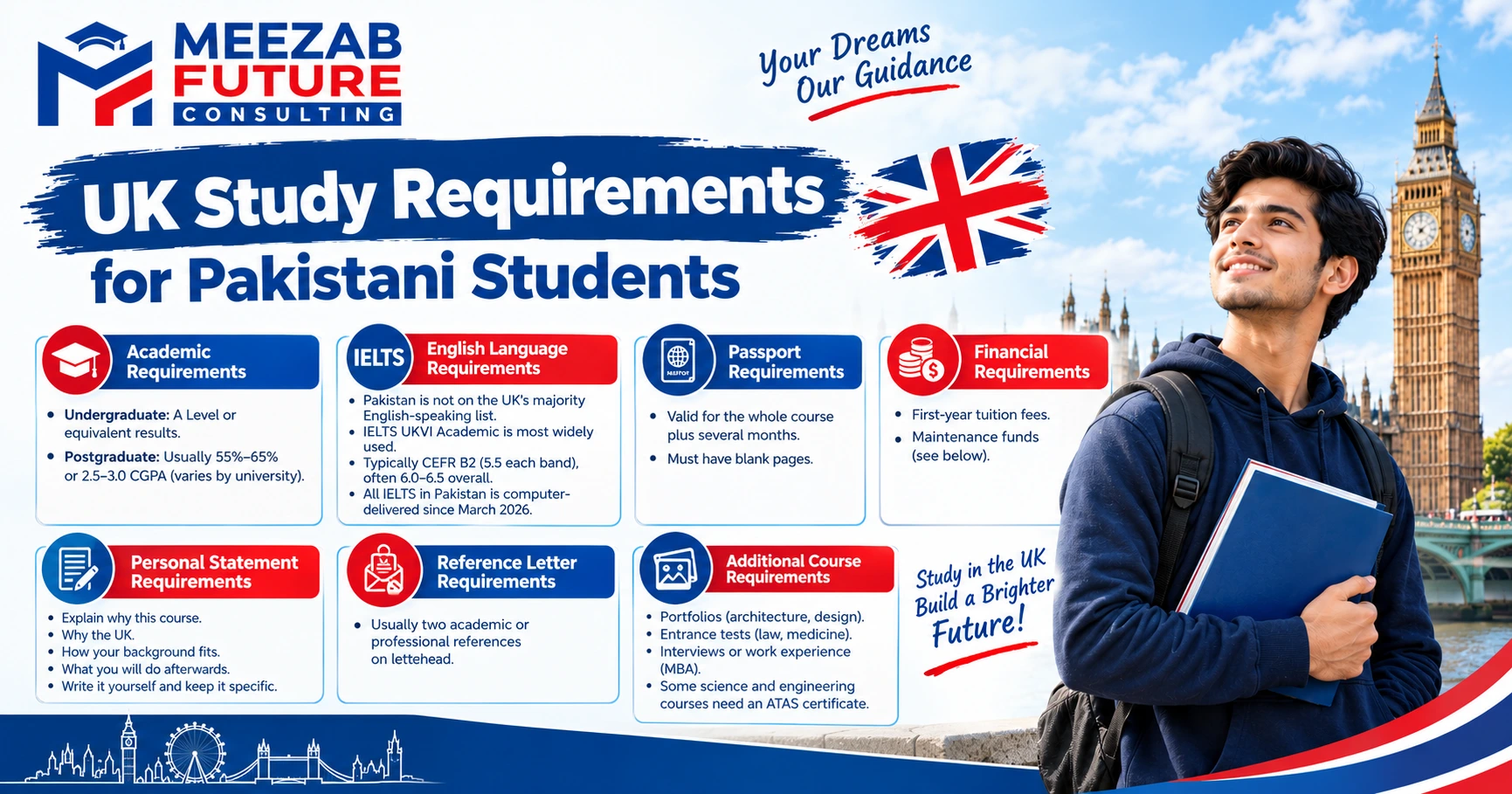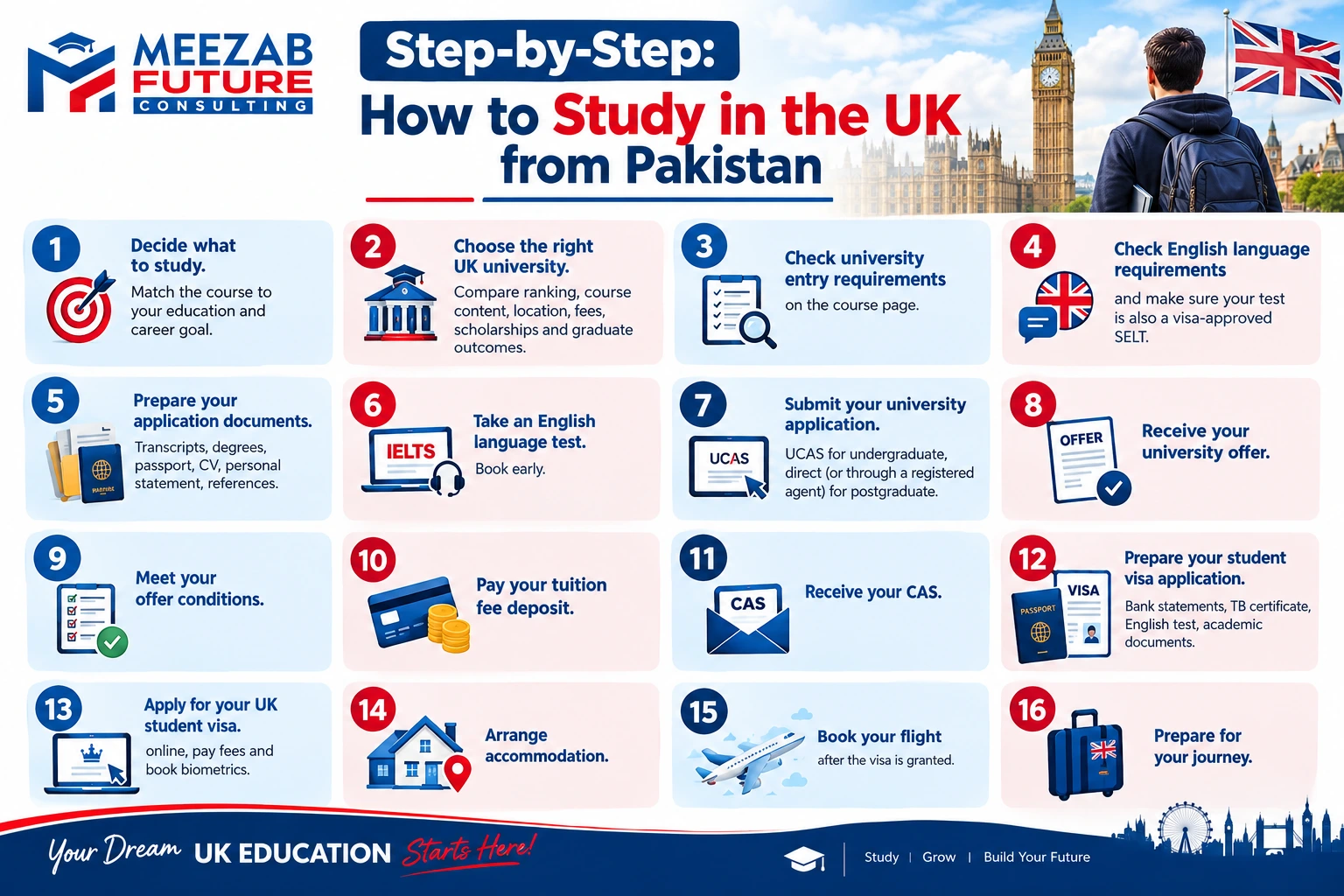
Studying in the UK from Pakistan takes nine clear steps: pick a course, meet the entry requirements, pass IELTS for UKVI, get an offer and a CAS, prove your funds, take a TB test, apply for the Student visa, wait for the decision, and travel. This guide walks through each one with the figures that apply to applications made in October to December 2026.
Step 1: Choose your course and university
Start here, because everything else (funds, visa, intake) depends on this choice. Your university must be a licensed Student visa sponsor, and the course must be at degree level or above for most visa rules in this guide to apply.
- Shortlist 4 to 6 courses. Compare the syllabus, tuition fee, entry requirements and intake months (usually September, with some January and May intakes).
- Check the city. Living costs and the visa funds you must show are higher in London than elsewhere in the UK.
- Check the sponsor licence. Confirm that the university is on the UK government’s register of licensed sponsors before you pay any deposit.
- Look at scholarships early. Many universities and external schemes offer funding, and some deadlines fall many months before the course starts, so check each one early.
- Check for ATAS. Some sensitive science and engineering courses need an ATAS certificate, and your university will tell you if yours does.
Step 2: Check entry requirements and gather your documents
Each university sets its own academic and English requirements, so read the course page carefully. Pakistani applicants should expect to prepare these documents:
- Valid passport
- Academic transcripts and degree certificates from every previous qualification, attested by the Higher Education Commission (HEC) where your university asks for it
- English test result (see Step 3)
- Personal statement and references (for most undergraduate and postgraduate applications)
- CV, if you are applying for a master’s course
- Proof of funds (see Step 5)
UKVI and UK universities are familiar with Pakistani qualifications, but they check documents closely. Keep every document clear, complete and consistent, because a mismatch in names, dates or grades can slow down or sink an application.
Step 3: Take IELTS for UKVI
Pakistan is not on the UK’s list of majority English-speaking countries, so most Pakistani applicants must prove their English with a Secure English Language Test (SELT). The most common choice is IELTS for UKVI (Academic), available through the British Council and IDP in Pakistan.
- Book the right test. When you register, choose “IELTS for UKVI”, not the standard IELTS Academic, or your result may not be accepted for the visa.
- Know your target score. For degree-level study the visa requires CEFR level B2, which is roughly 5.5 in each IELTS skill. Your university will usually ask for more, so aim for the score on its course page.
- Keep your Test Report Form (TRF). You need the result for both the university application and the visa.
- Plan the timing. Results take a few days to a couple of weeks, and the test is valid for two years, so take it early enough to leave room for a retake.
Other SELTs, such as PTE Academic UKVI and LanguageCert, are also accepted by some universities. Ask your university which tests it takes.
Step 4: Apply to the university and get your CAS
Apply directly or through the UCAS system for undergraduate courses, and directly (or through an authorised agent) for postgraduate courses. When you meet the conditions of your offer, the university issues an unconditional offer, and after you accept it and pay any required deposit, it sends you a Confirmation of Acceptance for Studies (CAS).
The CAS is an electronic record with a reference number, and your visa application cannot be made without it. Check every detail on it carefully:
- Your name and passport number, exactly as in your passport
- Course name, start date and end date
- Tuition fee for the first year and any amount you have already paid
- Whether your course is in London or outside London
If anything is wrong, ask the university to correct it before you apply. An error on the CAS is a common reason for delays.
Step 5: Prepare proof of funds
You must show enough money for your outstanding first-year tuition fees (the amount on your CAS minus anything already paid) plus living costs for up to 9 months. The living-cost amount depends on where you study and on the date you apply, because it rises on 30 November 2026.
| Where you study | Applications before 30 Nov 2026 | Applications from 30 Nov 2026 |
|---|---|---|
| London | £1,529 a month (£13,761 for 9 months) | £1,570 a month (£14,130 for 9 months) |
| Outside London | £1,171 a month (£10,539 for 9 months) | £1,203 a month (£10,827 for 9 months) |
These are the main rules for the money itself:
- Hold it for 28 days in a row. The full amount must stay in the account for 28 consecutive days, and the 28-day period must end no more than 31 days before you apply.
- Use acceptable accounts. Statements must show your name or your parent’s name, the account number and the balance. If you use a parent’s or guardian’s account, you must also show your relationship and their written consent. Your university’s visa team can tell you exactly which documents to bring.
- Add a buffer. Funds are checked in pounds, so exchange-rate movements between rupees and pounds can leave you short. Keep a margin above the minimum.
- Plan your dates. If you are applying close to 30 November 2026, check which amount applies to the date you submit your application.
Rules on what counts as acceptable evidence are detailed and change from time to time, so read the official guidance on GOV.UK before you move any money.
Step 6: Take the TB test
Pakistan is on the UK’s tuberculosis (TB) screening list. Anyone applying for a UK visa of more than 6 months from Pakistan must have a TB test certificate, and a Student visa always falls into that group.
- Use an approved clinic only. The test must be done at a clinic on the UK government’s approved list. There are approved clinics in major cities, including Islamabad, Lahore and Karachi.
- Expect a chest X-ray. A sputum test is added only if the X-ray needs follow-up.
- Mind the validity. The certificate is valid for 6 months, so book it close to your visa application but before it. If your visa is delayed and the certificate expires, you must test again.
- Check the fee. Clinic fees vary and change, so confirm the current price when you book.
Upload or bring the certificate with your visa application. A missing or expired certificate is one of the most common avoidable refusals.
Step 7: Apply online, pay the fees and give your biometrics
You can apply up to 6 months before your course starts, and it is best to apply as early as you can once you have your CAS, funds and TB certificate.
- Create your application on the official GOV.UK Student visa page and enter your CAS number and personal details.
- Pay the visa fee. The Student visa fee is £558 for applications from outside the UK (raised from £524 on 8 April 2026).
- Pay the Immigration Health Surcharge (IHS). For students it is £776 per year of your visa, paid upfront. It gives you access to the NHS during your stay.
- Book your biometrics appointment at a UK visa application centre in Pakistan, and give your fingerprints and photo.
- Upload your documents, including your passport, CAS, financial evidence, TB certificate, English test result and any academic documents requested.
A tip: ask a friend or family member to read your application before you submit it. Wrong passport numbers and mismatched dates are easy mistakes to make.
Steps 8 and 9: Wait for the decision and prepare to travel
Step 8: The decision. Standard Student visa applications from outside the UK are usually decided within about 3 weeks of your biometrics appointment. Some applicants are called for a credibility interview, where an officer asks about your course, your plans and how you will pay, so know your course and your finances well. If your visa is refused, the IHS is refunded but the visa fee is not.
Step 9: Prepare to travel. Once you have your visa:
- Check that the visa details match your passport and CAS.
- Book your flight, and book accommodation (university halls or private). Do not pay for non-refundable flights or housing before the visa decision.
- Confirm your university’s enrolment and arrival dates, and carry your original documents with you.
- Follow your university’s instructions on how to prove your right to study on arrival, set up your UKVI account if asked, and register with a local GP.
What it costs: a snapshot
Budget for these items on top of your tuition. The visa fee and IHS are in pounds, so rupee amounts move with the exchange rate.
| Item | Amount | When you pay |
|---|---|---|
| Student visa application fee | £558 | When you apply |
| Immigration Health Surcharge (student rate) | £776 per year of visa | When you apply |
| Living-cost funds to show, outside London (from 30 Nov 2026) | £1,203 a month, up to 9 months (£10,827) | Held in your account before you apply |
| Living-cost funds to show, London (from 30 Nov 2026) | £1,570 a month, up to 9 months (£14,130) | Held in your account before you apply |
| IELTS for UKVI, TB test, document attestation and translation | Varies, check current prices | Before you apply |
The IHS is charged for the full length of the visa you are granted, which usually runs a few months beyond your course end date, so a one-year master’s normally costs more than a single year’s rate.
Working while studying and the Graduate Route
Part-time work. Students on degree-level courses can usually work up to 20 hours a week during term time and full-time in official holidays, but your visa conditions are what count, so read them when your visa arrives. Do not depend on part-time income to meet the visa funds requirement.
Bringing family. Most taught students cannot bring a partner or children. Only students on a postgraduate research course or a government-sponsored course longer than 6 months can bring dependants.
After your degree. The Graduate Route lets you stay and work, or look for work, after completing an eligible UK degree. You must apply from inside the UK while holding a valid Student visa.
| Qualification | Graduate Route length |
|---|---|
| Bachelor’s or master’s, applying on or before 31 Dec 2026 | 2 years |
| Bachelor’s or master’s, applying on or after 1 Jan 2027 | 18 months |
| PhD or other doctoral qualification | 3 years |
Because the date you apply decides the length, a master’s student who finishes in late 2026 or 2027 should check the timing with their university’s visa team.
Common mistakes that cause refusals
- Wrong English test. Taking standard IELTS Academic when you needed IELTS for UKVI.
- TB certificate missing or expired. It is valid for 6 months and must come from an approved clinic.
- Funds not held for 28 days, or a balance that dipped below the required amount, or statements that end more than 31 days before the application.
- Unexplained large deposits. Be ready to show where the money came from.
- Mismatched details. Names, dates of birth or passport numbers that differ between documents.
- Weak answers about your course. If you are interviewed, you should be able to explain why this course, why this university and how it fits your career plan.
- Booking before the decision. Paying for non-refundable flights or housing before you have your visa.
FAQ
How long does the UK student visa take from Pakistan? Usually about 3 weeks after your biometrics appointment, so apply well before your course start date.
How early can I apply? Up to 6 months before your course starts.
Do I need IELTS? Most Pakistani applicants need a Secure English Language Test such as IELTS for UKVI. Some may be exempt, for example with a degree taught and assessed in English from a majority English-speaking country, so ask your university.
Can I use a parent’s bank account? Yes, in many cases, if you can prove the relationship and have their written consent. Confirm the exact documents with your university.
Can I switch to a work visa after I graduate? Many graduates move to the Graduate Route and later to a Skilled Worker visa if they find a qualifying job. Rules change, so check GOV.UK for the current requirements.