Introduction
To study in the UK from Pakistan, you need four things: an offer from a UKVI-licensed university, proof of English (usually IELTS UKVI or a university-accepted equivalent), enough money held in a bank account for 28 days, and a Student visa backed by a CAS letter and a TB certificate.
The UK remains one of the top choices for Pakistani students. Degrees are shorter (3-year bachelor’s, 1-year master’s), universities are globally ranked, and graduates can stay back to work on the Graduate Route.
But the rules change often. For 2027 intakes, Pakistani students face a higher bank balance requirement (in force from 30 November 2026), a £558 visa fee, and a shorter 18-month Graduate Route from 1 January 2027. This guide covers every requirement for the January 2027 and September 2027 intakes, step by step, so you can plan with confidence and avoid the mistakes that lead to refusals.
Quick summary: UK study requirements at a glance
| Requirement | What Pakistani students need |
|---|---|
| Admission | Unconditional offer + CAS from a licensed UK university |
| Bachelor’s entry | A Levels, or FSc/HSSC (often with a Foundation Year) |
| Master’s entry | 16 years of education (usually a 4-year HEC-recognised degree) |
| English | CEFR B2 for degree level; IELTS 6.0 (UG) / 6.5 (PG) is typical |
| Living costs (9 months) | £10,827 outside London / £14,130 London |
| Bank statement | Funds held 28 consecutive days, statement not older than 31 days |
| Visa fee | £558 |
| Health surcharge (IHS) | £776 per year of visa |
| Medical | TB test certificate from a UKVI-approved clinic in Pakistan |
| Work rights | Up to 20 hours/week in term time (degree level) |
What’s New for UK Study in 2027
| Change | Date | What it means for Pakistani students |
|---|---|---|
| Higher maintenance funds | From 30 Nov 2026 | Show £1,203/month outside London or £1,570/month in London (up to 9 months) |
| Graduate Route cut to 18 months | From 1 Jan 2027 | Bachelor’s and master’s graduates get 18 months to work after study instead of 2 years; PhD stays 3 years |
| Visa fee £558 | Since 8 Apr 2026 | Fees have risen every April recently, so a new rise in April 2027 is possible; check GOV.UK before paying |
| International Student Levy (England) | From 1 Aug 2028 | Universities in England will pay £925 per international student per year; this may push up tuition for students starting in 2028 |
Sources: Migration Observatory, UKCISA, ICEF Monitor.
1. Academic Requirements for Pakistani Students
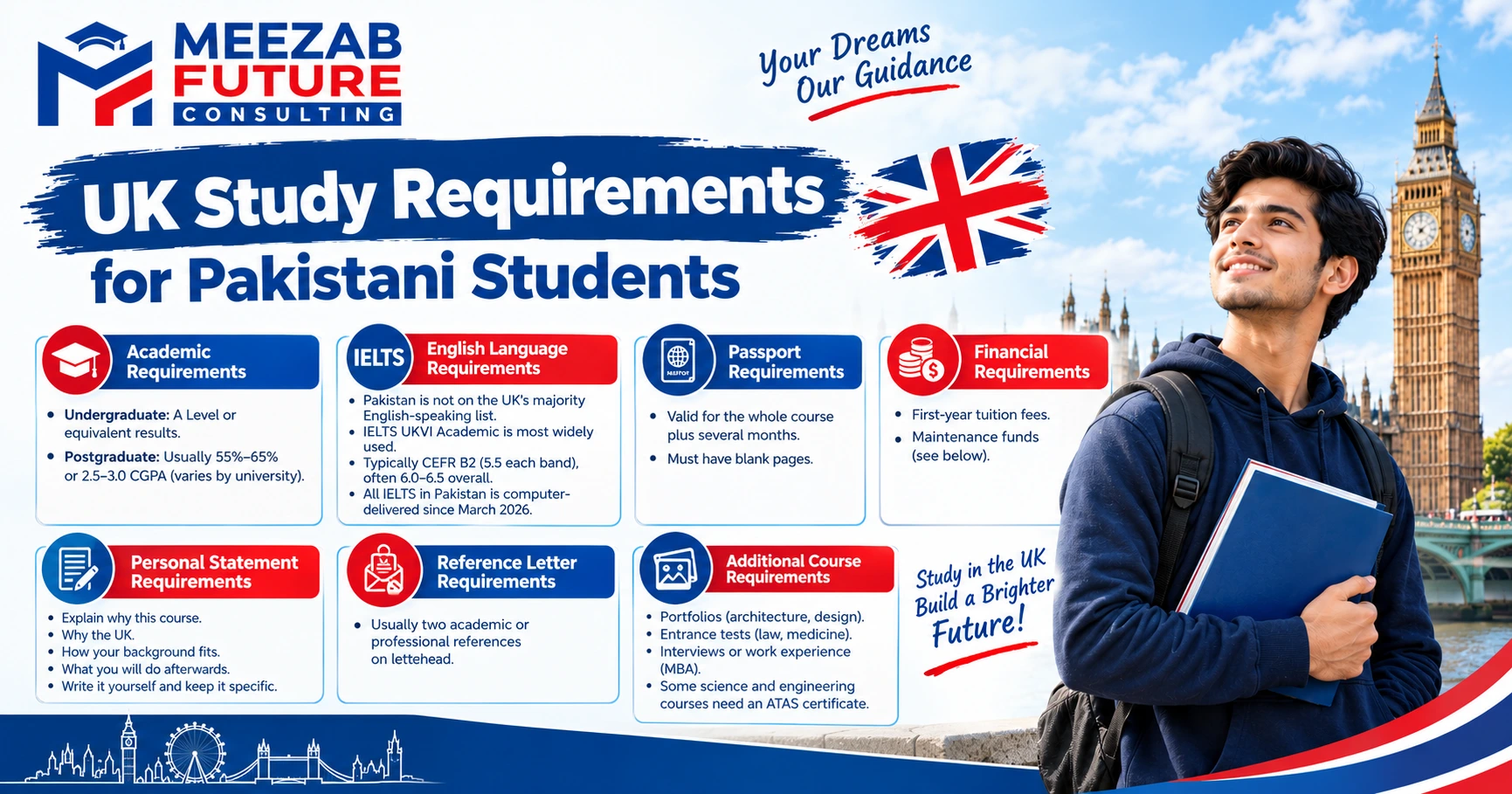
The UK does not set one national entry standard. Each university decides which Pakistani qualifications it accepts, so always check the “Pakistan” country page of your chosen university. The patterns below hold for most institutions.
Undergraduate (Bachelor’s) entry
- A Levels: Direct entry to Year 1 is standard. For example, the University of Sheffield considers applicants with at least three A Levels for direct admission.
- FSc / FA / ICS / HSSC (Intermediate): Most universities treat Intermediate as one year short of UK entry level, so students usually join an International Foundation Year first.
- Direct entry with strong Intermediate marks: Some universities do accept high scorers directly. Kingston University may consider HSSC/FSc results of 80% or more for Year 1, and Edinburgh Napier lists 60% or above for HSC/FSc.
- 2-year bachelor’s (BA/BSc) holders: Can often enter Year 1, and sometimes Year 2, with good grades.
Postgraduate (Master’s) entry
- The “16 years of education” rule: Most UK universities want a 4-year bachelor’s (BS, BBA, BE, MBBS, LLB 5-year) from an HEC-recognised university.
- 2-year BA/BSc + 2-year MA/MSc: Usually accepted as equivalent to a UK bachelor’s for master’s entry. Kingston and Staffordshire both list this route.
- 3-year bachelor’s: Some universities accept it with work experience. Edinburgh Napier, for instance, considers it with at least two years of relevant experience.
- Grades: Most master’s courses ask for a UK 2:1. Queen’s University Belfast equates a 2:1 with 70% or a 3.0/4.0 CGPA on a 4-year HEC-recognised degree; others are more lenient. Lower grades can still get in through a Pre-Master’s programme.
PhD / MPhil entry
A strong master’s degree is usually expected, plus a research proposal and, for most funded places, a supervisor’s support.
Documents universities ask for
- Matric and Intermediate certificates and mark sheets (or O/A Level results)
- Degree and transcripts (HEC-attested copies are commonly requested)
- English test result or Medium of Instruction (MOI) letter
- Personal statement / statement of purpose
- Two academic or professional references
- Passport copy
- CV (for master’s and MBA applicants)
2. English Language Requirements (IELTS and Alternatives)
For degree-level study, the UK Home Office requires English at CEFR level B2 in reading, writing, speaking and listening. Below-degree courses (such as some foundation programmes) need B1. Universities then set their own, usually higher, score on top.
Typical IELTS scores
| Level | Typical minimum |
|---|---|
| Foundation / Pre-Master’s | IELTS 5.0 to 5.5 overall |
| Bachelor’s | IELTS 6.0 overall (often 5.5 in each band) |
| Master’s | IELTS 6.5 overall (often 6.0 in each band) |
| Competitive courses (law, medicine, top universities) | IELTS 7.0 or higher |
For example, the University of Sheffield asks for IELTS 6.0 for bachelor’s and 6.5 for master’s.
Which test should you take?
- IELTS for UKVI (Academic): The safest choice. It is a Secure English Language Test (SELT) approved by the Home Office and accepted by virtually every university.
- Other SELTs: PTE Academic UKVI, LanguageCert and Skills for English are also on the approved list.
- Standard IELTS Academic, TOEFL, Duolingo: Many universities accept these for admission, because a licensed university can assess your English itself for degree-level courses. Check with the university before booking.
Can Pakistani students study in the UK without IELTS?
Sometimes, yes. Options include:
- Medium of Instruction (MOI) letter: Some universities accept proof that your previous degree was taught in English.
- O/A Level English or high Intermediate English marks: Accepted by certain universities for undergraduate entry.
- Pre-sessional English course: If your score is slightly short, you can take a university pre-sessional course in the UK and progress to your degree.
One caution: a visa officer can still refuse you after a credibility interview if your spoken English is weak, even with an IELTS waiver. Practise speaking either way.
3. Financial Requirements: How Much Money You Need to Show
You must show enough money for your first year’s unpaid tuition fee plus up to 9 months of living costs. The living-cost amount depends on whether your university campus is in London. The figures below apply to every application made from 30 November 2026, so they cover all 2027 intakes.
Living costs (maintenance funds)
| Study location | Per month | 9-month total (2027 applications) | Previous 9-month total (before 30 Nov 2026) |
|---|---|---|---|
| London | £1,570 | £14,130 | £13,761 |
| Outside London | £1,203 | £10,827 | £10,539 |
Source: the Home Office Statement of Changes laid on 3 September 2026, summarised by OTS Solicitors and ApplyBoard. The figure that applies is the one in force on the date you submit your visa application, so every January 2027 and September 2027 applicant must show the new amount. The Home Office now reviews this figure every year, so September 2027 applicants should re-check it in autumn 2027.
What counts as “London” is where your course is mainly taught, not where you will live.
How to calculate your total
Total funds = (first-year tuition − tuition deposit already paid) + 9 months’ living costs − any university accommodation deposit already paid.
Example: A master’s student at a university outside London, applying for September 2027, with a £17,000 tuition fee and a £5,000 deposit already paid:
(£17,000 − £5,000) + £10,827 = £22,827 to show in the bank.
The amount paid to the university appears on your CAS, so it is deducted automatically.
The 28-day bank statement rule
This is the number-one reason Pakistani applications get refused. Follow it exactly:
- The full required amount must stay in the account for at least 28 consecutive days. If it dips below the required amount for even one day, the application fails.
- The last day of that 28-day period must be no more than 31 days before you submit the visa application.
- Funds can be in your own account or your parents’ (or legal guardian’s) account. If you use a parent’s account, add your birth certificate (NADRA-issued B-form or FRC helps) and a letter of consent from the parent.
- Statements must show your or your parent’s name, the bank’s name and logo, the date, the account number and the balance throughout the period. A bank letter with the same details is also accepted.
- Accounts with Pakistani banks are fine, as long as the bank is one the UK Home Office accepts for financial evidence.
- Education loans from a regulated bank and official financial sponsorship (government, university or recognised scholarship body) are also accepted, with their own document rules.
Practical tip: Deposit the money at least 5 to 6 weeks before your planned visa date, and do not move it until your visa is issued. Some universities will also check your statement before issuing a CAS, so the money may need to be in place even earlier.
Other costs to budget for (not shown in the bank)
- Visa application fee: £558
- Immigration Health Surcharge: £776 per year of your visa
- TB test, IELTS test, flights, and initial accommodation deposit
4. UK Student Visa Requirements for Pakistani Students
Once your university issues a CAS (Confirmation of Acceptance for Studies), you can apply for the UK Student visa, formerly called Tier 4. You can apply up to 6 months before your course starts.
Visa document checklist
- Valid Pakistani passport
- CAS reference number from your university
- Financial evidence (bank statements or bank letter meeting the 28-day rule)
- Parent’s consent letter and birth certificate/FRC, if using a parent’s account
- TB test certificate from a UKVI-approved clinic in Pakistan (Pakistan is on the TB-testing list)
- English test result (if your CAS states a SELT was used)
- Academic documents listed on your CAS
- ATAS certificate, only for certain science and engineering postgraduate courses
- Translations of any document not in English
UK student visa fees (2027)
| Cost | Amount |
|---|---|
| Student visa application fee | £558 (current fee; may change in April 2027) |
| Immigration Health Surcharge (IHS) | £776 per year of visa |
| Priority service (optional) | About £500 extra |
| Super Priority service (optional) | About £1,000 extra |
The IHS is charged on your full visa length, which is longer than your course. A 1-year master’s usually gets a visa of about 15 to 16 months; a 3-year degree student pays roughly £2,328 in IHS. The IHS is refunded if your visa is refused, but the application fee is not (ApplyBoard).
Step-by-step application process
- Shortlist universities and courses that match your grades, budget and career goals.
- Prepare your English test (IELTS UKVI or an accepted alternative).
- Apply to universities directly or through UCAS (for undergraduate courses).
- Receive your offer and meet any conditions (final results, IELTS score).
- Pay the tuition deposit and complete the university’s pre-CAS checks or interview.
- Arrange your funds and let them sit for 28 days.
- Get your TB test at an approved clinic.
- Receive your CAS from the university.
- Apply online on GOV.UK, pay the visa fee and IHS.
- Attend biometrics at the UK visa application centre in Pakistan and submit documents.
- Attend a credibility interview if called.
- Receive your decision — standard processing is about 3 weeks from outside the UK.
Approved students now receive an eVisa (a digital immigration status linked to your UKVI account) instead of a physical residence card, plus an entry vignette or instructions for travel.
The credibility interview
UKVI often interviews Pakistani applicants to check that they are genuine students. Be ready to answer clearly:
- Why this course and why this university?
- Why the UK and not Pakistan or another country?
- How does the course link to your past studies and future career?
- Who is paying, and where did the money come from?
- What will you do after graduating?
Answer in your own words. Memorised, agent-written answers are easy for officers to spot and are a common reason for refusal.
5. Work Rights, Graduate Route and Dependants
Part-time work while studying
Students on a full-time degree at a university can usually work up to 20 hours per week during term time and full-time during official holidays. Below-degree courses often allow only 10 hours. Your exact limit is printed on your visa, so check it before taking a job.
Graduate Route (post-study work)
After graduating, you can apply for the Graduate visa to stay and work without a sponsor. The Home Office has cut the duration from two years to 18 months for bachelor’s and master’s graduates applying on or after 1 January 2027. So every bachelor’s or master’s student starting in 2027 will get 18 months, while PhD graduates still get 3 years. The Graduate visa application fee is currently £937, plus the health surcharge.
Can you bring your spouse or children?
Since 1 January 2024, only students on PhD or research-based postgraduate courses can bring dependants. Students on taught master’s and bachelor’s courses cannot.
6. Common Mistakes That Lead to Refusal
- Funds dropping below the required amount during the 28 days
- Submitting a bank statement older than 31 days
- Large, unexplained deposits just before the 28-day period
- Missing or invalid TB certificate
- Weak or rehearsed answers in the credibility interview
- Choosing a course with no clear link to past study or career plans
- Gaps in education left unexplained
- Paying the visa fee before all documents are ready
7. Expert Tips for a Successful Application
- Start 9 to 12 months early. For September 2027, shortlist and apply between October 2026 and March 2027.
- Consider the January intake if you miss September; many universities offer January 2027 and January 2028 starts.
- Apply for scholarships early, such as Chevening, Commonwealth and university-specific merit awards.
- Keep a clean money trail. Have documents ready that show where your funds came from (salary slips, property sale deed, business records).
- Book IELTS UKVI rather than standard IELTS if you are unsure; it is accepted everywhere.
- Use a registered, experienced study consultant to check your documents before submission.
Frequently Asked Questions
What is the minimum percentage to study in the UK from Pakistan? There is no single national minimum. For bachelor’s, many universities ask for 60% to 80% in Intermediate or a Foundation Year. For master’s, 60% or a 2.5 to 3.0 CGPA on a 4-year degree is common, though top universities ask for more.
How much bank balance is required for a UK student visa from Pakistan? For 2027 intakes: your unpaid first-year tuition plus £10,827 (outside London) or £14,130 (London) for living costs, held for 28 days.
Can I study in the UK without IELTS from Pakistan? Yes, some universities accept an MOI letter or O/A Level English. You still need to meet the B2 standard and may face an English-speaking interview.
Is a 14-year bachelor’s degree accepted for a UK master’s? Usually not on its own. Most universities want 16 years of education, so a 2-year BA/BSc normally needs a 2-year master’s alongside it, or a Pre-Master’s programme.
How long does a UK student visa take from Pakistan? Around 3 weeks for a standard decision after biometrics. Priority and Super Priority services can shorten this for an extra fee.
Do Pakistani students need a TB test for the UK? Yes. Pakistan is on the list of countries where a TB test from a UKVI-approved clinic is required for stays over 6 months.
Can I work in the UK while studying? Yes, up to 20 hours a week in term time on a degree-level course, and full-time during official vacations.
Conclusion
Meeting the UK study requirements as a Pakistani student comes down to careful planning: the right academic fit, a valid English test, correctly held funds, and an honest, well-prepared visa application. With higher maintenance funds, an 18-month Graduate Route and possible fee rises in April 2027, starting early has never mattered more for 2027 applicants.
Need help choosing a university, checking your bank statement or preparing for your credibility interview? Book a free consultation with our UK admissions team today.
Disclaimer: Immigration rules change frequently. Figures are correct for 2027 intakes as of October 2026; always confirm the latest requirements on GOV.UK and with your university before applying.